Three ancient-DNA headlines in one month — Donghulin's unknown lineage, Palau's pre-admixture, the biggest Y-chromosome tree. A plain-language thread tying them together, and the methods that make bones speak.
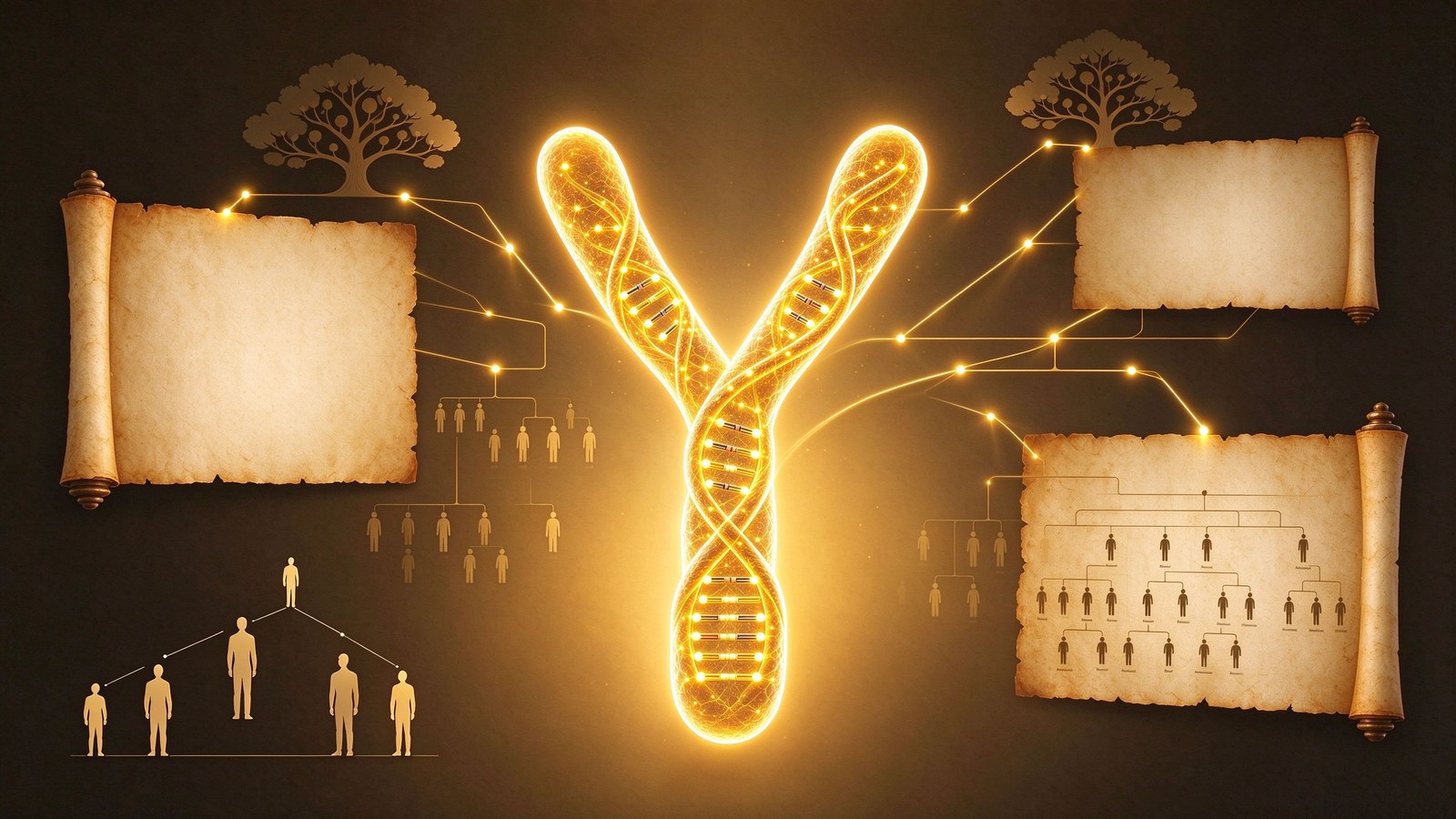
The Y chromosome passes only father to son — a paternal molecular clock. A plain-language tour of O1, O2, N, and C/D/F, and how a study of ~18,000 samples redraws East Asian male migration.
Integrating 17,740 modern and 977 ancient Y chromosomes — plus 1,045 newly sequenced individuals — this study builds the highest-resolution East Asian paternal tree to date, linking farming expansions to O-lineage growth and separating inland and coastal routes.
Integrating 1,507 high-coverage Y sequences, 780 ancient East Asian genomes, and 1,748 Southeast Asian sequences, the study identifies at least five Neolithic southward farmer waves carried mainly by O1 and O2 lineages.
FamilyTreeDNA updated its Y-DNA haplogroup tree with more than 100,000 new branches, covering finer downstream lineages and refined age estimates, giving genetic genealogy researchers a more precise tool to pinpoint recent common ancestors.
A Sichuan University team identifies 138 Neolithic paternal lineages—17 shared between China and mainland Southeast Asia—showing millet and rice farmers drove southward demic diffusion.
This article explores the link between the Y chromosome and surname genealogies. Strictly paternally inherited, the Y chromosome provides an unalterable genetic record for reconstructing family trees, resolving historical mysteries and tracing clan origins—opening a new chapter in historical anthropology.
Seven highly polymorphic Y-STR loci were used to analyze genetic relationships between the Ningxia Hui and 17 other Chinese populations. The Hui first cluster with Han populations, providing genetic evidence that substantial Han ancestry was incorporated during Hui origin and development.
This website uses cookies to improve your experience. By using this website you agree to our Data Protection Policy.