First prehistoric East-Asian plague genome reveals rapid trans-Eurasian spread ~5,300 years ago
2026年7月31日
From Private Scrolls to Shared Heritage: A Peking University Core Journal Article Proposes “Text–Gene–Image” Multimodal Genealogy Development
2026年8月6日Current Biology: 38 Ancient Genomes Reveal Female Exogamy and Ethnic Interaction in a Tang Dynasty Frontier Clan
In July 2026, Current Biology published online a study led by Professor Wang Chuanchao’s group at Fudan University, in collaboration with Xiamen University, the Inner Mongolia Institute of Cultural Relics and Archaeology, Shanxi University and Shandong University, titled “Genomic signatures of female exogamy and cultural interaction in a Tang Dynasty patrilineal clan.” The study focused on the Tang Dynasty cemetery at Naobaowan in Jungar Banner, Ordos, Inner Mongolia, sequencing and analyzing 38 ancient genomes from an elite Chen clan cemetery dated to AD 713–739. For the first time, it revealed at the scale of a single family how multi-ethnic interaction at the northern Tang frontier entered concrete household structures through marriage strategies, patrilineal inheritance and burial practices.
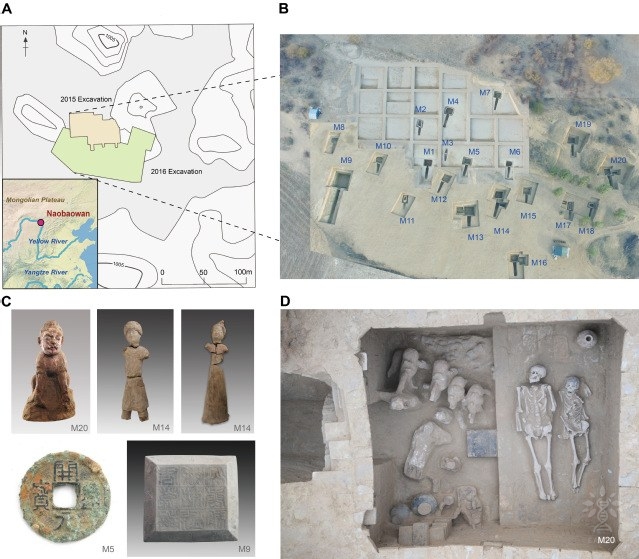
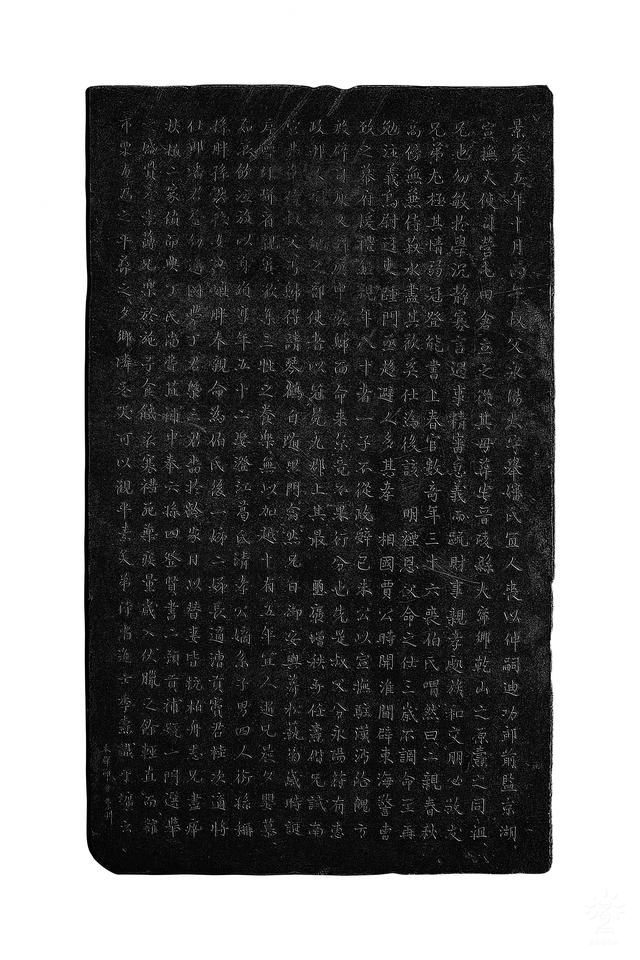
The Naobaowan cemetery lies on the south bank of the Yellow River, at the northeastern edge of the Kubuqi Desert — a typical agro-pastoral transition zone. Between 2015 and 2016, archaeologists excavated 20 tombs at the site. Based on excavated coins, epitaphs and direct radiocarbon dating, the cemetery is concentrated in the Xiantian–Kaiyuan period (AD 713–739) and is thought to be associated with the Chen clan of Yulin County, Sheng Prefecture. The tombs include brick-chambered tombs with sloping passageways and tombs with side chambers; differences in tomb scale suggest status differentiation within the clan.
The team resolved the family structure of the cemetery at the molecular level. All 38 individuals show typical ancient DNA damage patterns, with modern contamination below 5%, and an average of about 540,000 SNP sites was recovered per individual. Genetic sex identification reveals 18 males and 20 females. Haplogroup analysis shows that 13 males share the same Y-chromosome haplogroup O2a2b1a1a1a2a, consistent with a common patrilineal ancestor; maternal mitochondrial haplogroups, in contrast, are highly diverse — including common East Asian types such as B4, D4 and G1, as well as two examples of H5a1, more frequent among West Eurasian populations. Uniform paternal and diverse maternal lineages are the classic genetic signature of “patrilineal inheritance plus female exogamy.”
Using kinship inference methods such as READ, KIN and ancIBD, the team identified 30 first-degree relationships (5 sibling pairs and 25 parent–child pairs), 19 second-degree and 7 third-degree relationships. Combined with genetic sex, Y-chromosome and mitochondrial haplogroups, tomb dates and epitaph information, the researchers reconstructed an extended family genealogy comprising three main patrilineal branches and five household units. The core Chen patrilineal branch, defined by haplogroup O2a2b1a1a1a2a, constitutes the dominant family structure of the cemetery; a four-generation core family descended from male M13a and female M13b could be reconstructed, with epitaphs supporting the inferred identities and relationships. Spatially, these core household units occupy the central area of the cemetery.
The other two patrilineal branches lie at the edges of the cemetery; one is represented by a man named Zhang Jun. Zhang carried a different Y-chromosome haplogroup, yet his wife had a second-degree relationship with the core Chen family, and his epitaph explicitly identifies him as a son-in-law of the Chen clan. This shows that the family’s patrilineal structure, though stable, was not completely closed: it could absorb men from other surnames through marriage. The kinship network also shows a marked sex bias: male–male and male–female relationships are significantly more numerous than female–female relationships, confirming that the family was not perpetuated through a continuous female bloodline, but sustained by patrilineal descent and the marriage-in of outside women.
In population genetic structure, principal component analysis shows that the Naobaowan individuals are not fully homogeneous but lie on a genetic continuum between East Asian and West Eurasian populations: most individuals are close to Late Neolithic Yellow River populations and subsequent millet-farming groups, while three women — M13b, M18a and M10b — clearly shift toward ancient Eurasian steppe populations. ADMIXTURE, outgroup-f3, f4 statistics and pairwise qpWave analyses all support this result; further qpAdm modeling estimates that these three women carried as much as 76.2%–93.4% West Eurasian-related ancestry.
Especially intriguing is the founding couple of the core family: M13b, a woman carrying a high proportion of West Eurasian ancestry, together with the local East Asian man M13a, forms the ancestral pair of the four-generation core family. Their son M14a falls exactly between his parents in PCA space, consistent with the genetic profile of a first-generation admixed offspring. In subsequent generations, male descendants continued the Chen patriline but kept marrying local East Asian women, so the West Eurasian-related ancestry proportion gradually declined generation by generation. This means that East–West population exchange at the Tang frontier did not occur only at the macro-demographic level — it could enter the core genealogy of local elite families through marriage strategies.
Equally notable is integration at the burial level: women carrying steppe-related ancestry were not placed at the cemetery edge or excluded from the family funerary system. Instead they were buried in the core cemetery alongside their husbands and descendants, following the local Central-Plains brick-chamber burial tradition. Cross-ethnic marriage thus brought not only genetic admixture, but also the integration of social identity, kinship and funerary customs. At the same time, some joint tombs contain individuals with no direct genetic relationship, indicating that a burial unit is not fully equivalent to a biological family — it may also include in-laws, household members and other social relations. The Naobaowan cemetery therefore preserves not only a consanguineous family structure, but also the more complex social bonds of a Tang frontier elite household.
Wang Yuchun (doctoral student at Xiamen University), Huang Huangzhen (doctoral student at Fudan University) and Song Guodong (Inner Mongolia Institute of Cultural Relics and Archaeology) are co-first authors; Hou Liangliang (Shanxi University) and Wang Chuanchao (Fudan University) are co-corresponding authors. The study was supported by the National Natural Science Foundation of China, the Fujian Provincial Natural Science Foundation, a major project of the National Social Science Fund, and the National Key R&D Program. Paper: https://doi.org/10.1016/j.cub.2026.06.086.
This study offers rare “family-level” evidence for understanding ethnic interaction at the northern Tang frontier. Earlier discussions of the Silk Road and Sino-foreign exchange in the Tang dynasty focused more on state policy, trade networks, cultural diffusion or large-scale population admixture. The Naobaowan Chen clan shows that the mechanisms sustaining long-term exchange often operate in far more microscopic kinship networks: patrilineal inheritance ensured the continuity of local elite families, female exogamy served as a key channel absorbing external genetic and social resources, and flexible incorporation of in-laws together with shared burial practices reflected the dynamic integration of identity, kinship and culture. For East Asian genetic genealogy research, this is another exemplar of “family-scale ancient DNA”: a single family cemetery is a condensed history of regional ethnic interaction.