Behind Tens of Millions of Genealogy Records: The Digital Road of a Cross-Strait Root-Tracing Platform
2026年10月30日The Genetic Code of a Tang Dynasty Frontier Clan: 38 Ancient Genomes Reveal Patrilineal Inheritance and Female Exogamy in the Chen Family
The Tang Dynasty was a period of intense East–West contact across Eurasia. With the flourishing Silk Road, the expansion of frontier governance, and policies such as military colonisation and the jim system, the northern agro-pastoral ecotone became a frontier where Central Plains farmers, steppe herders and Central Asian groups interacted constantly. Historical records and archaeology have long shown that Turkic, Uyghur and Sogdian groups took part in Tang politics, trade and military life, and that the capital Chang\’an was steeped in a \’Hu\’ (foreign) fashion. Yet how such exchanges unfolded inside individual families — through marriage, kinship systems and burial practices — has lacked direct evidence.
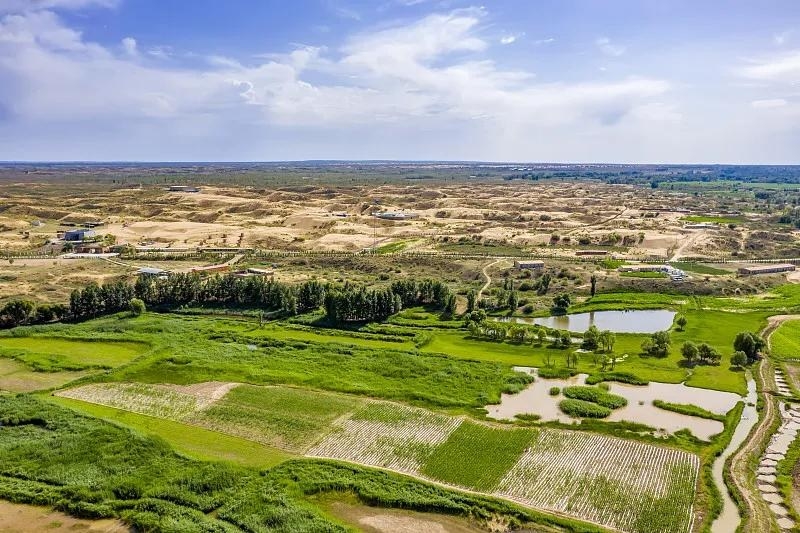
In July 2026, a team led by Professor Wang Chuan-Chao of Fudan University, together with Xiamen University, the Inner Mongolia Institute of Cultural Relics and Archaeology, Shanxi University and Shandong University, published a study in Current Biology that answered this question at family scale for the first time, using a frontier elite clan cemetery as its window. The site, the Naobaowan cemetery in Jungar Banner, Ordos, Inner Mongolia, lies on the southern bank of the Yellow River at the northeastern edge of the Kubuqi Desert — a classic agro-pastoral ecotone. Excavated in 2015–2016, the 20 tombs date, by coins, epitaphs and radiocarbon, to the early Kaiyuan years (AD 713–739), and are attributed to the Chen clan of Yulin County, Shengzhou. The tombs include brick-chambered burials with ramped passages and side-chambered forms, and their varied scale and structure suggest internal social stratification.
To dissect the family structure at the molecular level, the team sequenced ancient DNA from 38 individuals. All samples showed typical ancient-DNA damage and less than 5% modern contamination, yielding on average about 540,000 SNPs for downstream analysis. Genetic sex was determined for 18 males and 20 females. The haplogroup results are striking: 13 men share the same Y-chromosome haplogroup O2a2b1a1a1a2a, exactly matching the expectation of a common patrilineal ancestor; the maternal mitochondrial haplogroups, by contrast, are highly diverse — from the East Asian types B4, D4 and G1 to two examples of H5a1, more common in West Eurasian populations. A genetic pattern of \’one patriline, many matrilines\’ leaps off the page.
Using the kinship methods READ, KIN and ancIBD, the researchers identified 30 first-degree relationships (5 sibling pairs and 25 parent–offspring pairs), 19 second-degree and 7 third-degree relationships. Combining genetic sex, haplogroups, burial dates and epitaphs, they reconstructed an extended family genealogy with three main patrilineal branches and five household units. The core Chen branch, defined by O2a2b1a1a1a2a, forms the dominant family structure, with a four-generation core family founded by the male M13a and the female M13b; core household units cluster in the centre of the cemetery. The other two branches lie at the edges — one centred on a man named Zhang Jun is especially telling: Zhang carries a different Y haplogroup, yet his wife is a second-degree relative of the Chen core family, and the epitaph explicitly identifies him as a son-in-law. The patrilineal structure was stable but by no means closed; it absorbed unrelated men through marriage.
The kinship network also shows a marked sex bias: male–male and male–female relationships far outnumber female–female ones. Together with the diverse maternal haplogroups, this shows that the Naobaowan Chen family did not maintain its continuity through female lines buried generation after generation in the cemetery, but through male patrilineal descent and the marriage-in of outside women — precisely the coexistence of patrilineal inheritance and female exogamy.
Genetically, the Naobaowan individuals were not a homogeneous group. Principal component analysis places them on a continuum between East Asian and West Eurasian populations: most cluster near late Neolithic Yellow River and later millet-farming groups, while three women — M13b, M18a and M10b — fall clearly toward ancient Eurasian steppe populations. ADMIXTURE, outgroup-f3, f4 statistics and pairwise qpWave all support this; further qpAdm modelling puts their West Eurasian-related ancestry at about 76.2–93.4%. M13b jointly founded the four-generation core family with the local East Asian male M13a, and their son M14a sits between his parents on the PCA plot, consistent with a first-generation admixed individual. In later generations, male descendants maintained the Chen patriline but continued to marry local East Asian women, so the steppe ancestry fraction declined generation by generation.
The value of this study lies in bringing \’Hu–Han interaction\’ down from grand narrative to concrete households. The women carrying West Eurasian steppe ancestry were not consigned to the cemetery margins or excluded from the family mortuary system: they were buried in the core cemetery alongside husbands and descendants, using local Chinese-style brick-chambered tombs. Cross-ethnic marriage brought not only genetic admixture but also the integration of social identity, kinship and mortuary tradition. The burial record shows further complexity: adult couples and their children were often buried together or nearby, supporting the notion of conjugal and family plots, yet some joint tombs contain individuals with no direct genetic relationship — burial units did not exactly equal biological families. Patrilineal inheritance secured the continuity of a local elite family; female exogamy became a channel for absorbing external genetic and social resources; and flexible in-law incorporation and shared mortuary practice embody the dynamic integration of identity, blood and culture in Tang frontier society.