

Modern Humans Reached Sahul ~60,000 Years Ago via Two Routes, Mitochondrial Genomes Suggest
2025年11月25日
Why Were Most Sacrificed Individuals at Shimao Male? Reading a 4,300-Year-Old Society from Ancient DNA
2025年11月28日Ancient DNA from Shimao Records Kinship Practices in Neolithic China
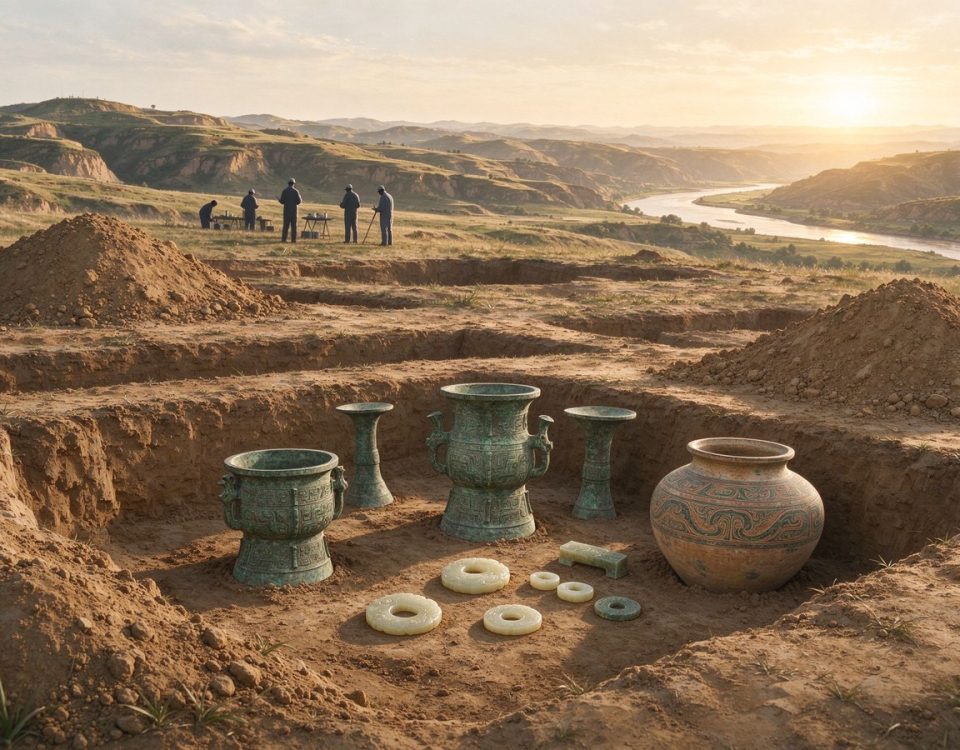
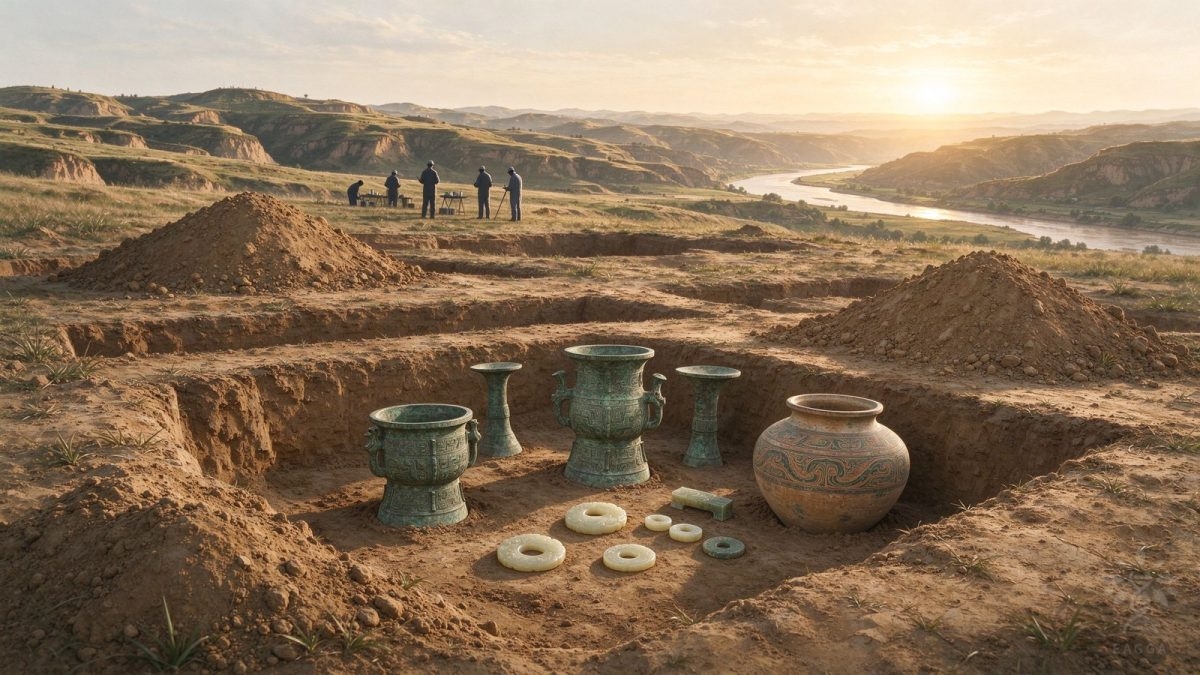
Located in northern Shaanxi, Shimao is a vast stone-walled city of about 4 square kilometers dating to roughly 4,300 years ago, and has long been central to debates over the origins of early states and complex societies in East Asia. In work spanning 13 years, a team led by Qiaomei Fu of the Institute of Vertebrate Paleontology and Paleoanthropology (CAS), together with the Shaanxi Academy of Archaeology and the team of Sun Zhouyong at Northwest University, analyzed nuclear genomes from 169 ancient human remains from Shimao, its surroundings and southern Shanxi. The study appeared online in Nature on 26–27 November 2025 and was presented in a dedicated release by the National Cultural Heritage Administration.
Of the 169 samples, 144 were unrelated individuals, radiocarbon-placed to roughly 4,800–3,600 years ago. The genomes show that the Shimao population was derived mainly from local late-Yangshao people of northern Shaanxi, while also exchanging genes with Taosi-related groups, northern Yumin-related populations, and southern rice-farming communities. The stone city was thus rooted in a local indigenous tradition yet embedded within a wide network of population interaction.
The most striking result is a four-generation patrilineal, patrilocal family pedigree reconstructed directly from the genetic data. Patrilineal-patrilocal descent means inheritance runs through male lines and couples reside with the husband’s kin; ancient DNA reveals this social rule directly, in the form of relatedness among individuals, providing a genetic skeleton for how power was organized at Shimao.
A second, counterintuitive finding concerns human sacrifice. Among roughly 80 skulls at the East Gate, genome analysis confirmed that nine out of ten sacrificial victims were male; female victims, by contrast, were found in aristocratic burial areas such as the imperial-mausoleum platform. This gender structure differs from earlier archaeologically based expectations and suggests that the ritual populations used in East Gate construction and in elite burials were not the same.
The authors argue that these genomes provide the first direct genetic evidence for the power structure and social rules of an early East Asian civilization—population origins, kinship and the gendered division of sacrifice together outlining how a prehistoric stone city mobilized labor and maintained hierarchy. The social-historical interpretation rests on high-resolution nuclear genomes from Shimao and nearby sites and is read alongside excavation, isotopic and radiocarbon evidence.
Source: Qiaomei Fu et al. Nature (CAS research news), 2025-11-27.