

First Large-Scale Ancient Nuclear Genome Dataset of East Asian Domestic Pigs Released by Peking University
2025年9月29日
89-Plex Y-SNP Microfluidic System Developed for Rapid On-Site Paternal Lineage Profiling
2025年9月30日Ancient Genomes from Central Mongolia: A Millennium of Coexistence Between Distinct Bronze Age Herder Groups, Ended by the Slab Grave Expansion
A landmark ancient DNA study of the Mongolian Plateau was published in Nature Communications in September 2025. Led by Christina Warinner and colleagues at Harvard University’s Department of Anthropology, the team analyzed genome-wide and mortuary data from 30 ancient individuals in central Mongolia—a key region where pastoralist groups with distinct burial traditions converged—providing fine-grained genetic evidence for a complex history of long coexistence and eventual replacement.
Background: the rise of pastoralism and diverse mortuary traditions
Dairy pastoralism reached Mongolia during the Early Bronze Age and flourished in the Late Bronze Age (c. 1400–900 BCE), alongside the emergence of diverse mortuary practices, most notably the Deer Stone–Khirgisuur Complex (DSKC) burials and figure-shaped (Ulaanzuukh) burials. Previous work has largely focused on the spread of pastoralism itself; interactions among pastoralist groups following distinct mortuary traditions remained underexplored, due to the difficulty of obtaining both genomic and mortuary data.
Key findings: a millennium of coexistence with limited genetic mixing
Focusing on central Mongolia, where these burial traditions converge, the researchers sequenced 30 ancient individuals and systematically documented their graves. Throughout the Late Bronze Age, two genetically distinct clusters coexisted in the region, corresponding respectively to DSKC and figure-shaped burials. Despite sharing the same landscape for centuries, the two groups maintained limited genetic mixing and preserved distinct mortuary practices and cultural identities.
This pattern came to an end at the transition to the Early Iron Age, when the expansion of the Slab Grave population replaced the earlier population structure and established a new burial tradition in central Mongolia.
Origins traced: western Eurasian ancestry of the DSKC people
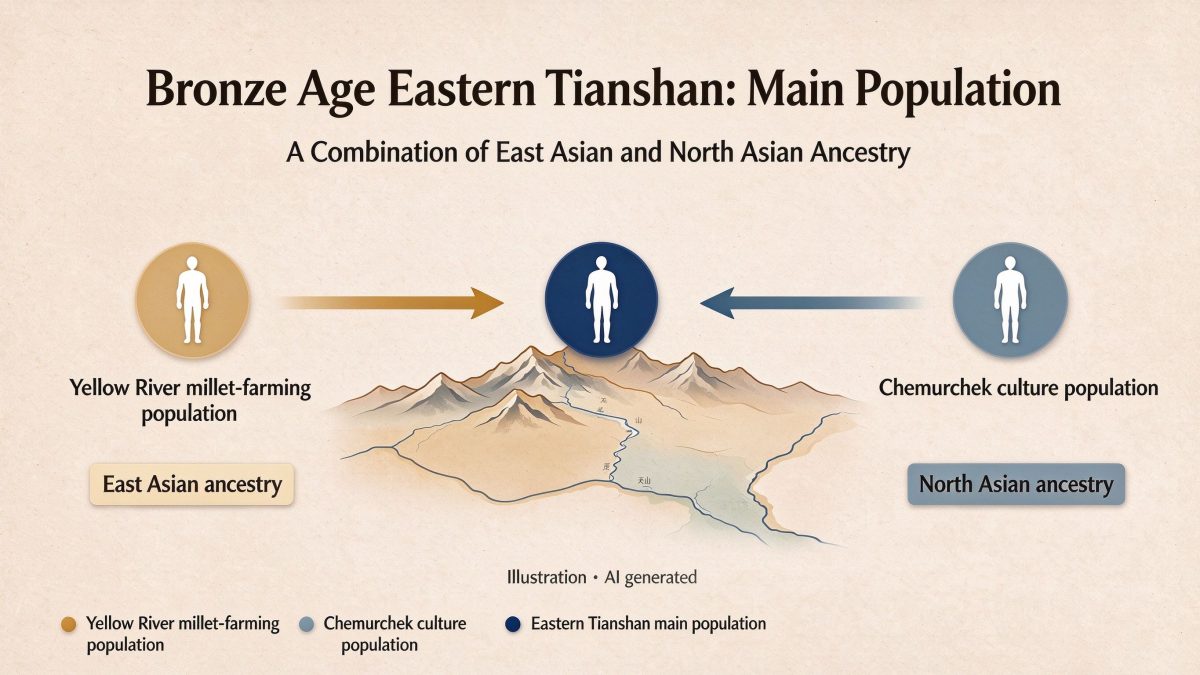
The study also refined the genetic origin of the Late Bronze Age DSKC populations, tracing their minor western Eurasian ancestry back to the Eneolithic/Early Bronze Age Afanasievo populations and the Early Bronze Age Khemtseg (Chemurchek) populations—new spatial and temporal anchors for early East–West contacts across the Eurasian steppe.
Significance
By providing fine-scaled genetic tracking of major mortuary transitions in prehistoric Mongolia, this work offers direct evidence for the complex and divergent processes that shaped ancient pastoralist societies in Asia, and adds an important chapter to the population history of the northern edge of East Asia and the Eurasian steppe.
Original article: Slab Grave expansion disrupted long co-existence of distinct Bronze Age herders in central Mongolia (Nature Communications, 2025).