
Interview with Fu Qiaomei: Ancient human evolution research to extend toward “older” and “closer to prehistory” times
2026年7月10日
Two mysterious ancestors revealed in modern human DNA: Science technique pinpoints a “ghost ancestor” and a “super-archaic ancestor”
2026年7月30日Maternal Genetic History of the Western Zhou Ba State: 207 Ancient Mitogenomes from Dahekou Reveal Two Millennia of Continuity in the Yellow River Basin
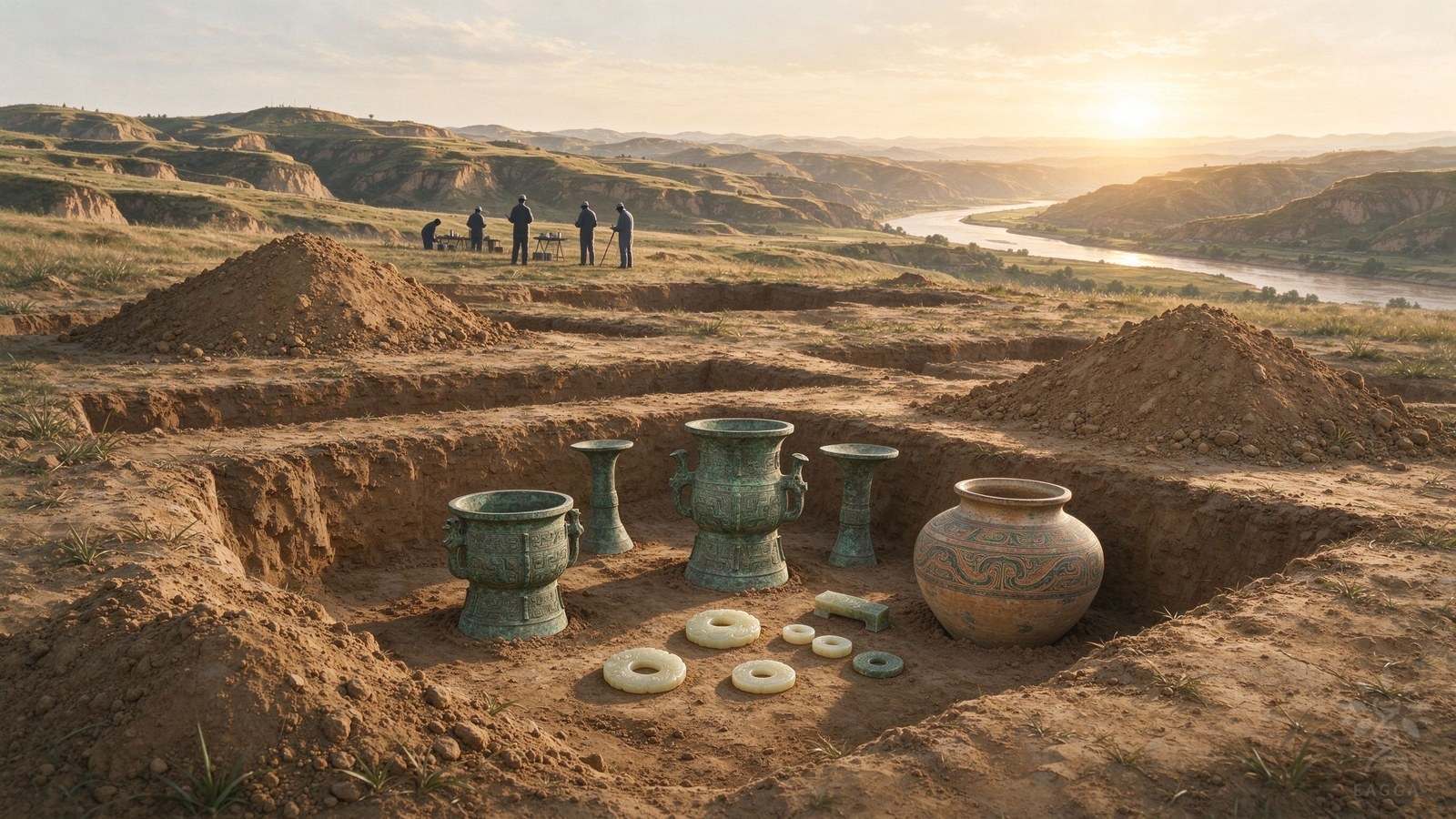
About six kilometres east of Yicheng County in Shanxi Province, at the edge of the Fen River valley, a cemetery spanning some 40,000 square metres quietly holds a Western Zhou story absent from the historical record. Since 2007, archaeologists have excavated more than 2,250 tombs and recovered over 25,000 grave goods — bronze ritual vessels, lacquered wood, jade and pottery — confirming this as the ancestral cemetery of the “Ba” state, a Western Zhou polity never mentioned in received historical texts. In 2010, the Dahekou cemetery was named one of China’s “Top Ten Archaeological Discoveries”.
Who were the people of Ba? Where did they come from? Within the Zhou enfeoffment system and the interweaving of clans, what was the maternal genetic composition of this small state that left no record of its own name? In July 2026, a team from Jilin University and partner institutions published a study in the Journal of Archaeological Science based on enrichment and deep sequencing of complete mitochondrial genomes from 207 individuals buried at the Dahekou cemetery (DHK). After rigorous quality control, 163 high-quality ancient mitogenomes were retained, enabling the first systematic reconstruction of the maternal genetic history of the Western Zhou Ba population.
A Western Zhou polity absent from the historical record
The Dahekou cemetery lies in Yicheng County, Linfen, Shanxi, measuring roughly 300 m north–south by 150 m east–west. Calibrated dates place the main use of the cemetery between 1050 and 800 BCE, spanning the Western Zhou and continuing into the early Spring and Autumn period. Bronze inscriptions identify the site as the cemetery of the Ba state, which maintained close ties with the Zhou royal house, the Jin state, the Peng state and Yan. Its clan surname remains a subject of ongoing scholarly debate.
Social stratification is clearly visible within the cemetery: high-status tombs contain fine bronzes, lacquered wood and jade, while low-status burials consist mainly of pottery. This hierarchy mirrors the graded structure typical of Zhou-period vassal states and makes Dahekou an ideal sample for studying the social composition of a peripheral polity.
207 complete mitogenomes: reconstructing maternal lineages
Mitochondrial DNA, inherited exclusively through the maternal line, is small and high in copy number — the most mature molecular marker for tracing maternal population history. The team used targeted DNA capture to enrich endogenous mitochondrial DNA and achieved deep sequencing for 207 individuals, retaining 163 high-quality genomes after filtering. These were compared against a large reference panel of 905 ancient mitochondrial genomes from East and Central Eurasia (Neolithic to historical periods) and 1,210 sequences from present-day East Asians, using haplogroup composition, principal component analysis, genetic distance and shared-haplotype analyses.
Finding 1: more than two millennia of maternal continuity in the Yellow River basin
The Dahekou population shares a high proportion of haplogroups with late Neolithic populations of the middle Yellow River basin, particularly the Taosi and Shimao cultures. Principal component analysis places Dahekou individuals close to central-region Neolithic groups, and genetic distances confirm this affinity: the average genetic distance between Dahekou and middle Yellow River populations is 0.0043, versus 0.0266 with the upper course and 0.0124 with the lower course.
In other words, although the region experienced repeated shifts in political and cultural landscapes — Taosi, Shimao, Erlitou, Shang and Zhou — the maternal genetic substrate remained remarkably stable. The authors argue that this regional genetic continuity across more than two millennia offers direct ancient-DNA evidence for the continuous development of Chinese civilisation in the Yellow River basin.
Finding 2: Bronze Age maternal exchange with the upper and lower Yellow River
Although the genetic base was predominantly local, Bronze Age population interaction is clearly detectable. Genetic affinity analyses show that Dahekou individuals share about 20% of maternal lineages with contemporary upper Yellow River populations and 16.67% with lower Yellow River populations. This aligns with the archaeology: Dahekou grave goods display cultural features shared with the Zhou dynasty of the central plains, and bronze inscriptions indicate that Ba maintained political alliances with its neighbours.
The researchers suggest that frequent warfare and increased population movement among Zhou vassal states amplified contact between the central plain and surrounding groups; the maternal components from the upper and lower Yellow River present in Dahekou are the genetic signature of that historical process.
Finding 3: expansion of haplogroup D4b and the rise of millet agriculture
Haplogroup D4b is among the most frequent maternal lineages in the Dahekou population. Coalescent-based reconstructions reveal a notable increase in effective population size beginning roughly 8,000 years ago — coinciding with the earliest phases of millet agriculture in the Yellow River basin. The authors propose that the food security and demographic growth provided by millet farming were a major driver of the lineage’s spread across the middle Yellow River region.
Finding 4: genetic links with present-day northern Han populations
Comparisons with modern Chinese populations show that Dahekou individuals share more than 19% of haplotypes with northern Han Chinese, suggesting that this Western Zhou maternal gene flow persists in present-day northern populations — further evidence for continuous population evolution from antiquity to the present.
Significance and outlook
The Dahekou study is among the largest mitochondrial genomic analyses of a Western Zhou vassal state to date. Seen through the maternal lens, it portrays a polity absent from historical records: rooted in Neolithic traditions of the middle Yellow River, absorbing surrounding maternal components during the Bronze Age, and leaving a measurable imprint in modern northern populations. The work fills a gap in the maternal genetic history of Shanxi and its surroundings during the Western Zhou, and offers a new scientific perspective on clan structure, population movement, and the early formation of China’s diverse-yet-unified civilisational pattern under the Zhou enfeoffment system.
Paper: Jiashuo Zhang et al., Journal of Archaeological Science (2026), conducted by Jilin University and collaborating Chinese institutions. Image credit: Jiashuo Zhang et al. 2026; site background illustration generated by EAGGA from public information.