
Maternal Genetic History of the Western Zhou Ba State: 207 Ancient Mitogenomes from Dahekou Reveal Two Millennia of Continuity in the Yellow River Basin
2026年7月16日
Cross-Strait Genealogy Big-Data Project Launches in Xiamen: Root-Seeking Shifts from “Ten Years of Asking” to “Instant Access”
2026年7月23日Genetic Genealogy Solves a 250-Year Cold Case: DNA Identifies an Unknown Teenage Soldier of the American Revolution

In June 2026, South Carolina formally announced the resolution of a cold case spanning nearly 250 years: a teenage Continental Army soldier killed at the 1780 Battle of Camden and buried in an unmarked grave has been identified through genetic genealogy as Private John Pumphrey. Smithsonian magazine reported this as the first known identification of someone who died in the 18th century using a genetic genealogy profile.
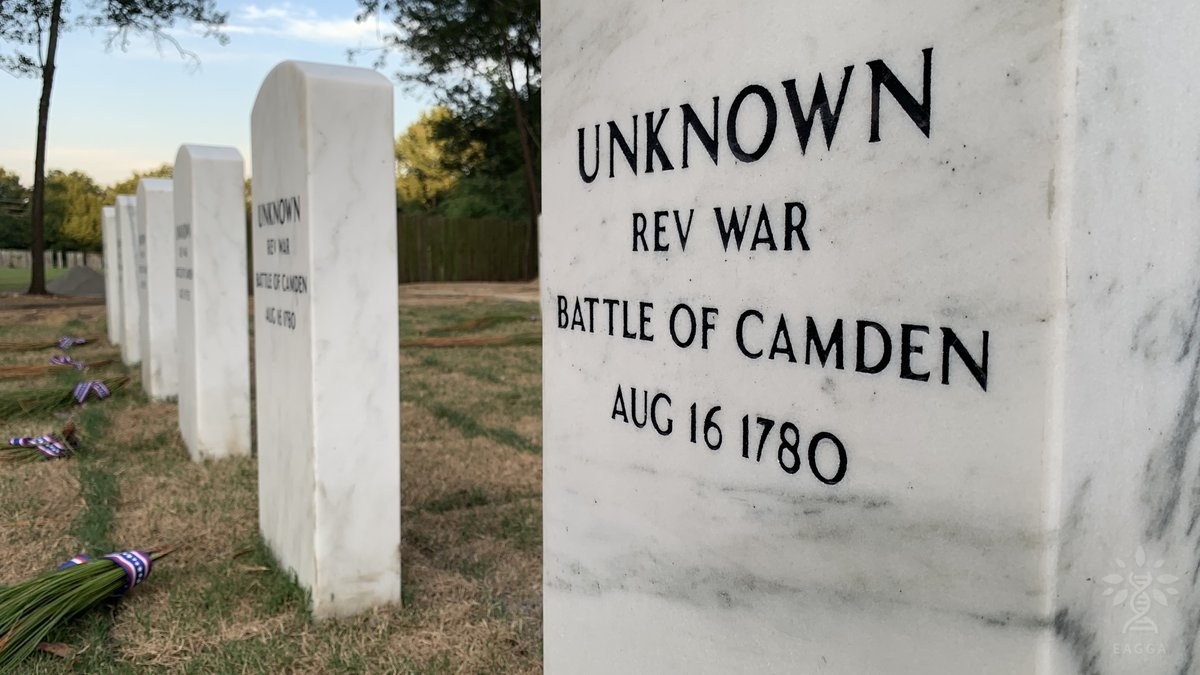
John Pumphrey’s story begins with a poor teenage boy. He was around 14 when he joined the Continental Army in 1777, signing his enlistment papers with an “X” — suggesting he had never learned to write his name. During his three-and-a-half-year military career he marched more than 1,000 miles. On 16 August 1780, he was killed at the Battle of Camden in South Carolina and buried in an unmarked grave, forgotten for nearly 250 years.
The Battle of Camden was a pivotal defeat for the Patriots: roughly 2,000 British troops defeated some 4,000 American forces, many of whom were ill with dysentery. Pumphrey’s military records show that he enlisted in the Seventh Maryland Regiment in 1777 and accepted a $100 re-enlistment bonus in 1779; after the Battle of Camden in 1780, he was listed as “missing”.
The turning point came with archaeology. Recovery efforts at the Camden battlefield began in 2020, when archaeologists surveyed the land with metal detectors. Amid the musket balls and buttons, they noticed two sets of human remains sticking out of the ground; further investigation revealed 14 Revolutionary War soldiers buried in shallow graves. Researchers moved the remains to the Richland County Coroner’s Office, where anthropologists examined them, before contacting FHD Forensics, a Texas-based company specializing in John Doe investigations.
Experts with Astrea Forensics, a California-based lab that works with ancient DNA, extracted and sequenced DNA from two of the soldiers, including Pumphrey, who was dubbed “Camden 9B”. According to FHD president Allison Peacock, the pair’s genetic genealogy profiles were the oldest the lab had ever created. The team uploaded the data to FamilyTreeDNA and GEDmatch — databases whose users have opted into forensic comparisons. At that point the researchers were not sure the experiment would work: so much time had passed, and they feared the genetic distance between these 18th-century soldiers and Americans alive today might be too great.
But when they looked at the databases, they found that Camden 9B was linked to prominent families from Maryland’s Anne Arundel County. From there, the researchers used several methods to identify the John Doe: three types of DNA — autosomal, X chromosome and Y chromosome — all pointed to Pumphrey, alongside extensive archival research. His great-grandfather, a carpenter, had moved the family from New Jersey to the Baltimore area around 1713; both of his parents died when he was a young boy. “He was orphaned at about age 10,” Peacock says. “He really didn’t have an opportunity to leave any record behind, other than his military record.”
Why would such a young boy enlist in the first place? After his father died, a cousin appears to have seized control of his estate, likely leaving Pumphrey and his siblings with few resources. “The earth shifted dramatically under John Pumphrey’s feet,” Peacock writes on her blog. “A young teen from an apparently prosperous family, and once with a bright, predictable future, now had little prospects.” By the end of his life, the growth plates around his knees had not fully closed, suggesting he was still quite young; although researchers are not sure how he died, “he didn’t have any visible injuries to his skeletal structure, which means it was probably a soft tissue injury — maybe a bayonet.”
In 2023, Pumphrey was reburied with full military honors. He was likely too young to have had children, but researchers have found some 20,000 DNA matches for living relatives. When the researchers officially announced his identification in June, some of his “next of kin” — descendants of his siblings and first cousins — gathered in Baltimore to celebrate his life. “He has waited almost 246 years for his name to be said out loud again,” Rick Wise, executive director of the South Carolina Battleground Preservation Trust, told the audience. “The blood that ran through his veins is going through yours.”
One of the most moving moments came from a relative in attendance. Julie Strickland from Lugoff, South Carolina — not far from the site of the Battle of Camden — told a local station: “I was born a Pumphrey. I was put up for adoption when I was 6 weeks old and later found both sides of my family. I started out without a name. He wound up without a name. And now we both know our name.”
This case sets a new milestone for the application of genetic genealogy: where traditional archaeology can only offer artifacts and dates, ancient DNA combined with family databases can directly answer “who he was”. Amid America’s 250th anniversary festivities, discoveries like this bring the 18th century to life. The researchers hope to identify more of the soldiers — each identification costs tens of thousands of dollars, and they are still looking for additional funding. Genetic genealogy is expanding its frontier from finding relatives to restoring names to the nameless of history, and Pumphrey’s story is one of the most moving footnotes in this field.