One 1985 Family Photo Reconnected a Line Broken for Decades: 34 Cousins Come Home to Nan’an
2026年11月23日
Claiming an Ancestor You Never Heard Of: Three Traps in Digital-Era Root-Seeking, and One Test That Still Works
2026年11月24日Seven Generations in One Graveyard: Ancient DNA Rebuilds a Ming–Qing Family Lineage in Tianjin
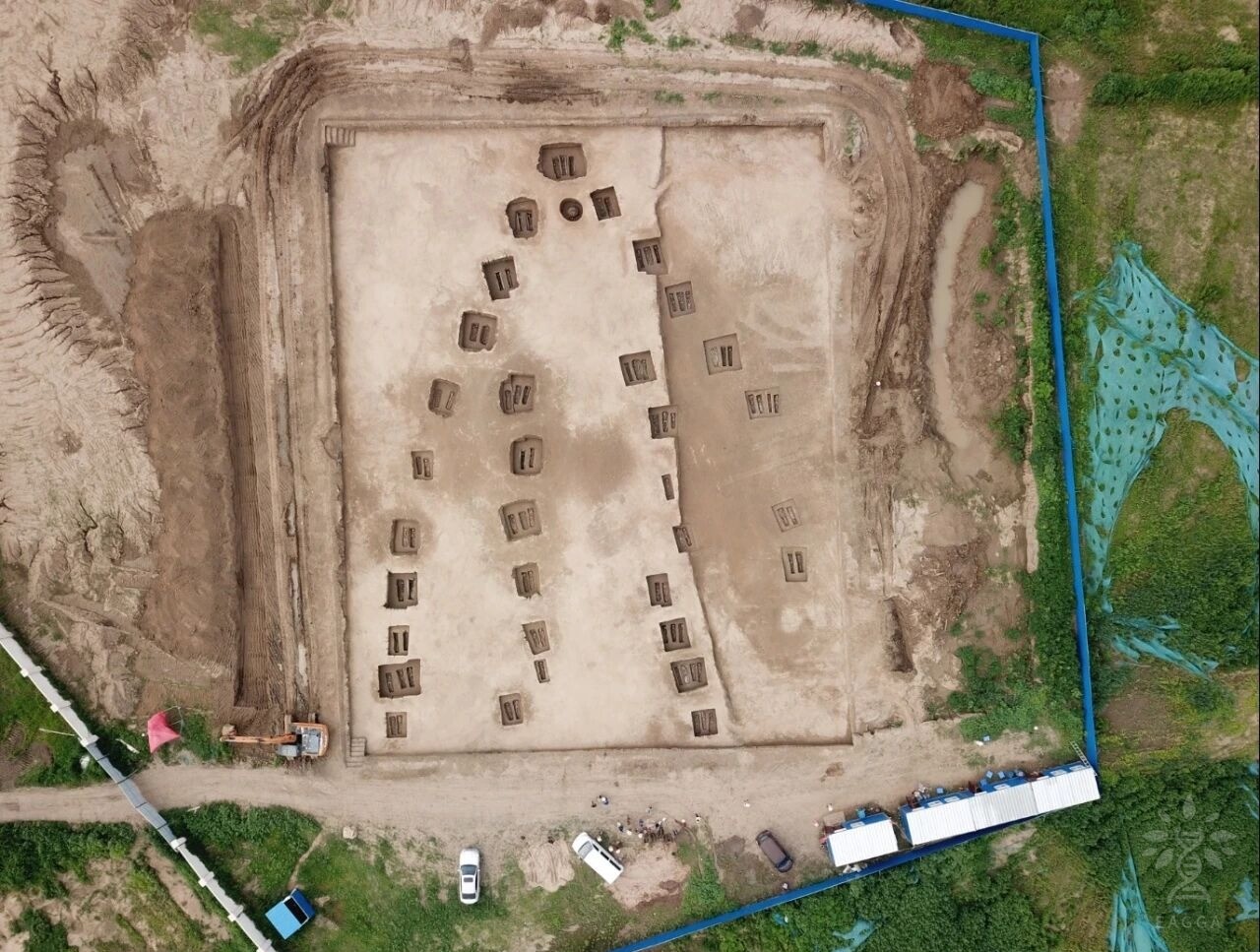
On the western edge of Beicang, in Beichen District, Tianjin, the North Canal bends around a low, unremarkable patch of ground. In 2021 the Tianjin Center for Cultural Heritage Protection excavated thirty-three tombs there and recovered the remains of seventy-nine people. The graves were modest and the grave goods sparse, but the layout was anything but casual: an ancestral tomb, a ritual structure known as the mingtang, and a spirit road formed a single axis, with every other grave arranged by generation to either side.
Five years later that patch of ground became the subject of a journal article. On 30 September 2026 the Journal of Archaeological Science (volume 195, article 106708) published “Ancient DNA reveals a seven-generation lineage and the Zhao-Mu system in Ming-Qing China.” The first author is Qu Youyang, a doctoral candidate at Jilin University’s School of Archaeology; the corresponding authors are Cai Dawei of Jilin University and Sheng Lishuang of the Tianjin center. The Bioarchaeology Laboratory at Jilin University and Peking University’s School of Archaeology and Museology collaborated, and the work was supported by China’s National Archaeological Talent Revitalization Program.
The question the paper sets out to answer is simple enough to state and hard to prove: were the people buried in this one field actually a single family, and if so, how did they pass property and standing from one generation to the next?
The answer is yes. From the seventy-nine individuals the team reconstructed a pedigree running seven generations. The founding pair lies in tomb M01, and their male descendants split into four branches, labelled M03a, M02b, M05a and M04b. According to the authors this is among the largest and most complete family lineages yet reconstructed from ancient DNA in East Asia; the project team describes it as the first successful large-scale reconstruction of an ancient family lineage in China using palaeogenomic methods.
The study does not rest on a single line of evidence. The first is genomic: DNA extracted from bone and teeth, with identity-by-descent analysis used to grade the relatedness of every pair of individuals — parent and child, siblings, uncles and nephews. The second is strontium isotope analysis: the strontium signature in bone reflects the geology of the ground where a person grew up, and can therefore flag who married in from elsewhere and who never left. The third is the spatial analysis of the cemetery itself, because grave position, orientation and generational rank are a language of their own. The conclusions emerge only where the three agree.
The published plan is easy to read once the conventions are known. Dashed lines divide the cemetery into seven bands, one per generation. M numbers are tombs, and lowercase letters a to d mark individuals within a single tomb, ordered from west to east. M34 is not a tomb at all but the mingtang, the focus toward which ancestral rites were directed. Colours mark the four branches, and same-coloured tombs link up across successive bands.
The most informative finding concerns the direction of marriage. Genetic relatedness shows that the lineage ran through men: within each branch, fathers passed to sons and sons to grandsons, with both Y-chromosome and autosomal evidence pointing to patrilineal descent. Women, by contrast, mostly came in from outside. They shared no local ancestry with the men buried around them, yet formed nuclear families with those husbands and their children. This is what anthropology calls patrilocality — residence with the husband’s kin.
Strontium supplies an independent check. The bones of the incoming wives carry isotope values that do not match the local geology, confirming that they grew up elsewhere, while the men’s values stay comparatively consistent. Two unrelated systems pointing at the same conclusion raise confidence considerably.
One further detail is worth noting: the family did not turn inward. Runs of homozygosity show no clear signal of marriage between close kin, which means wives kept arriving from outside and the marriage network stayed fairly open. For a lineage rooted in a farming village and settled in one place for generations, that is unsurprising. Stable residence let holdings accumulate; open marriage kept the bloodline from narrowing.
The arrangement of the graves also encodes ritual. The Zhao-Mu order, in use since the pre-Qin period, governs the placement of ancestral temples and tombs: zhao on the left, mu on the right, fathers and sons in alternating ranks, brothers in the same rank, with generation never out of sequence. Lizui follows exactly this scheme. Members of one generation lie in one band, the relative position of a husband and wife is regulated, and the placing of spouses expresses status. A rule written in ritual manuals was laid out, inch by inch, in a cemetery of ordinary people.
That leads to the social-history point. These were not officials. The grave goods are few and the tombs unassuming; the occupants look like ordinary Han villagers of Ming–Qing north China. Which means that clan organization built on patrilineal kinship was not confined to the genealogy books of the gentry — it had reached down into ordinary villages. The ancestral grave stood at the centre of the lineage, male descent kept it continuous, women entered it through marriage, and repeated practices such as tomb rites and the compiling of genealogies kept reinforcing the sense that these people were one family.
The comparison matters as much as the subject. Along the same Grand Canal, the Yuanbao Island cemetery on the South Canal in Xiqing looks quite different: largely charitable burial pits and temporary coffin storage, with no continuous lineage structure, and occupants far more varied in wealth and cultural expression. The authors therefore argue that Ming–Qing grassroots society in north China was not a single pattern. At one end stood the settled farming village with patrilineal kinship and a lineage that did not move; at the other, mobile commercial groups organized more loosely. Two bends of one canal, two kinds of society.
The limits deserve a paragraph of their own. This is one cemetery and seventy-nine individuals. It can explain how this particular family organized itself; it cannot be extrapolated to north China as a whole. Pedigree reconstruction depends on relatedness algorithms, resolution drops when samples are badly degraded, and generations may well include individuals who were never sampled. It works better as a ruler laid against one specific local society than as a census table.
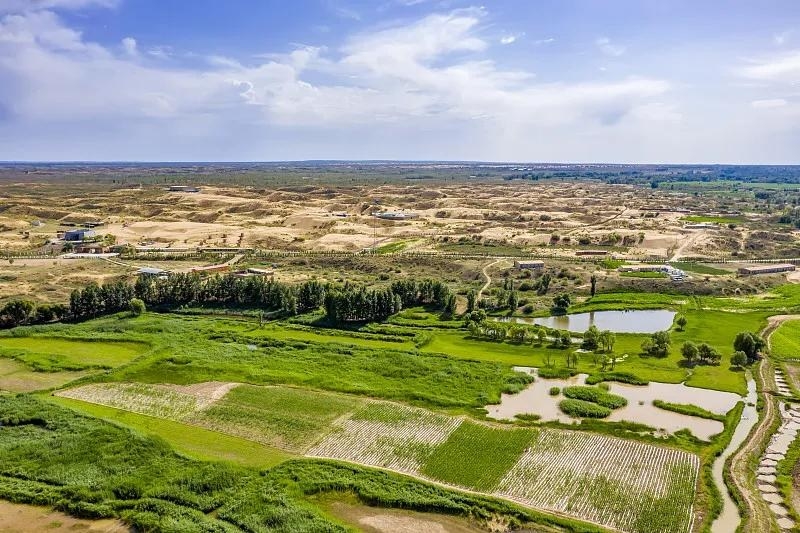
Caption: Aerial view of the Lizui Ming–Qing family cemetery near Tianjin, with tombs arranged on both sides of the axis formed by the ancestral grave, the mingtang and the spirit road. Image: Tianjin Center for Cultural Heritage Protection.