Seven Generations in One Graveyard: Ancient DNA Rebuilds a Ming–Qing Family Lineage in Tianjin
2026年11月24日Claiming an Ancestor You Never Heard Of: Three Traps in Digital-Era Root-Seeking, and One Test That Still Works
In May 2026, Jia Mo’s grandmother, scrolling on her phone, came across a video promising a free copy of her surname’s genealogy. She is old, no longer able to travel back to the village, and still thinks about home a great deal. She asked her granddaughter to make the contact. They reached out.
The man on the other end introduced himself as a fellow member of the Pang clan and sent a PDF. Jia skimmed it: copied Pang-surname material at the front, two digitised Qing-era Pang genealogies spliced in behind, a hundred pages or so in all — and not one line about her grandmother’s family. Then he asked for a mailing address so he could send “The Comprehensive Pang Clan Genealogy of China.” Jia ignored the request.
The next day he stopped waiting and moved to the sale. He was offering “Pang family banquet wine,” 390 yuan a case, with a 90-yuan deposit to secure delivery. Jia called him a fraud outright; her next message bounced back as blocked. When she posted the exchange online, other commenters described the same approach used on their own elderly relatives. The covers of the “genealogies” were identical across entirely different surnames — the same template, not even re-typeset.
Such episodes are one part of the noise that an old craft now attracts. Liu Yulong, a genealogy compiler born in the 1980s, has written several articles exposing these routines, and his judgment is blunt: a real genealogy belongs to one specific branch of one lineage. It cannot be valid for everyone sharing a surname nationwide, and it certainly cannot be given away in bulk for free. Compiling one, he says, consumes enormous effort, money and time.
Liu comes from Lantian County in Shaanxi. When his grandfather died in 2009, the household scroll listing three generations of ancestors was already crumbling, and he wanted to compile a genealogy — but he had no older book to work from at all. In 2014, renovating the old house, his father found a box holding thirty or forty land deeds, three of them wills in tiny regular script written in the hand of an ancestor, Liu Shengjia. Cross-checking the deeds against the scroll, Liu placed Liu Shengjia as his fifth-generation ancestor, a locally known physician who treated sores and lived around the end of the Qing. That fixed point let him start visiting one place at a time.
In 2017 he published what he had learned as Genealogy and Root-Seeking: The Liu Surname as a Case Study, cataloguing the characteristic faults of surviving Liu genealogies — botched proofreading, incomplete conventions, broken lineages, and claims asserted without evidence. His method is homely enough: pin down the links that can be proven, and mark clearly the ones that cannot.
The frauds have grown more elaborate. Some operators join dozens of surname-based clan chat groups at once, calling themselves Wang in the Wang group and Zhang in the Zhang group; Liu has a name for them, the retainers of ten thousand surnames. Others crop a corner off photographs of genealogies taken by somebody else and repost it with an originality label. Since AI video arrived, batches of generated ancestral-rite footage, complete with matching surname T-shirts and sweeping crowd scenes, draw applause and shares from elderly viewers. The platform stamps “AI-generated” into a corner. Many people never look.
The only reliable test, Liu says, is to ask for specifics: where is the ancestral hall, who leads the local clan association. Anyone who cannot answer is suspect. And he is careful about what is actually lost. Many people are not robbed of money so much as of feeling — what they were buying was the reassurance of having found their root.
Worse than the money is what AI does to the record itself. While organizing Liu clan material, Liu tried letting AI help and caught it merging two men into one: Liu Guan, a Yuan-dynasty literary figure whose courtesy name was Daochuan, and a completely different tribute student of the same name who lived under the Ming Hongwu emperor. The model treated them as a single person. It also reported that Liu Kai of the Northern Song entered officialdom through scholarly recommendation, when Liu Kai in fact passed the regular metropolitan examination in 973, and no recommendation exists in the record.
The reason is not mysterious. Real genealogy sources are scattered across rare books, archival holdings, local gazetteers and epitaphs, and much of that material has never been digitised. What the model retrieves are second-hand fragments that have already been copied, recopied and altered online. Companies now offer genealogy compilation as a service, and if their researchers lean on AI, the errors go straight into the finished book. “You pay,” Liu says, “and end up honouring somebody else’s ancestor.” A genealogy like that, he argues, is worse than none.
Consumer DNA testing offers a different kind of check. Zhou Kun founded a genetic testing company in 2015, starting in health and later adding ancestry products. He had been told since childhood that his family descended from Zhou Yu, the Three Kingdoms commander — but the histories record Zhou Yu dying at thirty-six with two sons and no recorded grandchildren, and the claim never sat right with him.
In 2017 his team recruited more than a dozen people who claimed descent from Zhu Yuanzhang, the Ming founder, and tested them according to their genealogies. Their common ancestor fell in the late Yuan to early Ming transition, which supported a paternal marker for the Ming imperial line designated O-MF12415. In 2025, Sui Mingru, then a master’s student in forensic medicine at Jilin University, sampled material from a Ming royal tomb; the ancient DNA result matched. Cross-checks of that kind were simply unavailable to genealogy researchers of the past.
The counter-examples are more numerous. A Wei-surname genealogy in Guangxi holds that its ancestor was Han Xin, the Han general, and that his infant son was smuggled to Guangxi by Xiao He and given a new surname to survive; testing showed the family is indigenous to the region and has lived there for three to four thousand years. A Chen genealogy claims descent from Chen Youliang, the rival warlord defeated by Zhu Yuanzhang. Mo Yuchou, a jinshi of the Jiaqing reign from Dushan in Guizhou, presented his line as stemming from the Mo clan of Jiangning; scholars concluded the family was locally Bouyei. The historian Ge Jianxiong explains the motive plainly: to avoid being classed as barbarians, some families invented elite ancestors.
Ge offers a further rule of thumb that is more useful than any single case: what a genealogy says about the local founding migrant is usually dependable; what it says about origins traced back to the Tang, the Song, or even the Qin and Han, usually is not. In the late Qing, compiling genealogies became a popular pursuit, but most households lacked the scholarship to verify distant ancestors, and professional genealogy craftsmen filled the gap with stock templates — the most common being the story of migration from the great locust tree at Hongtong in Shanxi. Zhao Shiyu of Beijing Normal University examined six Ming and Qing editions of the Hongtong county gazetteer and found no such record; Hongtong in the early Ming held roughly ninety thousand people.
So the tools of root-seeking have changed while the standard for judging a claim has not. The dates have to line up: a common ancestor’s estimated age against the years the documents actually cover. The places have to line up: the ancestral hall, the village of departure, the successive names of the locality. And the people have to line up: the genealogy against what living kin and other branches can independently confirm. When all three hold, an ancestor stands. When only one does, what you have is usually a wish rather than evidence.
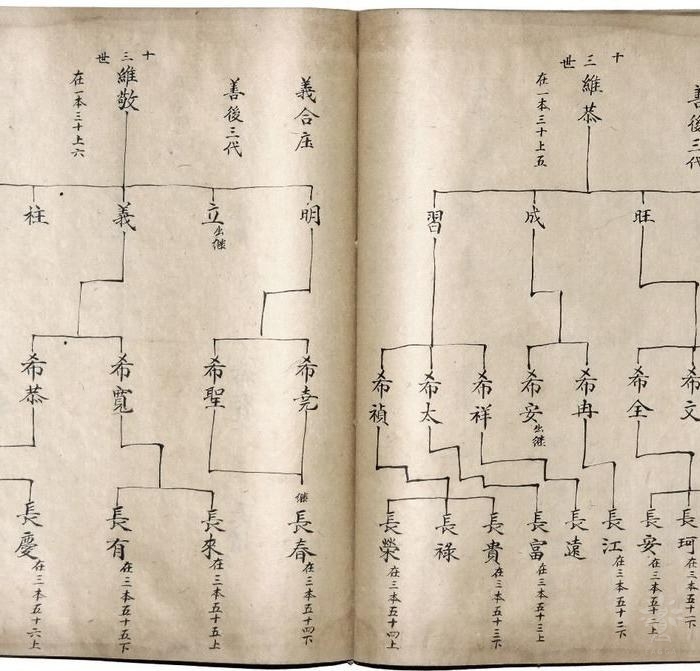
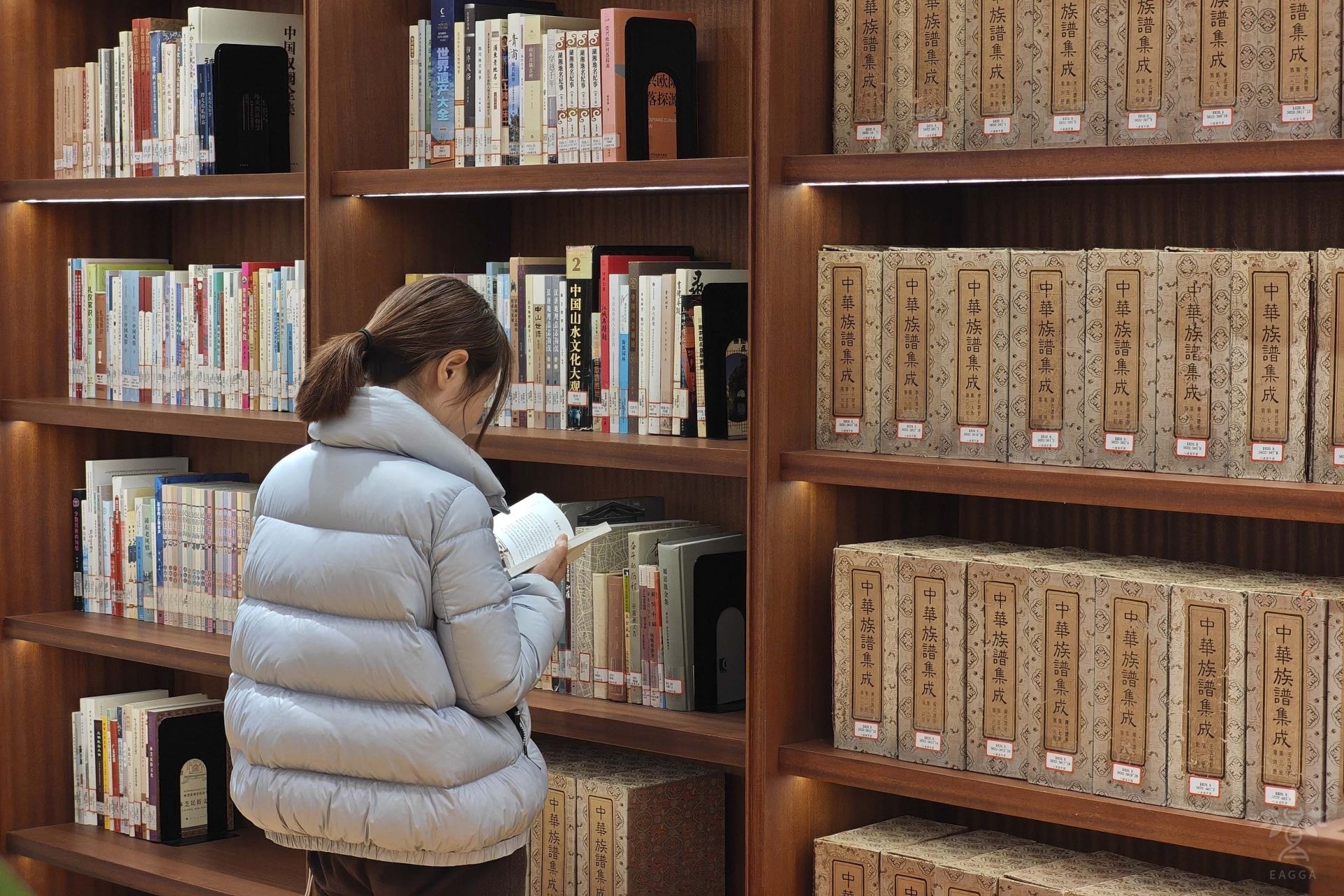
Caption: A reader browsing genealogy volumes at the Shanghai Library’s family-history collection. Image: Visual China Group.