
Cultural Exploration: The Genetic History of the Ewenki People – New Northeast Asian Ancestry Evidence from a Reindeer-Herding People
2026年6月8日
Cross-Strait Root-Seeking Service Center Opens in Xiamen: Big-Data Genealogy Makes “One-Click Ancestor Search” a Reality
2026年6月18日Mitotree Released: A Universal Human Mitochondrial Reference Phylogeny at 10x Resolution

On 28 May 2026, a preprint titled “Mitotree: The Universal Human Mitochondrial Reference Phylogeny at 10x the Resolution” was uploaded to the biology preprint server bioRxiv. The paper’s lead author, Paul Maier, and most of the author team come from FamilyTreeDNA’s (FTDNA) R&D division, including veteran genetic genealogist Roberta Estes. The upload marks the formal academic debut of the Mitotree project, led by the Million Mito Team — a human-wide mitochondrial DNA phylogeny of far greater resolution, now with a methodology that can be peer-reviewed.
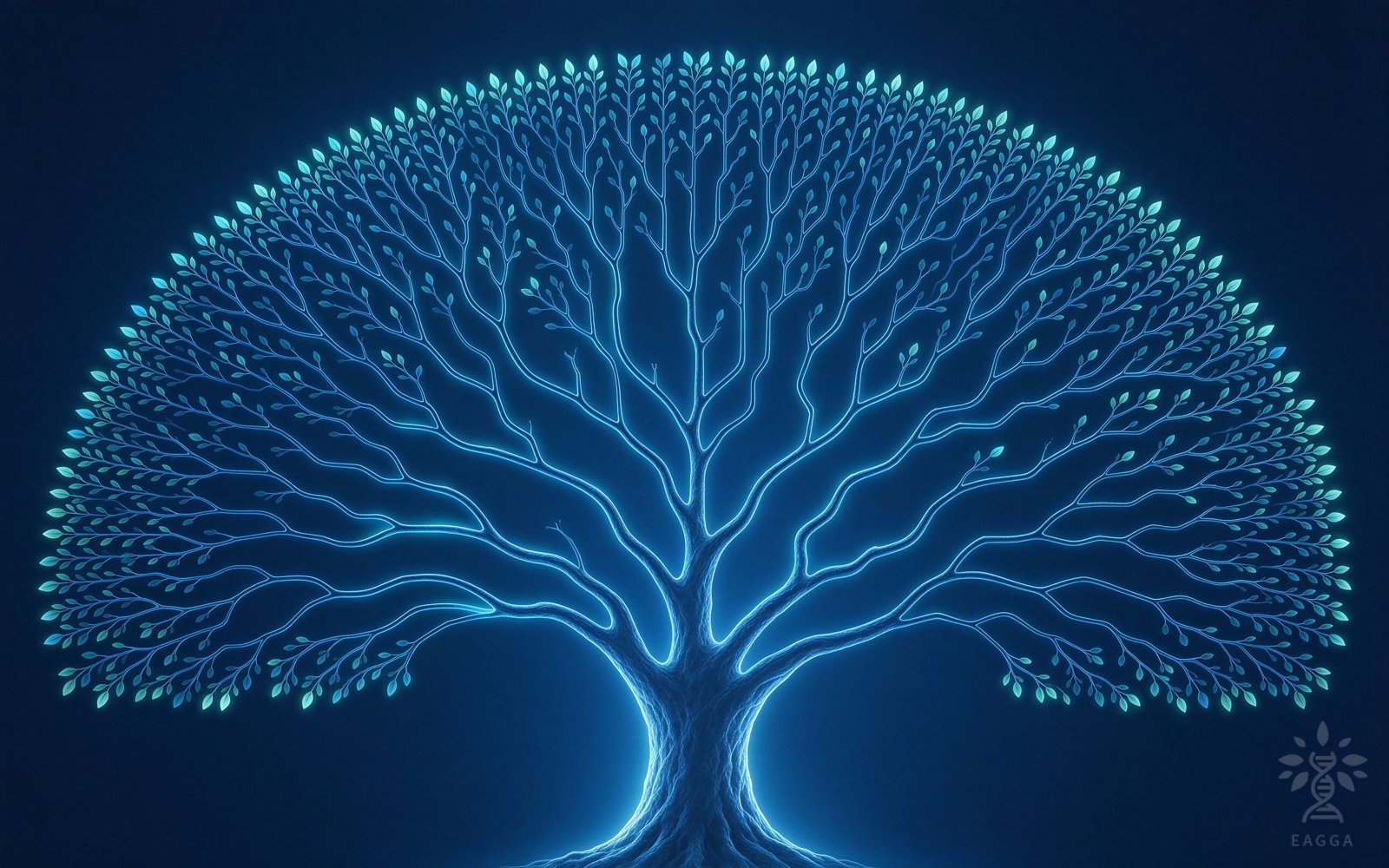
Mitotree officially “born” on 25 February 2025, and the tree has been updated several times since. According to FTDNA, about 75% of customers who took the full-sequence mitochondrial DNA test received a more refined haplogroup with the release of Mitotree or its subsequent updates. On average, those haplogroups are about 2,000 years younger — and some much more recent — than the legacy PhyloTree assignments. In other words, the tree’s branches have become far bushier near the tips: countless new twigs and leaves have grown where the old trunk showed nothing.
In scale, Mitotree is an order-of-magnitude leap. The researchers began with PhyloTree v17 — a hand-curated tree of 5,438 branches built from 24,275 full and partial sequences, last updated in 2016 before being abandoned. The Million Mito Team’s robust phylogeny, by contrast, contains more than 54,000 branches formed from over 330,000 complete mitochondrial sequences, of which 177,196 are unique. The sample base grew by more than an order of magnitude, and all of it is full-sequence data.
Why did the old tree have to be rebuilt? The core problem was methodology. PhyloTree’s construction and maintenance were never automated: roughly once a year, a new version appeared, with new samples individually evaluated and new haplogroups hand-grafted onto an existing backbone. Because the backbone itself was never recalculated, deep splits could not surface — which is exactly how haplogroup L7 remained undetected until the Million Mito Team recalculated the entire tree, including the backbone, in 2022 and published its discovery. In short, PhyloTree was publicly available, but there was no recipe for how it was created or maintained.
Automation became the only path forward. The team first had to write software to phylogenetically reverse-engineer PhyloTree v17, establishing a consistent foundational backbone — an essential step for preserving the established haplogroup naming pattern. The software also had to scale exponentially: early versions took weeks to run, clearly unsustainable in the long term, yet programmatically establishing a foundation backbone was a victory in itself. Today the pipeline handles tree-building for more than 330,000 samples.
The quality and quantity of samples changed fundamentally as well. In the PhyloTree era, researchers worked mostly with HVR1 and HVR2 partial sequences; today, with over 330,000 full-sequence samples available, partial samples are no longer included. Before tree construction, identical samples from known immediate relatives are deduplicated to reduce clutter and processing time — leaving 177,196 unique sequences out of 331,221. That number alone refutes a long-standing myth: mitochondrial DNA is not “too slow to mutate to be useful for genealogy.” On the contrary, more than half of the samples differ from one another, revealing a far richer mutation signal than commonly assumed.
Mitotree has produced a series of exciting discoveries. About 180 branches in the base tree are older than 30,000 years; the oldest is haplogroup L7, dating to roughly 100,000 years ago, which both expands and more firmly roots the most ancient portions of the tree. Astonishingly, L7 still has living descendants whose earliest known family members are found in Turkey, Saudi Arabia, Yemen, the UAE, Palestinian Territory, Ethiopia, Sudan and South Africa. Another striking finding concerns Otzi the Iceman — the 5,000-year-old mummy found frozen in the Italian Alps, long thought to belong to an extinct haplogroup named in his honor, K1ö. Mitotree shows that Otzi was actually a member of haplogroup K1f, a clade with living descendants in Algeria. Otzi also now matches four ancient burials — he has cousins after all.
Building a mitochondrial tree comes with unique challenges. The mitochondrial genome offers only 16,569 usable positions, versus roughly 22 million “gold standard” positions on the Y chromosome. Of those 16,569 positions, some are too unreliable for tree-building: insertions (named like 309.1C) and heteroplasmies (multiple nucleotides detected at one position) tend to mutate back and forth and are excluded from branch formation. They are not discarded entirely, however — they now feed haplotype clusters, grouping tools that benefit even the roughly 25% of testers who did not receive a new haplogroup.
Why does a mitochondrial phylogeny matter so much? Because it is the only time channel back to our maternal ancestors. Unlike autosomal DNA, which is halved every generation, mitochondrial DNA passes strictly from mother to all children, and Y-DNA from father to sons — both uniparental paths are transmitted with only occasional mutations, forming a trail of breadcrumbs backward in time. Autosomal DNA is diced and recombined every generation, so no tree is possible for it. Mitochondrial DNA, by contrast, is both broad — many leaves — and deep, looking straight back through time like a laser sight to Mitochondrial Eve, the maternal common ancestor of all humanity, who lived roughly 140,000 years ago in Africa.
For genetic genealogy in East Asia, Mitotree carries several lessons. First, automated tree-building with a published methodology is the foundation for sustainable use of large-scale population data. Second, mitochondrial DNA’s value for pre-surname maternal tracing and ancient-DNA comparison has long been underestimated and deserves fresh attention. Third, the vast datasets contributed by citizen scientists and commercial testing companies are becoming an indispensable “new infrastructure” for human genetics. As Estes puts it, mitochondrial DNA is absolutely useful and absolutely interesting — and the success stories keep rolling in.