

The Naotegai Site in Inner Mongolia: A New Super-Large Hongshan Settlement Discovery
2026年5月29日
Fudan team reveals 6,000 years of population history in the middle Yellow River: Yangshao ancestry endures for 6,200 years
2026年6月26日Cultural Exploration: The Genetic History of the Ewenki People – New Northeast Asian Ancestry Evidence from a Reindeer-Herding People
On 8 June 2026, the Journal of Translational Genetics and Genomics published online a population genetic study of the Ewenki people of China. Researchers from Northwest Minzu University, Chongqing Medical University, and Sichuan University generated genome-wide data from 46 Ewenki individuals sampled on the Hulunbuir grasslands of Inner Mongolia, providing new resources and evidence for understanding the evolutionary history of Northeast Asian populations.
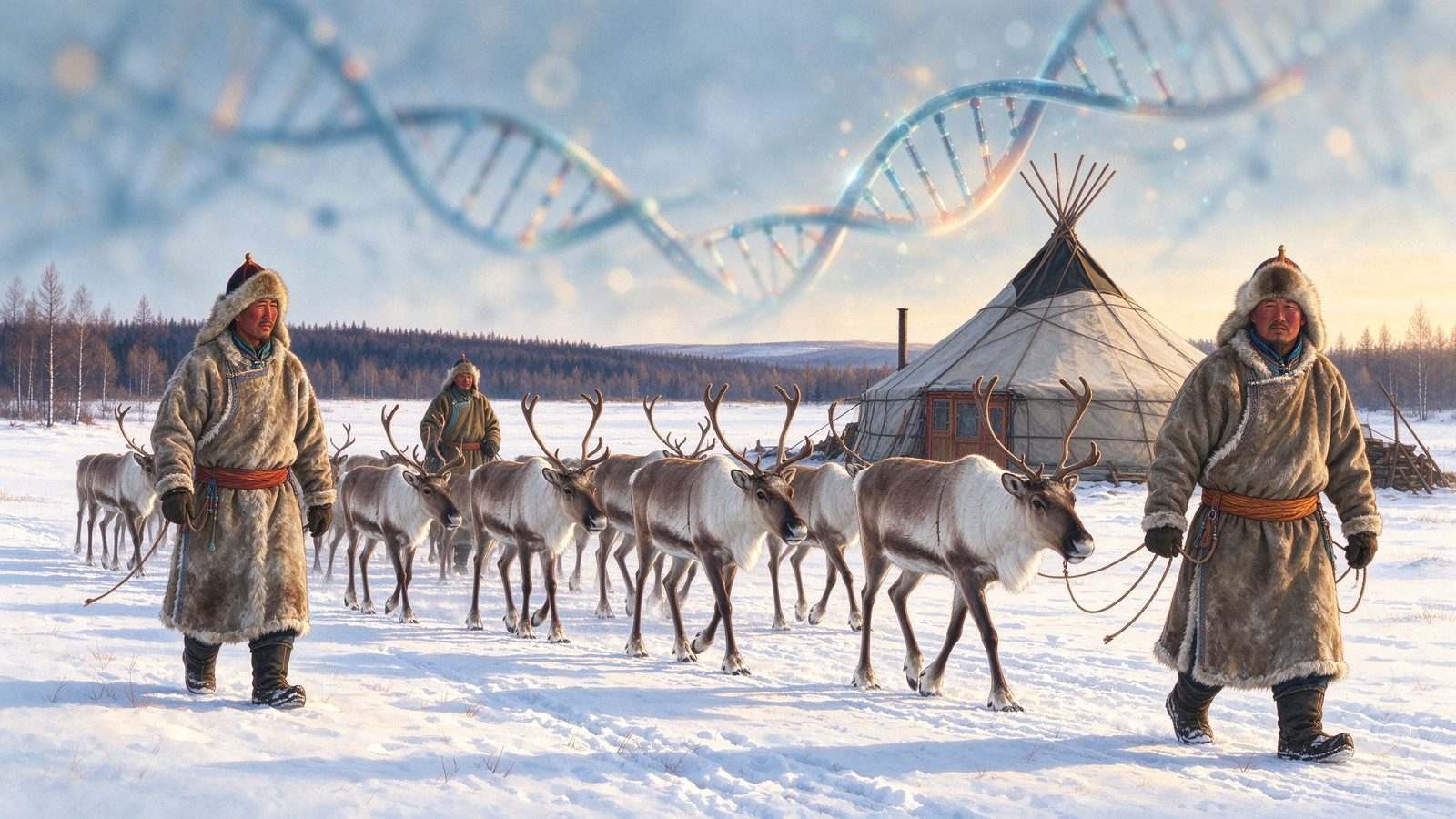
A people of reindeer herders: the long-underrepresented Ewenki
The Ewenki, an ethnolinguistic minority of roughly 30,000 people mainly inhabiting the cold, high-latitude regions of northeastern China, are famous for reindeer herding and forest hunting cultures. Yet they remain insufficiently characterized at the genomic level – one of the “underrepresented” groups in global population genetics. The team sampled 46 Ewenki individuals on the Hulunbuir grasslands, generated genome-wide SNP data, merged them with public modern and ancient datasets, and systematically reconstructed the population structure, ancestral composition, and demographic history of the Ewenki.
Methods: multidimensional genetic analyses
The study combined principal component analysis (PCA), model-based ADMIXTURE clustering, fineSTRUCTURE haplotype clustering, f3/f4 statistics, and qpWave/qpAdm admixture modeling, inferring population structure, ancestral components, and admixture events from multiple perspectives.
Results: a distinct genetic position in Northeast Asia
The Ewenki occupy a genetically distinct position within Northeast Asia and show close affinities with Chinese Mongolic, Tungusic-speaking, and ancient Northeast Asian populations. f3/f4 statistics revealed shared genetic drift and admixture signals linking the Ewenki to ancient Northeast Asian, Siberian, and Yellow River Basin-related populations. qpWave and qpAdm analyses further indicated that the Ewenki can be modeled primarily as a mixture of ancient Northeast Asian/Siberian-related ancestry and ancient Yellow River Basin farmer-related ancestry – reflecting long-term population interaction and admixture across Northeast Asia.
Significance: filling a gap in the Northeast Asian genetic map
The study concludes that the Ewenki’s significant genetic similarity to Tungusic-speaking populations mainly results from admixture between ancient Northeast Asian groups and Yellow River Basin farmers. Beyond providing high-quality genomic resources for this long-neglected people, the research offers key evidence on the origins of the Tungusic language family, prehistoric exchanges between Northeast Asia and the Central Plains, and the deep genealogical relationships among East Asian and North Asian populations.
(Compiled from the Journal of Translational Genetics and Genomics publication.)