Tropical Ground Keeps Little Ancient DNA: A 5,000-Year Ceiling Measured from 300 Caribbean Skeletons
2026年11月18日
One 1985 Family Photo Reconnected a Line Broken for Decades: 34 Cousins Come Home to Nan’an
2026年11月23日Not One People: 37 Ancient Genomes Show How Farmers, Herders and Southerners Assembled the Qin
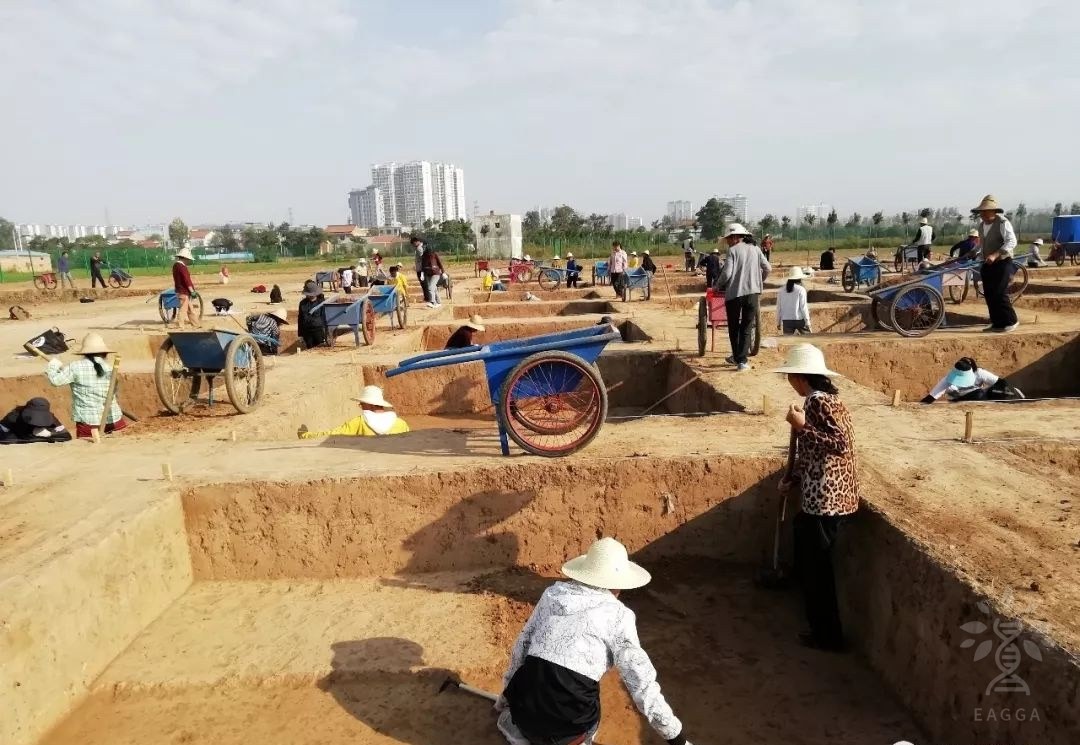
In November 2026, the molecular anthropology group at Xi\’an Jiaotong University\’s School of Life Science and Technology, working with the Shaanxi Academy of Archaeology, Fudan University and Xiamen University, published a paper in iScience titled Ancient human genomes reveal farmer-pastoralist interactions in the formation of Iron Age Qin people. Zhang Huqin is the corresponding author and Wang Xirui, a doctoral student, the first author. The study places a late Longshan mega-settlement in northern Shaanxi and the Qin capital of Yongcheng inside a single ancestry framework, and uses 37 ancient genomes to answer an old question: were the Qin one people, or many who slowly became one?
For decades the literature has offered two answers, an eastern origin and a western one. Archaeology sees shifts in material culture; genetics sees where ancestry came from, and the two accounts often disagree. Yongcheng, near present-day Fengxiang in Baoji, served as the Qin capital for nearly three centuries, from Duke De\’s move there until Duke Xian moved the court east, and it sat on the corridor between farming and pastoral zones in western Guanzhong, which makes it an unusually good vantage point for watching farmers and herders meet.
The team sampled two sites: three individuals from the late Neolithic site of Lushanmao near Yan\’an, dated to about 4,000 years ago, and 34 Qin individuals from Yongcheng, dated to about 2,000 years ago, 37 in total. These new genomes were merged with more than a thousand published ancient genomes from the Yellow River basin and the wider Eurasian continent, then checked against one another using principal component analysis, population-genetic statistics, individual relatedness testing and ancestry mixture modelling.
The first set of results points to northern Shaanxi. In the ancestry model for Lushanmao, roughly 93% of the genome comes from Yellow River farming populations linked to Yangshao culture and about 7% from ancient northeast Asian pastoralists; the population\’s genetic structure closely resembles that of Shimao, its contemporary. That suggests several large Longshan-era settlements in northern Shaanxi formed, at least in terms of blood, one densely intermarrying whole. A stone city like Shimao was not only a military centre but also a node in a marriage network.
The second set of results concerns the Qin themselves. The people of Yongcheng still carried a Yellow River farming majority, but its share had fallen to about 70.4%, and two new components had appeared: about 16.4% ancient northeast Asian ancestry and about 13.1% southern East Asian ancestry. Fitted against a different reference set, the model returns roughly 85% local late Neolithic ancestry plus 15% southern East Asian. If pastoralists from the upper Yellow River, associated with Qijia culture, are allowed as a source, the proportions come out at about 49.8% pastoralist-related, 39.4% central plains and 10.8% southern East Asian. The models weight different sources differently, but all agree on one point: the Qin carried more than one origin.
Set side by side across two millennia, the trend is legible. Farming ancestry fell from about 93% to about 70%, the northern steppe component rose from 7% to 16.4%, and a southern component appeared where there had been almost none. This is addition rather than replacement: the population core persisted while new branches kept joining it. The Qin formed more like a river absorbing tributaries than like a clean substitution.
The most striking finding is an absence. Across the whole set of Qin samples, no western Eurasian contribution was detected. A second study makes a useful comparison: 149 prehistoric genomes from Gansu, dated to roughly 4,700 to 3,000 years ago and published in Cell in September 2026, likewise found ancestry drawn mainly from within East Asia and no western Eurasian input. Wheat, barley, cattle and sheep arrived in China largely as objects and techniques rather than as large-scale replacement of people, which is precisely the opposite of the pattern in Europe and Central Asia, where farming spread alongside mass migration of farmers.
A third layer of information sits inside the cemetery. Among the 34 Yongcheng individuals, relatedness testing identified several groups of biologically related people. Placed back onto the layout of the graves, those relationships allow researchers to discuss plot arrangement, family sections and continuity between generations. A written genealogy records who was whose son; bone records who actually shares DNA. Only when the two confirm each other does a pedigree become trustworthy.
For anyone working on surnames and lineages, the paper offers methodological cautions. First, do not treat a high frequency of one Y-chromosome haplogroup in a region as proof of that region\’s ethnic origin. A haplogroup traces a single paternal line, while real populations are the product of long mixing among many branches. Second, cultural diffusion and human migration must be kept apart: objects, crops and burial customs can travel far without people travelling with them. In the paper\’s schematic, the link drawn between Lushanmao and its neighbours is explicitly labelled cultural diffusion, not population movement.
Third, an ancestry model is a probabilistic fit, not a verdict. Change the reference panel or the candidate sources and the percentages move; the authors themselves report more than one fit. When reading such work, check sample size and chronological span first, then the model\’s assumptions, and only then the numbers.
The limitations are equally clear. Thirty-seven individuals from two sites cannot stand for all Qin people, and the 34 from Yongcheng come from a single cemetery, so social rank and geographic diversity are constrained by sampling. These genomes are a window, not a panorama.
Yet the window is enough to unsettle a common assumption. The Qin were not one people in the blood sense. Across two millennia from Lushanmao to Yongcheng, Yellow River farmers supplied the frame, while groups from the northern steppe and the southern highlands kept joining, until writing, institutions and war consolidated them into a single identity called Qin. What lineage research really follows is rarely one pure line; it is a series of junctions.
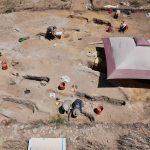
Excavation at the Qin capital site of Yongcheng (archive photograph). Source: Shaanxi Academy of Archaeology.