Ancient Genomes from the Eastern Tianshan: Where East Asian and North Asian People Met in the Bronze Age
2026年10月22日
The “Time Code” of the Y Chromosome: Large-Scale Lineage Studies Reconstruct East Asian Paternal History
2026年10月24日Twelve Thousand Years of Population Turnover: Guizhou Ancient Genomes Rewrite the Prehistory of Southwestern East Asia
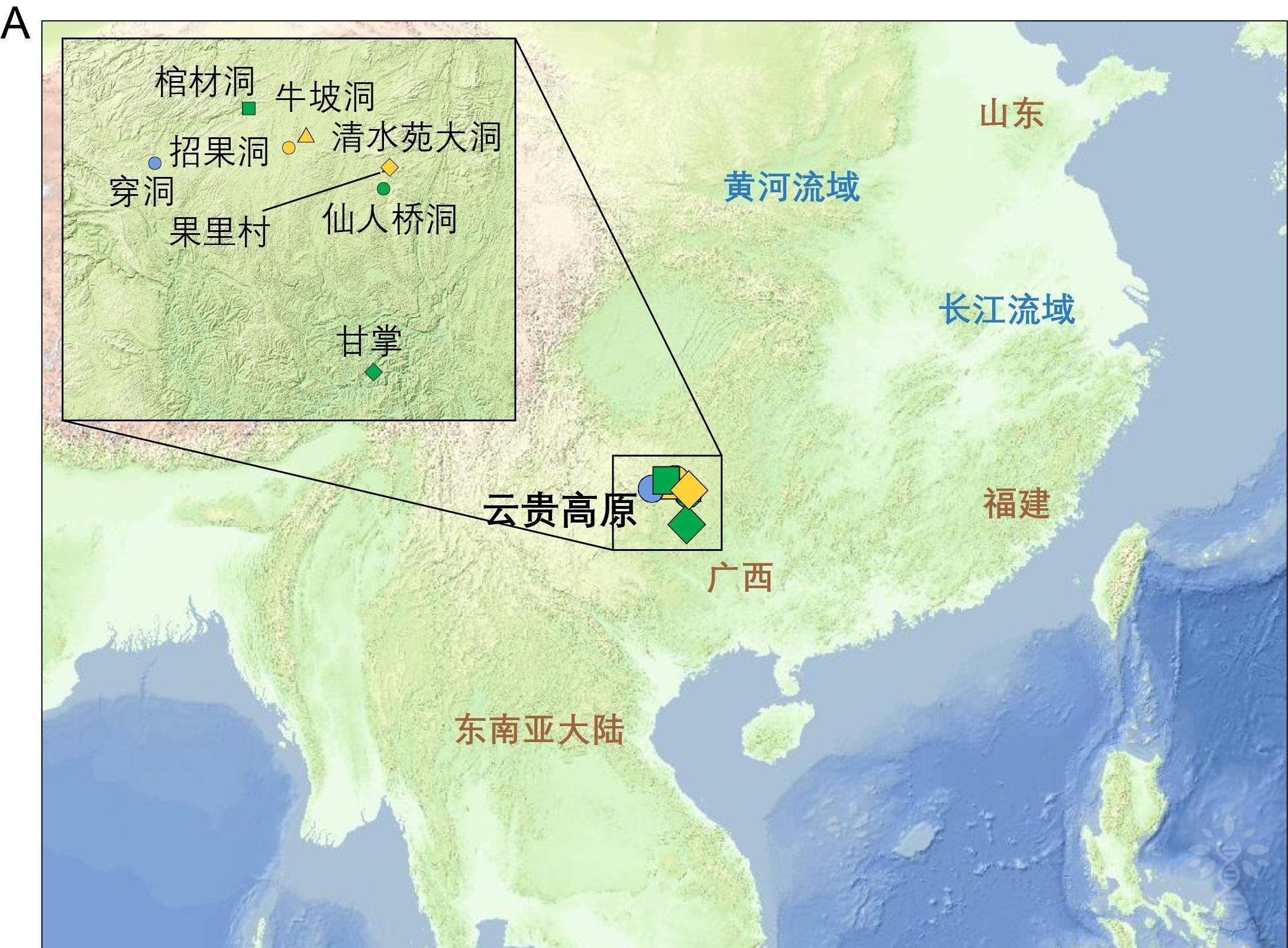
The Yunnan–Guizhou Plateau in southwestern East Asia is a pivotal corridor linking southern East Asia, Southeast Asia, and the Tibetan Plateau—and a critical region for studying early human migration. Yet on its eastern flank, in Guizhou Province, where karst landscapes preserve remarkably rich archaeological sequences at sites such as Zhaoguodong, Niupodong and Chuandong, ancient DNA research had long remained a blank on the map.
A team led by Fu Qiaomei of the Institute of Vertebrate Paleontology and Paleoanthropology (IVPP), Chinese Academy of Sciences, together with the Guizhou Provincial Institute of Cultural Relics and Archaeology, the Institute of Archaeology of the Chinese Academy of Social Sciences, the Guizhou Museum and Sichuan University, systematically studied 50 human bone samples from eight archaeological sites in Guizhou—Zhaoguodong, Niupodong, Qingshuiyuan Dadong, Chuandong, Guancaidong, Xianrenqiaodong and others—dating from about 12,000 to 300 years ago. The work yielded 36 high-quality nuclear genomes and was published in National Science Review on 18 September 2026.
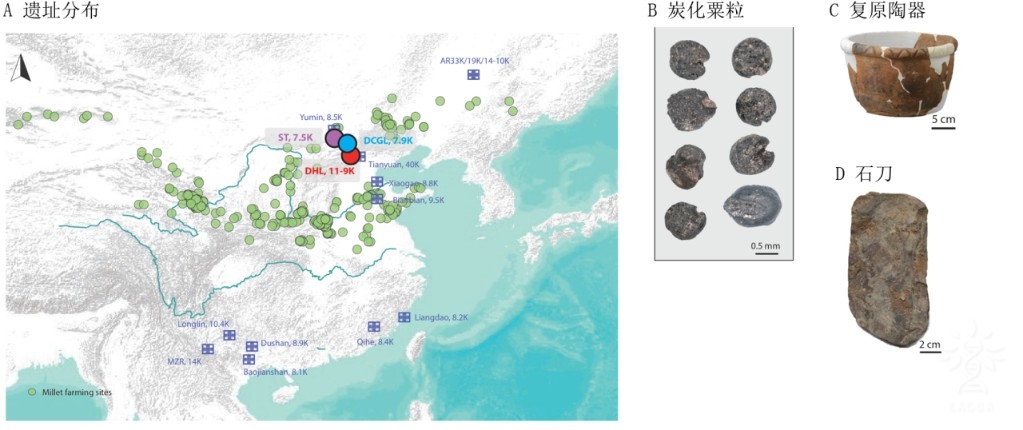
The data alone mark a milestone. Previously, nuclear genomes older than about 10,000 years from southern East Asia were represented by only a handful of cases, such as the Longlin individual from Guangxi and the Qihedong individual from Fujian. This study adds five Guizhou genomes older than 10,000 years (about 12,000–10,000 BP), doubling the number of such ancient genomes from southern East Asia and broadening our picture of late Paleolithic genetic diversity in the region.
The first key finding concerns Paleolithic population structure. Ancient Guizhou people carried a deep basal East Asian ancestry represented by the Xingyi individual from Yunnan—a deeply diverged Asian lineage phylogenetically similar to the 40,000-year-old Tianyuan individual from Beijing and the 8,000-year-old Hòabìnhian individuals. Unlike neighboring Yunnan, however, where basal ancestry dominated, Paleolithic Guizhou groups also carried a substantial proportion of East Asian northern ancestry, revealing marked population structure across southwestern East Asia at the time.
The timing is what makes this discovery significant. Scholars had generally assumed that the southward expansion of East Asian northern groups was closely tied to the spread of farming populations. This study shows that ancestry related to northern groups had already reached Guizhou by about 12,000 years ago—during the Paleolithic, well before agriculture—implying that interaction between northern and southern East Asians began far earlier and was far more complex than previously thought.
The finding also speaks to a long-standing archaeological debate over the origin of the \’small flake stone tool\’ technology found at these sites. Some scholars argued it was brought by northern hunter-gatherers migrating south; others favored a local origin. The genetic evidence now supports the former: populations carrying northern ancestry were indeed present in Guizhou by the late Paleolithic.
The second key finding is a dramatic population replacement on the eve of the Bronze Age. Genomes from the Chuandong site, dated to roughly 4,000–2,000 years ago, show that by the Bronze Age the basal East Asian ancestry represented by Xingyi was no longer detectable in Guizhou—or anywhere in southwestern East Asia. Instead, the Chuandong people closely resembled late Neolithic populations from central Yunnan, who carried ancestry related to Austroasiatic speakers and showed no direct genetic continuity with the older Paleolithic inhabitants. At least 4,000 years ago, then, people from central Yunnan—ancestral to Austroasiatic speakers—expanded eastward into Guizhou and largely replaced the region\’s ancient basal-ancestry population.
Notably, agricultural remains in Guizhou appear relatively late in the Neolithic sequence, suggesting farming technology was not highly developed there. Yet even without a well-developed farming economy, the Paleolithic basal population did not survive into the Bronze Age—hinting that the shift in subsistence technology was accompanied by a profound demographic replacement.
The third finding concerns historical times. Guizhou and Guangxi are among the most ethnically diverse regions in southern China, where Hmong-Mien (Miao-Yao) and Tai-Kadai (Zhuang-Dong) speakers have long coexisted. Genomes of Guizhou cave-burial populations dating to about 1,100–300 years ago show that Hmong-Mien speakers in Guizhou were genetically highly similar to contemporary Hmong-Mien groups in Guangxi, but significantly different from Tai-Kadai groups there. Despite frequent contact between the two provinces, language and cultural identity continued to shape patterns of population interaction at a deep level.
Taken together, the study reshapes our understanding in four ways: it fills a geographic and temporal gap in the ancient genomics of southwestern East Asia; it pushes the onset of north–south gene flow in East Asia back to before agricultural expansion; it documents, with solid evidence, a major population replacement on the eve of the Bronze Age; and it clarifies persistent genetic differences among historical language groups. These insights provide key scientific support for understanding the origins, migrations and fusions of southwestern populations within the \’unity in diversity\’ pattern of Chinese civilization.