
The Open-Source Wave in Genealogy Digitization: GRAMPS, GEDCOM and the Return of Data Sovereignty
2026年10月13日
The ‘Silk Road’ Written in Paternal DNA: How More Than a Thousand Y Chromosomes Rewrite Northwest China’s Population History—and the Hui
2026年10月16日Four and a Half Millennia on the Yellow River: 61 Ancient Genomes from the Central Plains and Shandong Rewrite a Regional Story
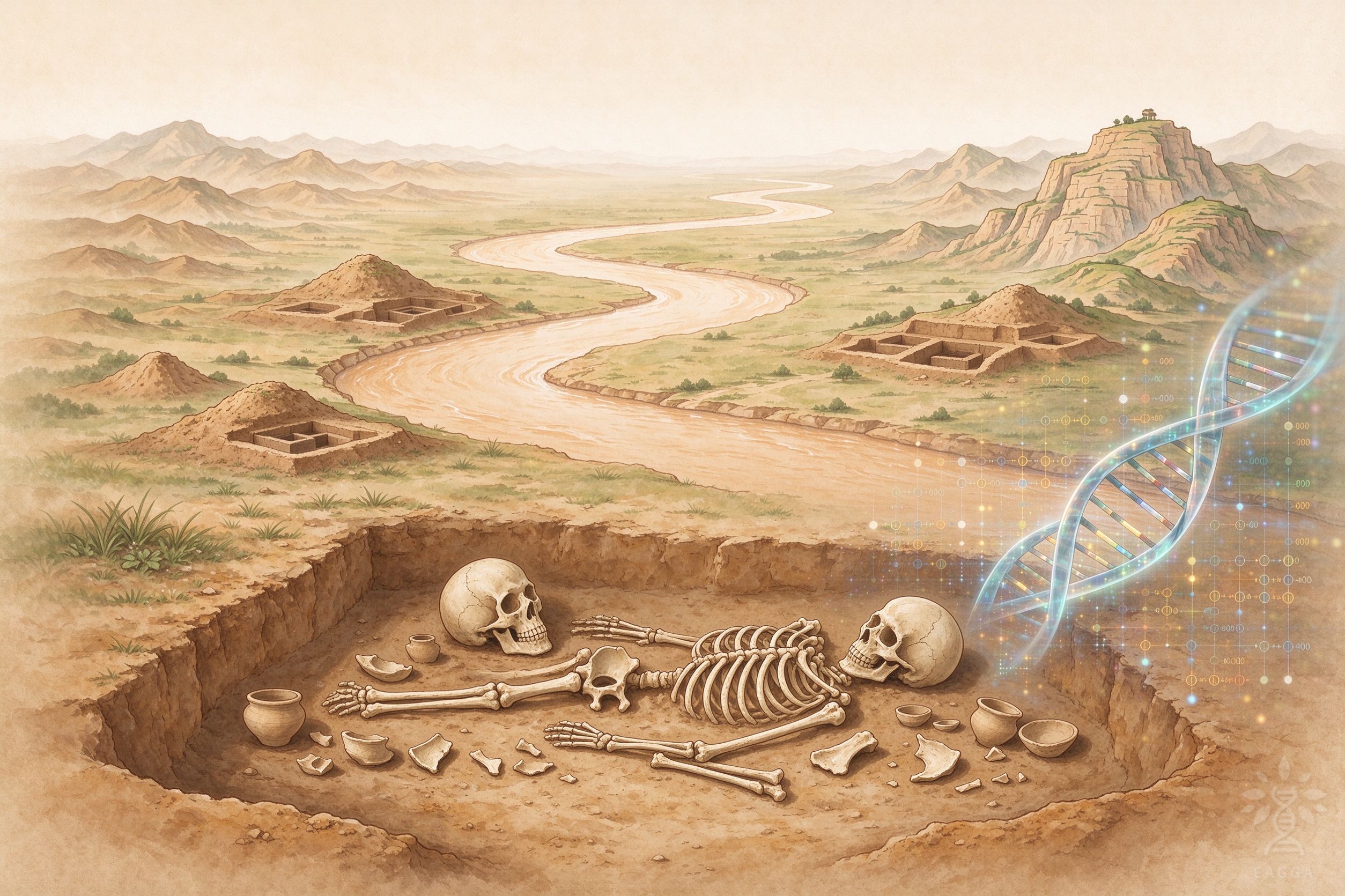
One river, four thousand years of people. The middle and lower Yellow River basin—from Henan to Shandong—is where East Asian agriculture began, where complex societies emerged, and where early civilization grew. Yet it is also a region ancient DNA studies had long failed to read at fine resolution. In October 2026, a study in Cell Reports drew on genome-wide data from 61 ancient individuals (c. 4,500–200 years before present) from three sites—Dahecun in Henan, and Xigao and Chaocheng Sanliyingnan in Shandong—to sketch, for the first time at comparatively high time resolution, the population history of this land.
Why the middle and lower Yellow River? Around 10,000 years ago, foxtail millet and broomcorn millet were domesticated here, grounding an economy built on dryland farming. Yangshao, Longshan, Erlitou, Shang and later dynasties followed in sequence, forming East Asia\’s most continuous cultural sequence. But cultural continuity does not mean a static population. Archaeologists have long debated how the Central Plains interacted with its neighbors: Su Bingqi\’s \’star-scattered\’ model stressed parallel regional traditions, while Yan Wenming\’s \’petal-like\’ model saw a hierarchical structure centered on the Central Plains taking shape around 5,000 years ago. The question is whether cultural exchange was accompanied by migration and gene flow. Earlier ancient-DNA work on Yellow River populations focused on broad continuity between Middle Neolithic (Yangshao-related) and Late Neolithic (Longshan-related) groups. Whether the Henan core had internal genetic substructure, whether the Yangshao–Longshan transition saw detectable gene flow, and whether the genetic structure established in Shandong around 3,000 years ago persisted into modern Han populations—all remained open questions.
Data and methods: 112 skeletons, 61 genomes. The team sampled 112 human remains from the three sites and recovered genome-wide data for 61 individuals at an average coverage of 0.002×–1.6×. Radiocarbon dating shows the Dahecun individuals date to c. 4,800–4,500 cal. BP (Middle to Late Neolithic), while the Xigao and Chaocheng Sanliyingnan individuals span the Late Neolithic into historical periods. The analytical pipeline is comprehensive: AMS radiocarbon dating, postmortem-damage and contamination screening, pseudo-haploid genotyping on the 1240K SNP panel, mitochondrial and Y-chromosome haplogroup assignment, READ v.2 kinship analysis, and population-genetic tools including PCA, ADMIXTURE, qpWave, f4, outgroup-f3, qpAdm, TreeMix and admixfrog—a standard \’deep-read\’ pipeline for ancient genomes.
Finding one: the Central Plains Neolithic population was genetically homogeneous. The Middle-to-Late Neolithic Dahecun people were genetically homogeneous and closely related to contemporaneous Yellow River millet-farming populations. Beneath millennia of cultural turnover (Yangshao–Longshan–Erlitou), the Henan core rested on a stable local genetic base; changes in agriculture and pottery traditions did not bring large-scale population replacement.
Finding two: around 3,000 years ago, Shandong populations shifted toward Yellow River ancestry. By about 3,000 BP, the ancestry profile of Shandong individuals turned to a Late Neolithic middle-Yellow-River-related component—consistent with an eastward expansion of central Yellow River farming populations. Crucially, this profile persisted into historical periods, implying long-term genetic continuity in Shandong for millennia thereafter, with modern Shandong Han tracing their genetic foundations to this point.
Finding three: two Tang–Song individuals carried about 15% \’distant\’ ancestry. The study\’s most striking result comes from two Tang–Song individuals from western Shandong, who carried roughly 15% West Eurasian-related ancestry. The proportion is not trivial, yet it is not a sign of mass immigration—a more parsimonious reading is limited, low-intensity cross-regional gene flow through trade, garrisoning or individual migration. In the Tang–Song period, Shandong sat at the crossroads of land and water routes, and this \’distant ancestry\’ echoes the Silk Road trade and relay-station traffic recorded in the historical texts.
Significance: agriculture spread, cultural interaction and migration are being recalibrated. The study adds fresh calibration to the old question of whether cultural diffusion traveled with people. In the Central Plains core, the answer is \’cultural change, population continuity\’; in Shandong, a clear eastward expansion of farming populations followed by long-term stability; in Tang–Song western Shandong, limited but real cross-regional gene flow. Together these form a layered population history for the middle and lower Yellow River—local continuity at the base, regional expansions as the variable, and distant ancestry dotting the historical periods.
The authors acknowledge the limitations: 61 genomes remain sparse across four millennia; the two Tang–Song individuals from western Shandong are too few to determine the range and depth of West Eurasian ancestry in the region; and historical-period samples from the Henan core remain to be added. Denser time-sampling in the middle and lower Yellow River—especially town and village cemeteries from the Tang–Song period onward—would make this \’mother river\’ population history far more three-dimensional.
A note for genetic-genealogy enthusiasts: when you see your autosomal ancestry composition in a database, or trace your family records back to Shandong or Henan, this study offers a temporal coordinate—your East Asian ancestry components may have been rooted in this soil as early as the Yangshao and Longshan eras 4,000–5,000 years ago. And if your family history carries tales of the Western Regions or the northern steppe, those two Tang–Song individuals are a reminder that historical-period \’distant genes,\’ though dilute, were real.