Four and a Half Millennia on the Yellow River: 61 Ancient Genomes from the Central Plains and Shandong Rewrite a Regional Story
2026年10月16日
Three Hundred Pages of an Ancestral Scroll, Now in the Cloud: How One Overseas-Chinese Village Digitized Its Genealogy for Root-Seekers Worldwide
2026年10月16日The ‘Silk Road’ Written in Paternal DNA: How More Than a Thousand Y Chromosomes Rewrite Northwest China’s Population History—and the Hui
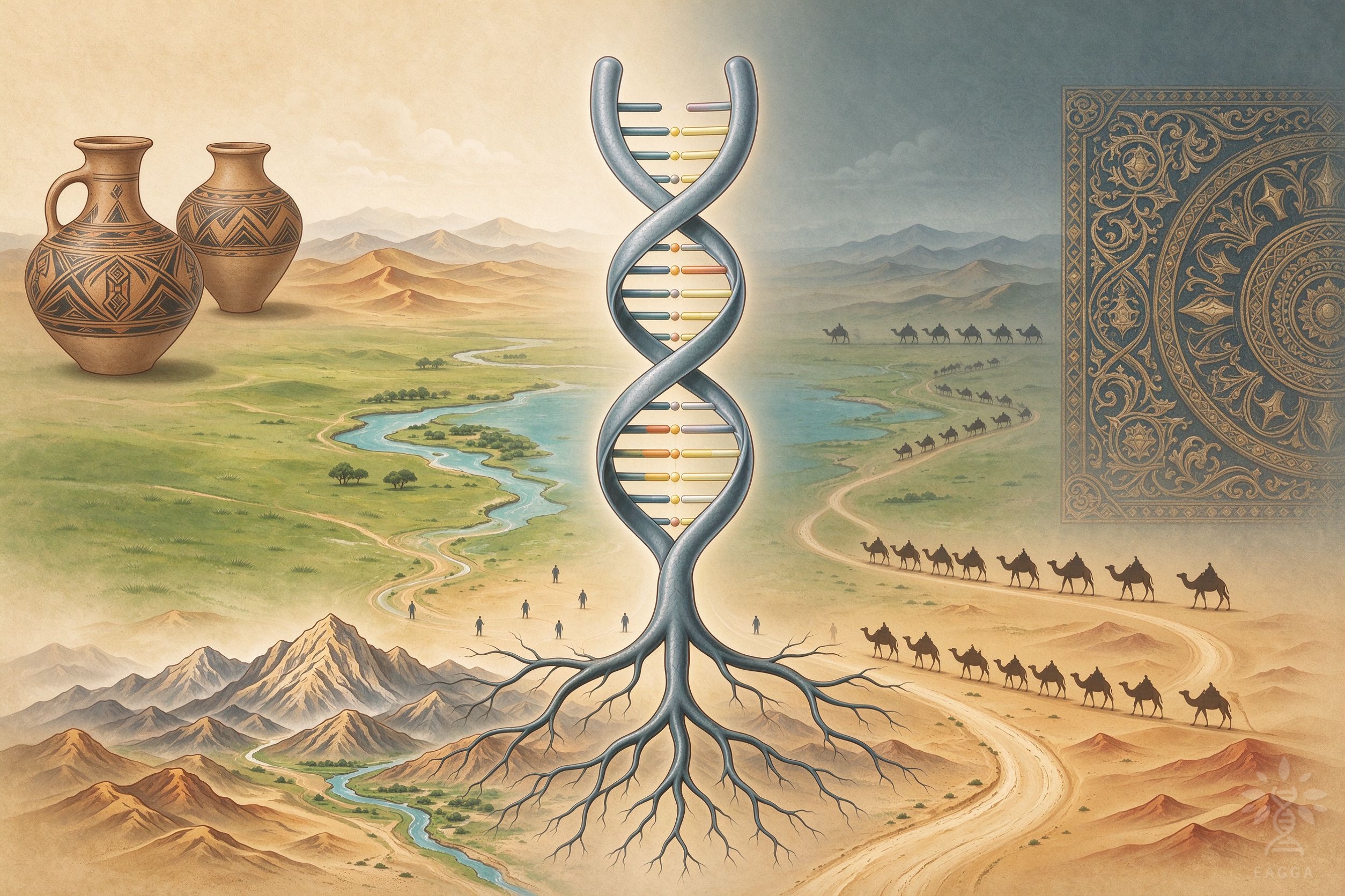
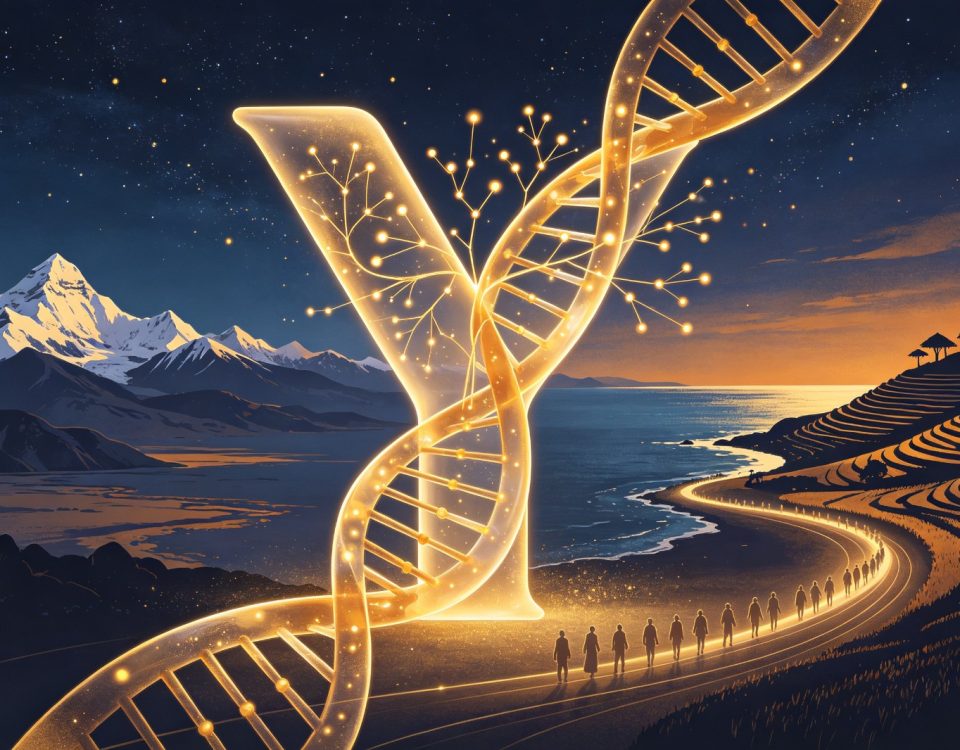
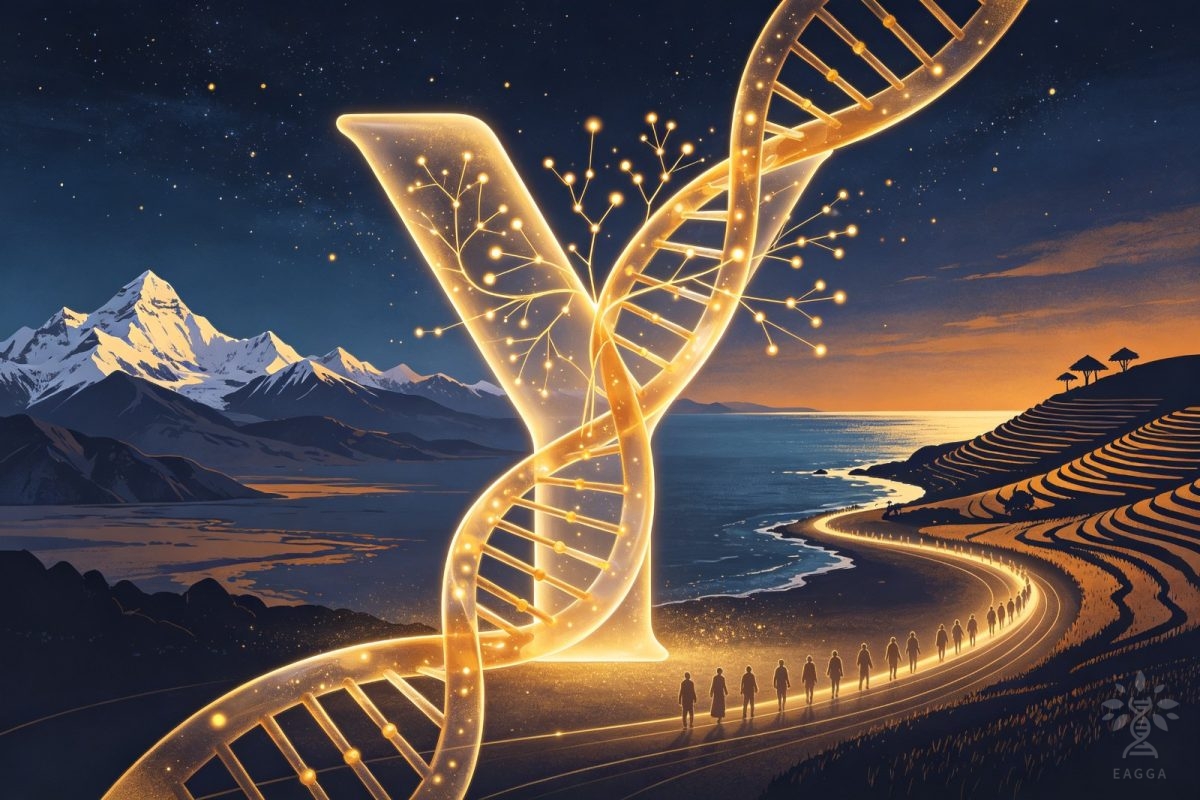
In human genetics, the Y chromosome is a paternal archive—passed from father to son with almost no recombination. On 2 October 2026, Science Advances published a study led by Academician Liu Chao of Jinan University, with teams from Sichuan University (Professors Ying Binwu, Dong Haohao and Associate Researcher He Guanglin), Chongqing Medical University (Professor Wang Mengge) and others, tackling a long-blurred question: how trans-Eurasian steppe herders and barley farmers shaped paternal genomic dynamics in Northwest China and contributed to the formation of the Hui people.
The data foundation: 1,053 newly sequenced genomes plus 3,301 Y-chromosome sequences. Building on the newly generated \’Yanhuang cohort\’ of 1,053 whole-genome sequences and integrating 3,301 Y-chromosome sequences from across the globe, the team constructed a paternal phylogeny spanning Eurasian space and time. On this framework they identified 15,810 previously unreported variants, sharply improving the resolution of the Y-chromosome tree—which in turn lets researchers place ancient Eurasians on the phylogeny far more accurately and trace their paternal origins.
Three layers of gene flow: from the Bronze Age to the Iron Age. The analyses show that paternal composition in Northwest China changed not once but in at least three successive trans-Eurasian pulses. Bronze Age Xinjiang populations were dominated by Xiaohe-related local lineages or western steppe herder lineages; from the Iron Age onward, paternal contributions from East Asian farmers, eastern steppe pastoralists, and Southwest/Central Asian farmers increased. This is not the single outcome of one mass migration but a multi-wave flow spanning centuries to millennia—closely matching the timing of trade, garrisoning and agro-pastoral interaction along the Silk Road.
Altaic-speaking peoples: an Iron Age echo in the paternal tree. Modern Altaic-speaking populations show strong paternal continuity with Iron Age ancestry. In other words, the paternal lineages of today\’s Altaic speakers can be traced back in large part to a genetic landscape already in place during the Iron Age. Northwestern Han, meanwhile, display a west-to-east gradient of paternal lineages—the farther west, the more West Eurasian-related paternal components; the farther east, the more dominant the East Asian ones.
Four Hui subgroups: one people, multiple paternal sources. Using the largest Hui paternal dataset to date, the study reveals a markedly differentiated paternal structure within the Hui: northwestern Hui carry the strongest West Eurasian-related paternal influence; northeastern and central Hui harbor higher proportions of western herder or barley/wheat farmer-related lineages; and the paternal profile of Lingnan Hui is largely consistent with local populations. This \’north-strong, south-weak\’ gradient is read as the coexistence of two formative mechanisms. In the north, demic diffusion contributed more—incoming paternal lineages entered through trade and military networks and were locally amplified. In the south, cultural diffusion dominated: Hui identity formed mainly through the local spread of faith and culture, with limited external paternal gene flow.
Male-mediated gene flow: a \’scissors gap\’ between paternal and autosomal ancestry. The study also notes a telling pattern: some northwestern Hui individuals show predominantly East Asian autosomal ancestry while retaining substantial West Eurasian Y-lineages. This \’western Y, eastern autosome\’ combination points to male-mediated gene flow. In societies organized around patrilocal residence and lineage-based kinship, male migrants arriving through trade, military and garrison networks could preserve and amplify their Y chromosomes even when their overall autosomal contribution stayed modest.
A mosaic model: one land, several historical processes. The paper\’s core conclusion is a mosaic model: trans-Eurasian flows introduced paternal lineages into Northwest China at multiple times, and each region\’s demographic history decided whether those lineages were absorbed, amplified, or diluted. Northern Hui, Altaic-speaking populations and northwestern Han retain substantial West Eurasian paternal imprints; the south relied more on cultural transmission. This picture echoes the broader pattern from East Asian ancient DNA studies—Neolithic farming expansions accompanied major demographic change, while later cultural diffusion often spread with fewer genome-wide alterations.
Significance and outlook: paternal phylogenies are becoming a high-resolution recorder of Eurasian exchange. For genetic genealogy and family-history practice, the resource\’s value lies in testability: when a northwestern family obtains haplogroup and branch information from a Y-chromosome test, it can be checked against this time-calibrated phylogeny to estimate time to most recent common ancestor and search for geographic clues. As the authors note, combining high-resolution Y data with autosomal DNA, mtDNA and densely sampled ancient remains from the Hexi and Tianshan corridors—together with refined historical context—will be essential to define more precisely the timing, scale and sex bias of these paternal contributions.
From the local lineages of the Bronze Age Xiaohe cemetery, to the infiltration of Iron Age steppe herders, to the western imprints in the paternal trees of today\’s Hui and Han—every Y chromosome is a piece of \’Silk Road\’ testimony written into the genome. They remind us that the boundaries of populations formed earlier, and are harder to erase, than the boundaries of language or faith.