

Popular Science: High-Coverage Genomes of an 8,300-Year-Old Jomon Woman and a 2,300-Year-Old Yayoi Man Reshape East Asian Ancestry
2026年8月16日
Industry News: Ancient DNA and Isotopes Reveal a “Third Pathway” of Millet Farming in Northern China
2026年8月22日First Denisovan Leg Bones Found in Taiwan Strait: Penghu Femur and Tibia Suggest Height up to 1.9 m
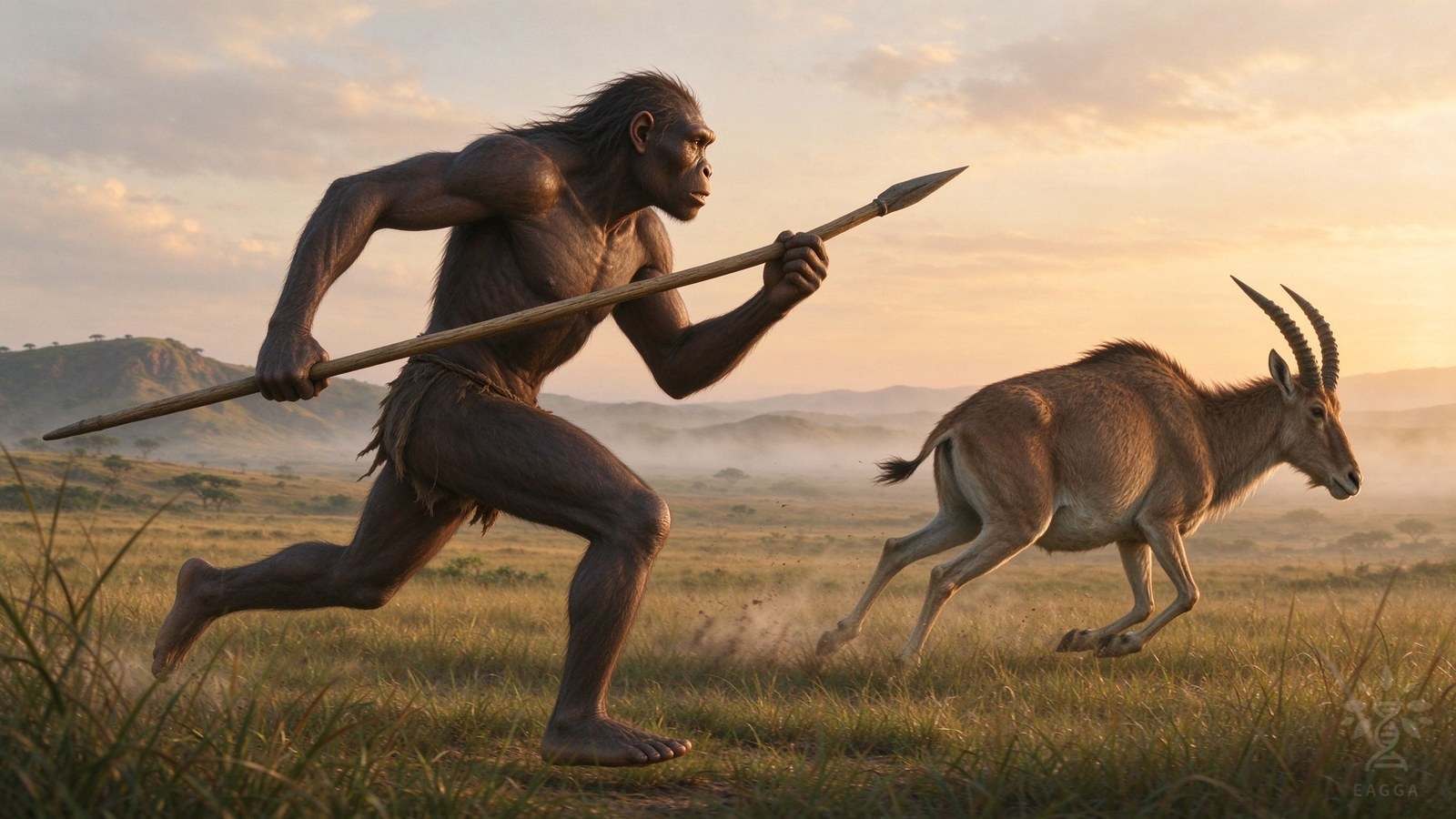
In 2010, fishermen trawling the seabed of the Penghu Channel in the Taiwan Strait hauled up a collection of fossils, including two human leg bones that would spend the next decade and a half in museum storage, their identity unknown. In August 2026, a joint team from the University of Tokyo and Taiwan’s National Museum of Natural Science delivered the answer: the bones belong to a Denisovan — the first Denisovan lower-limb remains ever confirmed, adding the first piece of the puzzle “below the neck” for this enigmatic human lineage.
Penghu 2 and Penghu 3: leg bones from the seafloor
The two specimens — a proximal femur (Penghu 2) and a tibia (Penghu 3) — were recovered by fishermen from the seabed of the Penghu Channel, tens of metres below the surface. Lacking a clear stratigraphic context and having spent millennia in seawater, the bones preserve little usable ancient DNA for conventional genome sequencing. The team therefore turned to palaeoproteomics, extracting amino-acid sequences from collagen preserved in the bone — proteins survive degradation far better than DNA and permit molecular identification even without DNA. The analyses identified a Denisovan-specific collagen variant in both specimens and placed them in the same molecular cluster as known Denisovan fossils. Radiocarbon dating of associated fossils from the same channel suggests an age of roughly 45,000–43,000 years ago, not long before Denisovans are thought to have disappeared.
Striking stature: possibly close to 1.9 metres tall
What surprised the researchers most was the sheer size of the bones. Based on morphometric reconstruction, the Penghu 2 femur is estimated at about 491 mm long, corresponding to a stature of roughly 180 cm and a weight of about 83 kg; the Penghu 3 tibia would measure about 432 mm when complete, with its owner possibly reaching about 190 cm and 91 kg. These figures place the Penghu Denisovans among the largest-bodied hominins known from the Pleistocene — about 20–30 cm taller and 20–30 kg heavier than estimates for Homo erectus from Zhoukoudian, and far larger than contemporaneous modern humans in the same region.
The finding challenges a long-standing expectation in palaeoanthropology known as Bergmann’s rule, which predicts that populations living farther from the equator tend to be larger-bodied, while those near the tropics — Penghu lies at roughly 23° N — tend to be smaller. The team suggests the Denisovans’ unusually large stature may instead be tied to their meat-based diet and hunting strategy: isotopic evidence shows that the Penghu 3 individual heavily relied on meat, and Denisovan populations on the Tibetan Plateau exploited a wide range of animal species, including megaherbivores and carnivores.
The puzzle of modern-like traits: femoral pilaster and gene flow
The Penghu 2 femur also displays a pronounced ridge on its back surface — a pilaster typically associated with the highly mobile lifestyle of Upper Paleolithic modern humans and extremely rare in archaic hominin femora. The researchers propose two possibilities: behavioural convergence — Denisovans likewise possessed the capacity for long-distance terrestrial mobility — or gene flow with early modern humans, consistent with prior genetic evidence of introgression between Denisovans and anatomically modern Homo sapiens in Asia. Either way, the femur suggests that some 45,000 years ago, Denisovans and modern humans may have coexisted and interacted across East Asia.
From Siberia to the Taiwan Strait: the Denisovan range
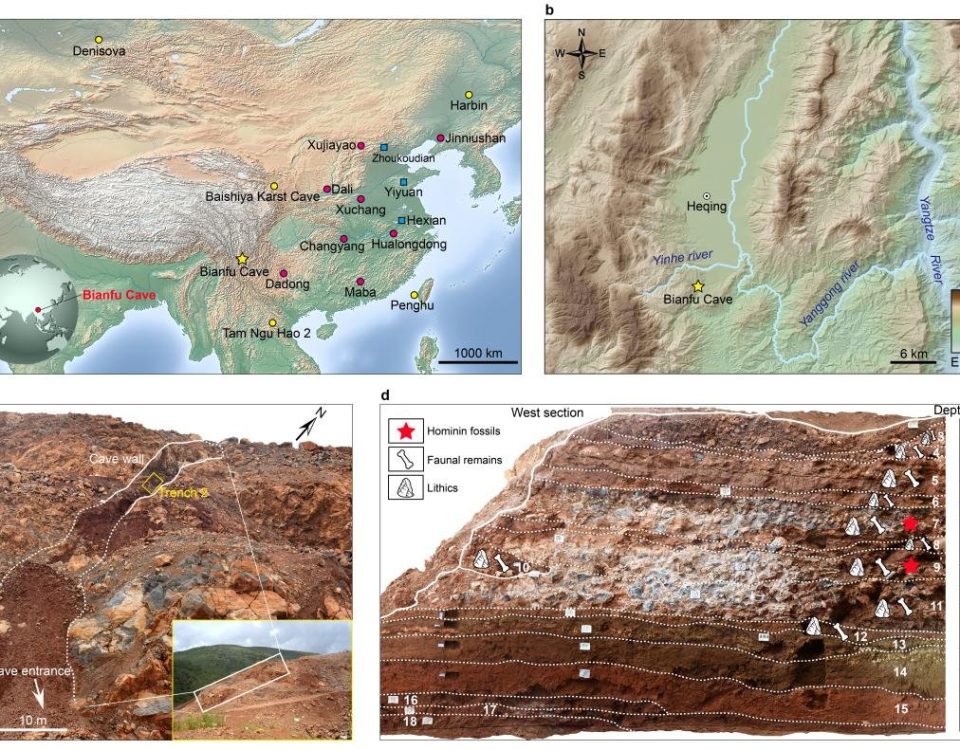
Denisovans were first identified in 2008 from DNA in a finger bone from Denisova Cave in Siberia; they form a sister group of Neanderthals, the two lineages splitting around 400,000 years ago. Molecular evidence later confirmed the Xiahe mandible from the Tibetan Plateau (~160,000 years old) and the Harbin cranium (“Dragon Man”) as Denisovan, while the Penghu 1 mandible (published in Science in 2025) brought Denisovans to an East Asian island for the first time. The confirmation of the Penghu 2 and Penghu 3 leg bones extends this lineage’s range from cold highlands to the subtropical Taiwan Strait, demonstrating remarkable adaptability across diverse climates. Today, populations in Southeast Asia and Oceania retain variable Denisovan ancestry — in Papuan New Guineans, Denisovan DNA can account for up to 5% of the genome.
A note on status
The two related studies are currently available as preprints on bioRxiv and have not yet completed peer review; their conclusions should be regarded as preliminary scientific evidence. That said, the research combined multiple independent approaches — palaeoproteomics, morphometrics, radiocarbon dating and stable isotopes — and has been highlighted in a Science news feature.
Research credit: University of Tokyo (Yousuke Kaifu) and the National Museum of Natural Science, Taiwan (Chun-Hsiang Chang), with collaborating teams; released August 2026.