
Industry News: Ancient DNA and Isotopes Reveal a “Third Pathway” of Millet Farming in Northern China
2026年8月22日
Why the Chuandong Cave Site Reshapes Our Picture of Prehistoric Human Interaction
2026年9月4日149 ancient genomes reveal how wheat agriculture reached Gansu as technology transfer, not mass migration
Between roughly 5,000 and 4,000 years ago, domesticated plants and animals—barley, wheat, millet, cattle and sheep—flowed in both directions across the Eurasian continent, building an early system of transcontinental agriculture and pastoralism. Gansu, in northwest China, sits at the convergence of the Loess Plateau, the Tibetan Plateau and the Mongolian Plateau, making it a key corridor in this prehistoric exchange. But a long-standing question has faced archaeologists and geneticists alike: did barley, wheat, cattle and sheep appear in Gansu through the spread of culture and technology alone, or did they arrive with migrating populations?
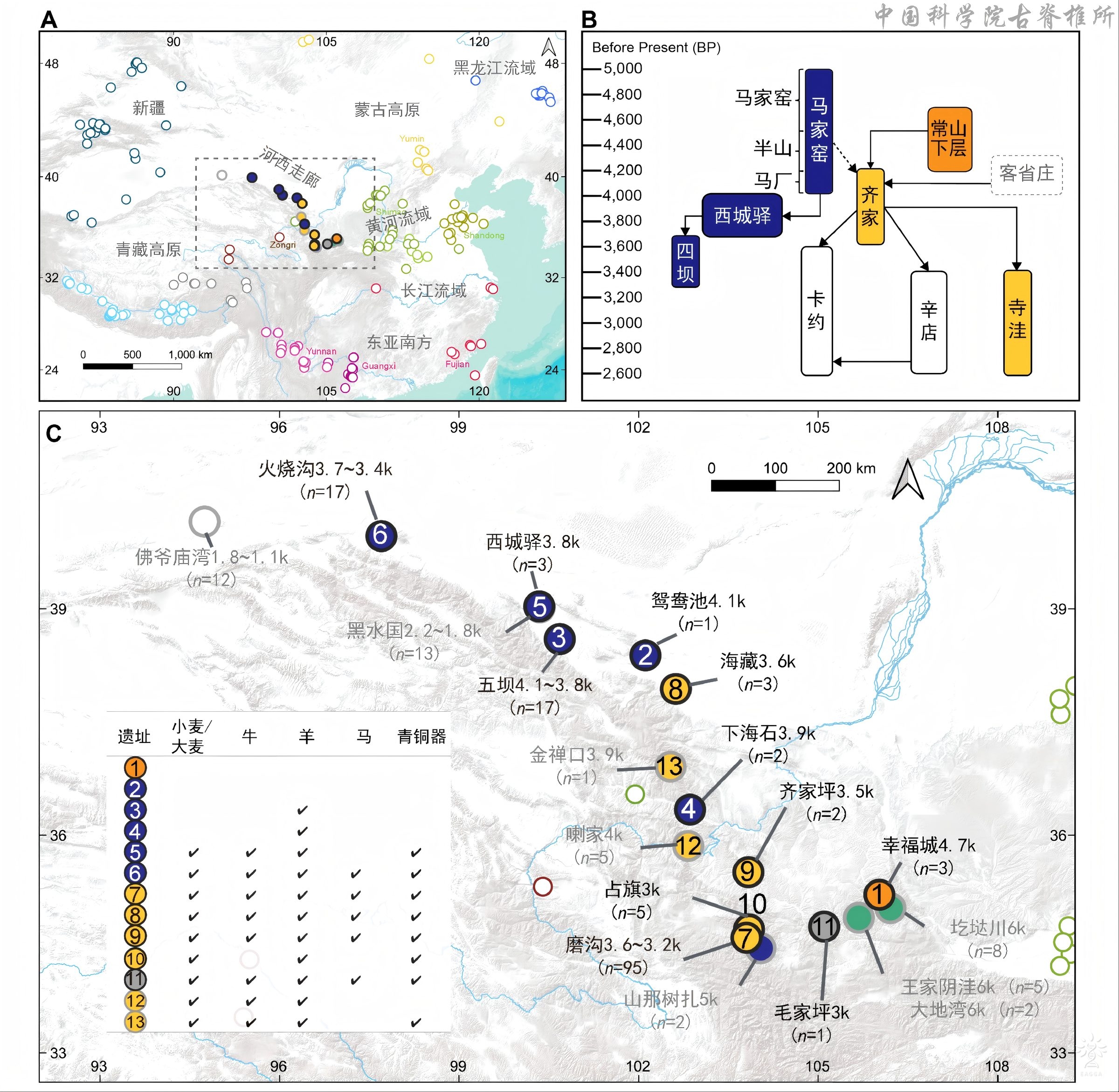
A 12-year effort: 149 ancient genomes from 11 sites
On 3 September 2026 (Beijing time), the journal Cell published online a major study led by Qiaomei Fu’s research team at the Institute of Vertebrate Paleontology and Paleoanthropology (IVPP), Chinese Academy of Sciences, in collaboration with the Gansu Provincial Institute of Cultural Relics and Archaeology, the Department of Cultural Heritage and Museology of Fudan University, the Department of Anthropology of the University of Washington, the National Centre for Archaeology, and the School of Cultural Heritage of Northwest University: “Genomics and social practices at Mogou and other Gansu sites during prehistoric trans-Eurasian exchange”.
Over 12 years, the team recovered 149 ancient human genomes from 11 Gansu sites, dating to roughly 4,700–3,000 years ago, including 95 genomes from the Mogou cemetery. Combining cutting-edge palaeogenomic methods with deep interdisciplinary evidence from archaeology and anthropology, the study reveals for the first time the genetic history and social structure of Gansu populations in the context of prehistoric trans-Eurasian exchange.
Key finding I: Wheat-based agriculture arrived as “technology transfer”, not large-scale migration
In sharp contrast to Europe and Central Asia, the genetic analysis delivered a surprising answer. In ancient Europe, the arrival of Fertile Crescent domesticates was directly linked to the large-scale expansion of Anatolian farmers, and the Bronze Age Yamnaya expansion carried horses and wheeled technology across the steppe. In Gansu, however, although most sites had already adopted wheat-based agriculture, cattle, sheep or bronze by 4,700–3,000 years ago, multiple genetic analyses found no trace of Western ancestry in any sample from this period or in contemporaneous neighbouring samples.
This key result shows that wheat-based agriculture and associated technologies probably reached Gansu without a large-scale influx of people from the west—the crops and technologies diffused culturally, while the local population was not replaced. This contrasts markedly with the European and Central Asian pattern, where agriculture and bronzes arrived with large expansions of farming populations.
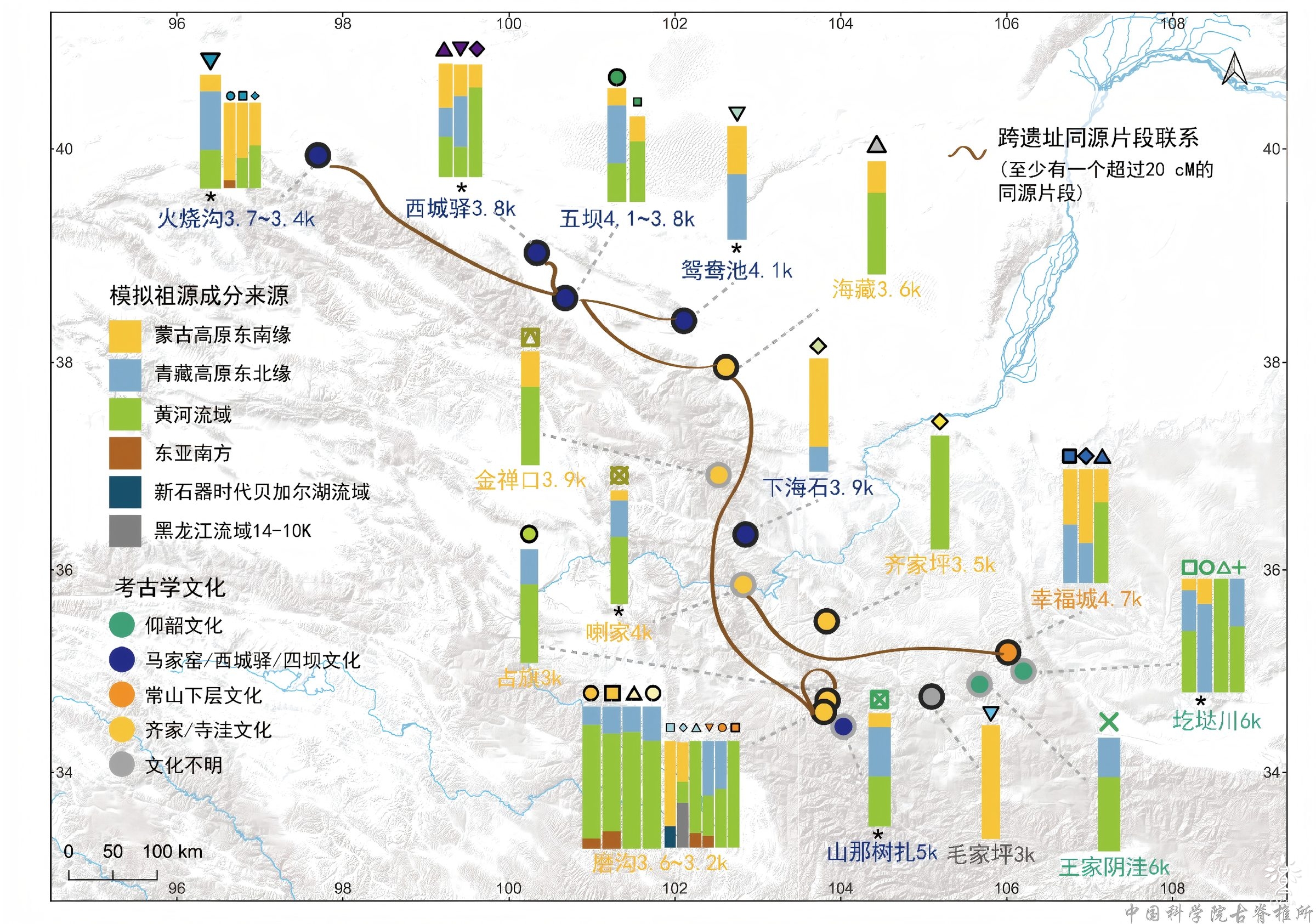
Key finding II: Gansu populations were predominantly of ancient Northeast Asian ancestry
People in Gansu between roughly 4,700 and 3,000 years ago carried predominantly ancient Northeast Asian ancestry, drawn mainly from ancient Yellow River populations, populations related to the Yumin culture of the southeastern Mongolian Plateau, and populations from the northeastern Tibetan Plateau. A few individuals also carried small amounts of ancestry related to Neolithic Baikal populations.
Drawing on archaeological evidence for routes of agricultural spread, the team suggests that Fertile Crescent domesticates may have reached Gansu through cultural diffusion along the Inner Asian mountain corridor, or through steppe corridors via intermediate populations; confirming the exact routes will require more archaeological and genetic evidence.
Key finding III: Archaeological cultures and genetic profiles do not map strictly onto each other
During this period, Gansu developed complex and distinctive regional archaeological cultures, with differentiation, collision and fusion among them and lively interaction with neighbouring cultures. Genetic analysis shows a partial link between ancestry and archaeological culture: most Qijia and Siwa culture individuals are relatively closer to Yellow River populations, consistent with the archaeologically documented “east-to-west” cultural trend of early Gansu Neolithic–Bronze Age cultures; meanwhile, most individuals of the contemporary Majiayao, Xichengyi and Siba cultures, or the slightly earlier Changshanxiaceng culture, are closer to populations of the southeastern Mongolian Plateau and the Tibetan Plateau.
However, most ancestry components are already widely distributed and mixed across Gansu populations, some sites contain a few outlier individuals, and some sites—whether of the same or different cultures—may share genetic segments. This illustrates the complexity of cultural diffusion and human mobility: the two do not correspond strictly, and independent research into cultural and genetic history remains essential.
Key finding IV: The Mogou cemetery reveals a social structure never seen before
The Mogou cemetery (c. 3,600–3,200 years ago) is one of the largest excavated cemeteries in China to date, with more than 1,700 tombs, spanning from the Qijia culture to the Siwa culture. Integrating kinship, biological sex, mitochondrial and Y-chromosome haplogroups and genetic grouping, the team built a genetic kinship network for the Mogou sample.
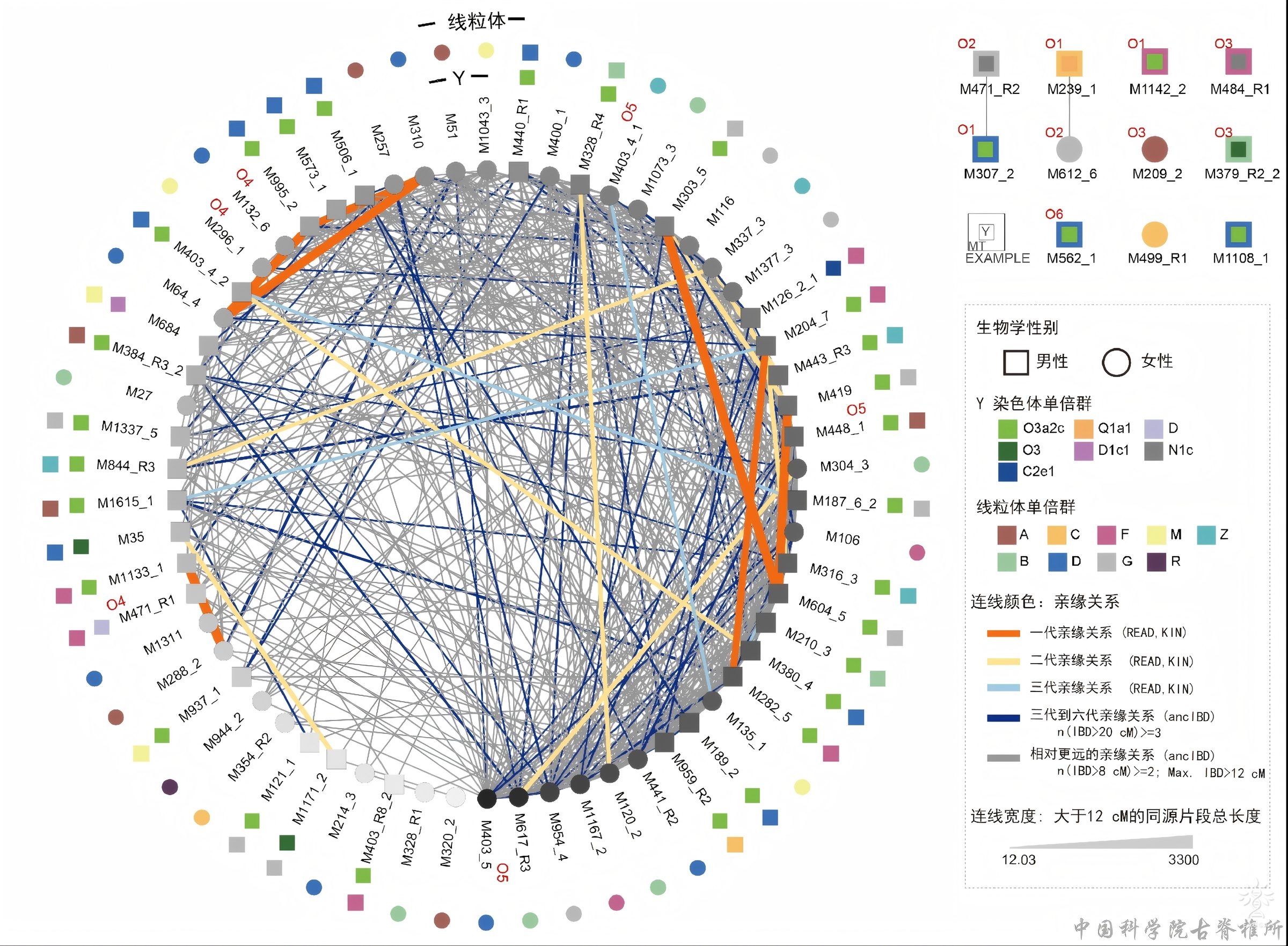
The study documents for the first time worldwide a social structure that differs from previously reported European and East Asian cases: individuals at Mogou were widely connected by biological kinship, yet endogamous marriages were limited, with no clear sex bias; neither kinship ties nor burial time served as the key factor in joint burial. Although a few possible outsiders at Mogou hint at small-scale contact with other regions, the main population remained genetically stable and internally well connected through long-term use and cultural succession.
On marriage patterns, the Mogou sample includes a few cases of endogamy—including offspring of second- or third-degree relative unions—alongside possible exogamous practices. Importantly, genetic relatedness between male and female samples at Mogou shows no significant difference. This stands apart both from societies practising female exogamy and virilocal residence (where males are more closely related) and from reported societies practising male exogamy and uxorilocal residence (where females are more closely related). The authors suggest that marriage and residence patterns at Mogou may have shown no clear sex bias—a complex and distinctive social practice.
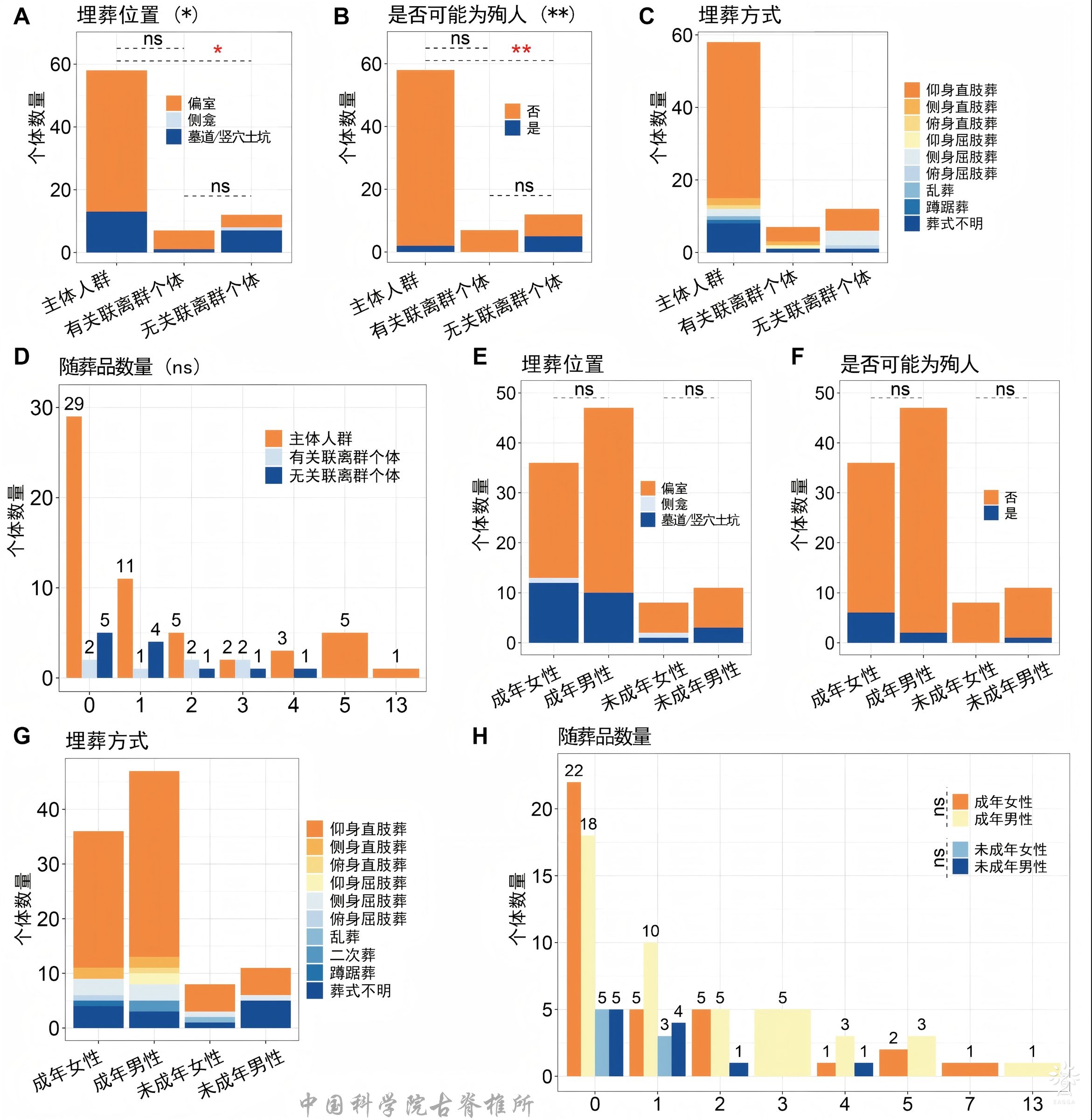
Why does this study matter?
The significance of this study is multi-layered. First, it answers—with large-scale ancient genomic data—the global question of whether agricultural spread was driven by population movement or by technology transfer, in the Chinese context: prehistoric people in Gansu adopted foreign crops and technologies while retaining their local genetic core, providing scientific evidence for the continuity and independence of Chinese civilisation.
Second, the distinctive social structure of the Mogou cemetery is a global first, offering a fresh window into kinship, marriage systems, social hierarchy and burial customs during the increasing social complexity of prehistoric China, and showing that ancient social organisation was far more diverse than previously imagined.
Third, the team’s 12-year perseverance showcases the power of deep integration between palaeogenomics, archaeology and anthropology—genetic evidence can tell the “stories of people” beyond artefacts and sites, providing precious baseline data for the study of East Asian genetic lineages.
Source and further reading
Paper: Genomics and social practices at Mogou and other Gansu sites during prehistoric trans-Eurasian exchange. Cell, 2026.
News release: Institute of Vertebrate Paleontology and Paleoanthropology, Chinese Academy of Sciences, “Population diffusion or technology transfer? 12 years of ancient DNA research reveal the genetic history and social structure of prehistoric Gansu populations in the context of Eurasian exchange”.