

Who’s Afraid of Genetic Ancestry?
2024年7月23日
Re-understanding the Issue of Confucius’ Descendants from the Perspective of Genetic Genealogy
2026年5月11日Fudan-Led Study Reveals the Qiang’s Ancient Yellow River Ancestry and Two Divergent Admixture Histories
On January 15, 2026, a team led by Professor Shuhua Xu of Fudan University, together with the Institute of Medical Biology at the Chinese Academy of Medical Sciences and other partners, published a paper in Science Advances titled “Ancient Yellow River ancestry and divergent admixture histories in the Qiang people.” It offers the first genome-wide portrait of how the Qiang originated in the Yellow River basin, diversified at the margin of the Tibetan Plateau, and were ultimately shaped by population admixture.
The Qiang are among the earliest-recorded peoples in Chinese historical sources. The character “者” already appears in Shang-dynasty oracle bone inscriptions dating back roughly 3,000 years, and later records such as the Records of the Grand Historian and the Book of the Later Han continued to document this ancient ethnonym. Yet until now, the Qiang’s genetic origins, internal structure, and adaptive history lacked direct molecular evidence.
A dual genetic structure: Han-like and Tibetan-like Qiang subgroups
Analyzing whole-genome data from 20 Qiang individuals in Maoxian, Sichuan, alongside published modern and ancient genomes from across Eurasia, the team found that the Qiang are not a genetically homogeneous people. They divide clearly into two subgroups: one genetically closer to Han Chinese (Qiang_H) and the other more similar to Tibetans (Qiang_T). This resonates with the observations of historian Wang Mingke during his fieldwork in western Sichuan, who described “sinicized” and “tibetanized” Qiang communities. Notably, the genetic divergence between the two Qiang subgroups exceeds that between northern and southern Han Chinese, pointing to long-term, stable differentiation within the Qiang. Admixture and ancestry-fragment analyses confirm that asymmetric gene flow between Han and Tibetan populations was the key driver of this internal division.
Tracing 5,300 years: a common ancestor on the Yellow River
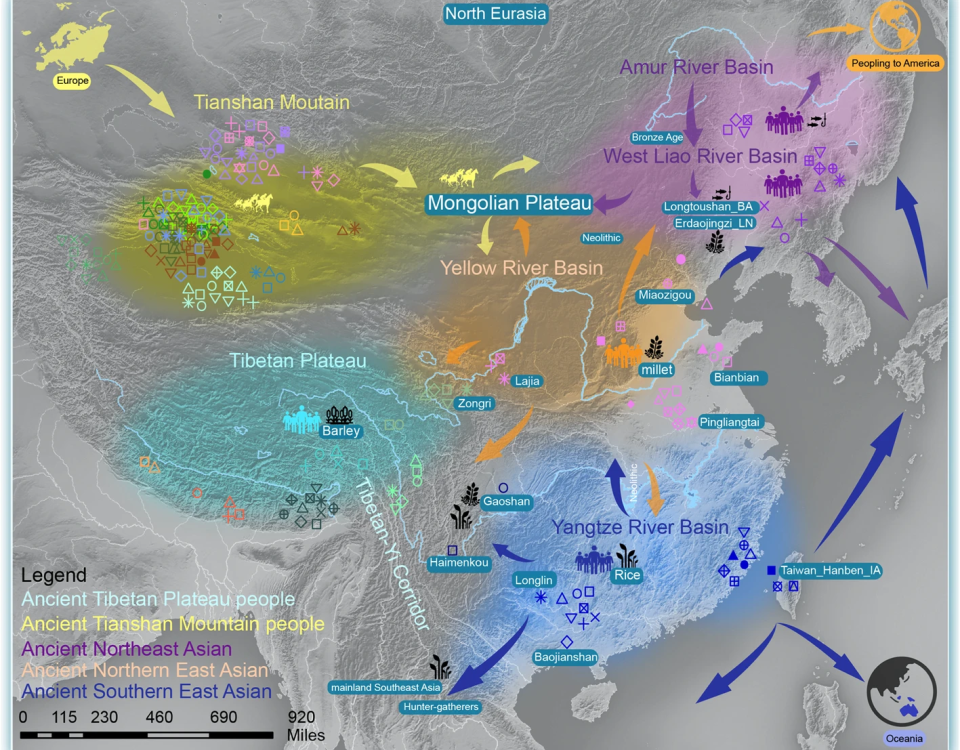
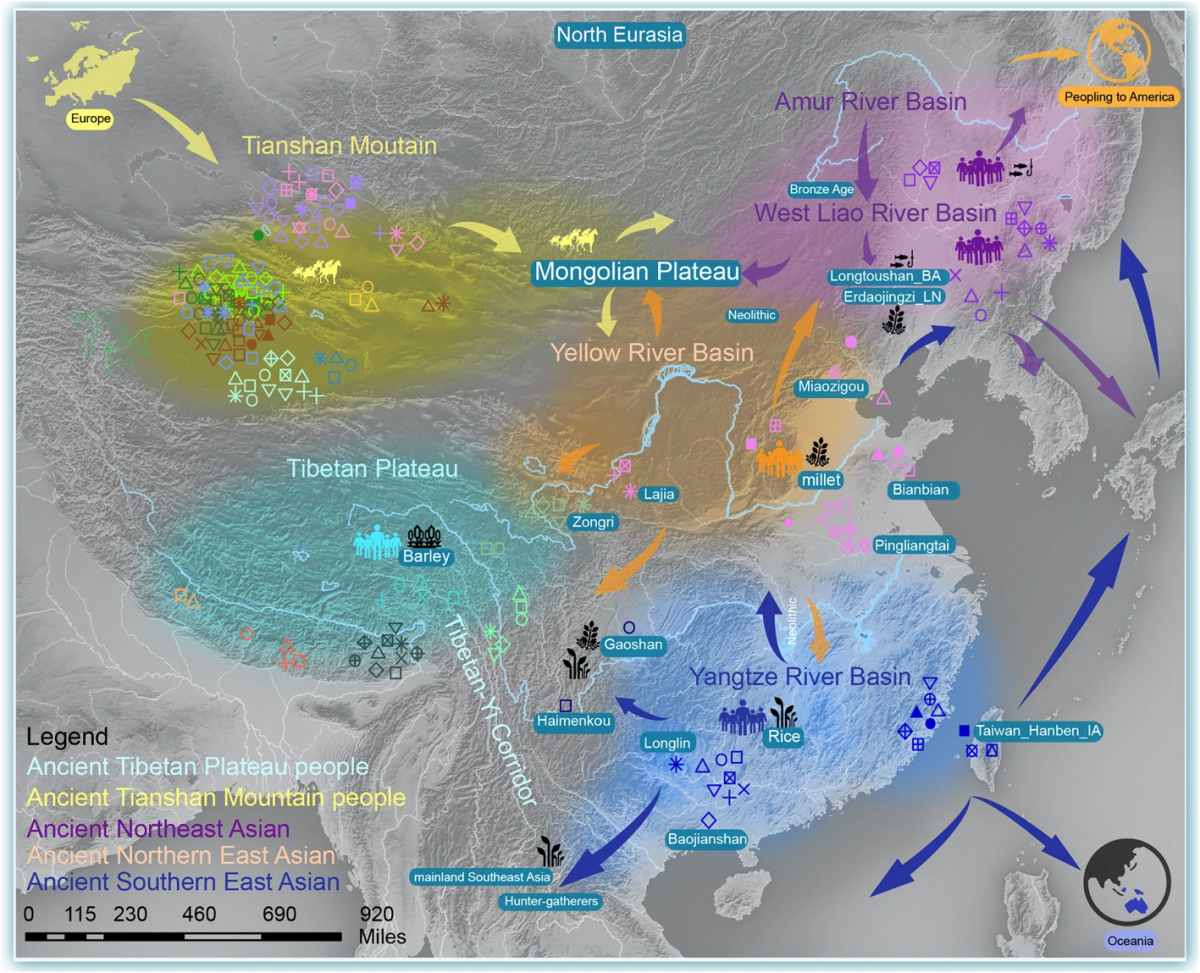
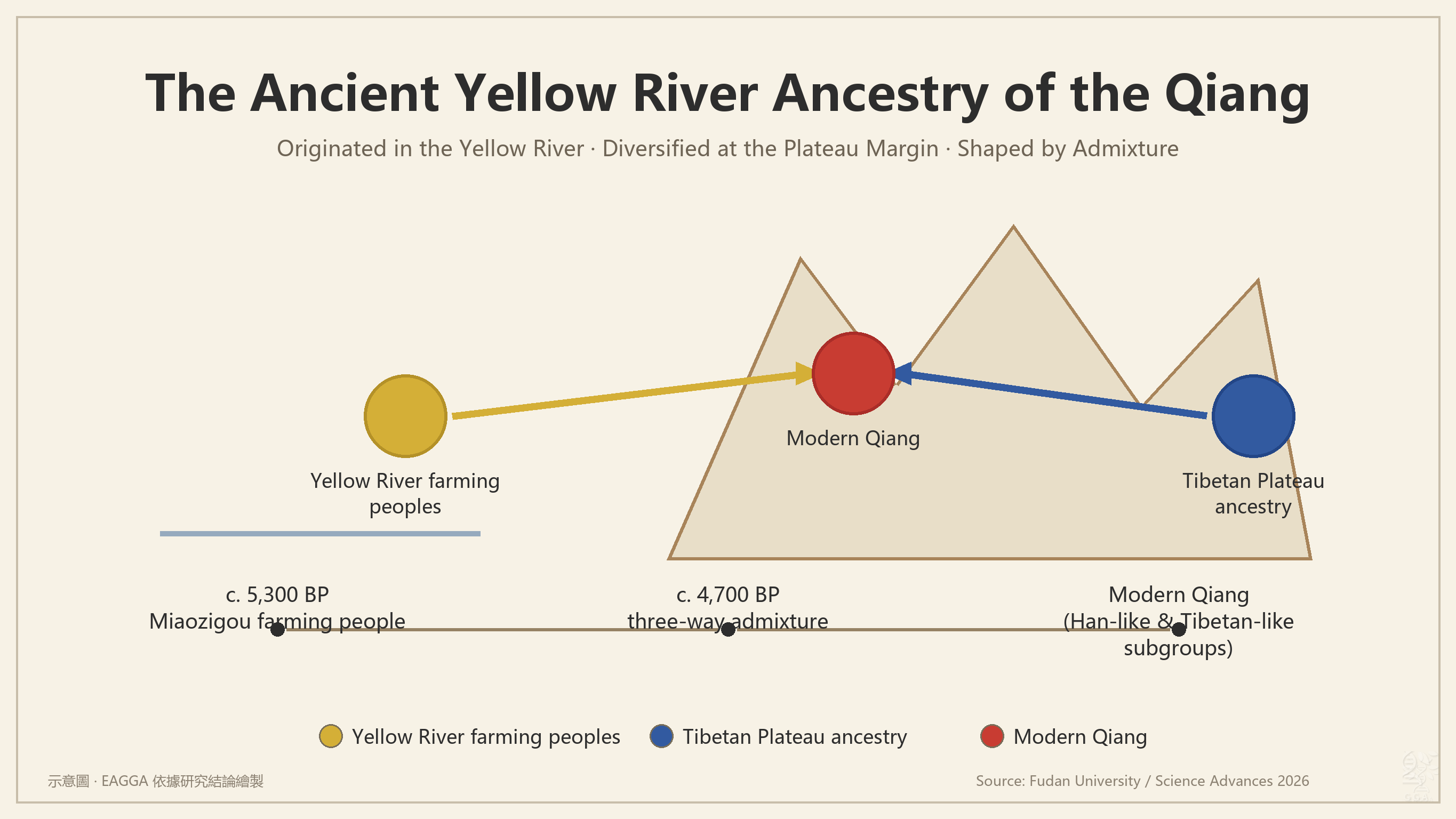
To trace the Qiang’s deeper origins, the team integrated roughly 450 ancient genomes from East Asia and neighboring regions spanning the past ~40,000 years. Both Qiang subgroups show their closest genetic affinity to Neolithic farming populations of the middle and upper Yellow River. Among them, the Miaozigou culture people (~5,300 years before present) share the strongest affinity and nearly identical genetic drift with the Qiang, identifying them as the most recent common ancestor before the Qiang diverged—corroborating at the molecular level historical records that the Di-Qiang originated along the Yellow River.
c. 4,700 years ago: the fusion of three ancestral lines
Admixture modeling suggests that the Qiang ancestral population formed around 4,700 years ago from a three-way mixture of ancient Yellow River ancestry (represented today by Han Chinese), ancient Tibetan Plateau ancestry (represented by Tibetans), and a distinct “ancient Di-Qiang” component. The two subgroups then followed different paths. Qiang_H received repeated Han-related gene flow over the past two millennia, coinciding with events such as the large-scale population movements of the Wei, Jin and Northern-Southern Dynasties and Han migration into Sichuan during the Yuan and Ming periods. Qiang_T, by contrast, experienced more gene flow with Tibetan-related groups, likely linked to the expansion of the Tibetan Empire and the spread of Tibetan culture. This asymmetric gene flow cemented the genetic structure of the Qiang.
Environmental adaptation: an ancient lineage for high-altitude life
The two subgroups also differ significantly at functional loci. In Qiang_H, rapid-alcohol-metabolism variants of the ADH1B and ADH1C genes are markedly elevated, likely shaped by admixture and post-admixture selection. More strikingly, the team identified a missense variant (rs143216880, C>T) in ANKRD36 that is common among the Qiang, rare in Han Chinese, and almost absent in Tibetans and most global populations. The variant forms a distinctive haplotype in strong linkage with dozens of eQTLs. Given ANKRD36’s role in blood-pressure regulation, the authors suggest this haplotype may help the Qiang cope with chronic hypoxia at moderate-to-high altitudes by modulating ANKRD36 expression and protein structure. The variant traces back roughly 46,000 years in the Qiang—older than in other carriers such as Han and Yao—representing an exceptionally ancient genetic lineage preserved in East Asia.
Scientific significance
This study provides the first genome-wide account of the Qiang’s full genetic history, showing that beyond their deep ties to Han and Tibetan populations, the Qiang retain one of the most ancient genetic backgrounds in East Asia. The authors stress that medical-genetic research has long focused on majority populations, undervaluing minority ethnic groups such as the Qiang. Studies like this not only refine global models of human evolution but also open new perspectives for precision medicine and population-specific disease research.
Weishun Zeng (PhD student, Human Phenome Institute, Fudan University) and Professor Zhaoqing Yang (Chinese Academy of Medical Sciences) are co-first authors; Professor Shuhua Xu (Fudan University) and Professor Jiayou Chu (Chinese Academy of Medical Sciences) are co-corresponding authors. The study was supported by the National Key R&D Program, the National Natural Science Foundation of China, and the Shanghai Municipal computational biology program, with computational analysis supported by Fudan University’s CFFF intelligent computing platform.
Original paper: Science Advances (DOI: 10.1126/sciadv.ady6667)