Rome Changed the People, the Goths Changed the Rulers: 243 Ancient Genomes from Iberia
2026年11月17日Who Should Keep a Family Genealogy? A District Archive in Zaozhuang Now Holds a Hundred
In August 2022, the Xuecheng District Archives in Zaozhuang, Shandong, did something that looked unremarkable at the time: it issued a public call for family genealogies. Four years later that notice has become more than a hundred sets and over six hundred volumes of clan records, and a complete path from private donation to public exhibition.
The story begins with an absence. Before 2022, the archive held no formally accessioned genealogy at all. In the villages of southern Shandong, clan registers from the late Qing, the Republican era and recent decades mostly sat in private hands — locked in cabinets, pressed into the bottom of trunks, exposed to damp, insects and mould. As custodians changed generation by generation, many volumes quietly disappeared. For a district, that meant a large body of records about family migration, village formation and local figures was fading out of existence.
The archive’s answer was to lower the threshold. Staff held a planning meeting with local scholars of clan records and settled on a three-part approach: collect widely, ask little, activate later. A genealogy did not have to be complete or in good condition. It could come in first and be sorted afterwards. Once the call went out, the work ran through a network of the archive plus society: local media coverage, clan associations, family-culture research centres and local history enthusiasts each bringing in volumes one by one.
Four years on, the collection stands at more than 100 sets and 600-odd volumes, a jump from nothing that has gradually grown into a regional system of clan archives with a southern Shandong character. The holdings include large comprehensive registers such as the Huang and Feng clan genealogies, branch records such as the Yiyang Jia, Guteng Sun, Yiyang Shan and Zhang clan genealogies, lithographed editions from the Republican period and branch volumes compiled within the past two decades.
Bringing them in was only the first step. What followed was professional conservation: cleaning, removing mould, repairing damaged leaves, and cataloguing by lineage, locality and date, with each register’s edition, volume count, founding ancestor and branch distribution recorded. This is the least visible part of the work, and it decides whether the paper survives another century.
The third step is activation. On 8 January 2026 the archive opened an exhibition pairing its genealogical holdings with rubbings of rural stone inscriptions — hundreds of volumes of clan records from the Ming, Qing and modern periods on one side, and more than a hundred rubbings on the other, arranged in four sections on filial virtue, enduring stone, mountain inscriptions and the war years. Read together, the lineage and the village lock into each other: a register that notes an ancestor’s burial place as unknown may be matched by a stone that carries his name and year of death.
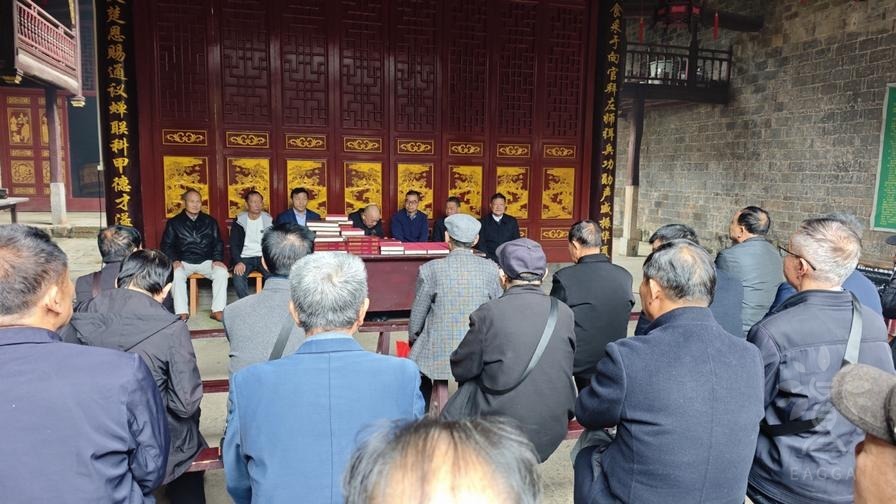
In May 2026 the archive held a donation ceremony and symposium under the title ‘One genealogy carries a family’s pulse; the archive nourishes its tradition’. Donors handed over their volumes, and a signature wall invited each family to write a line of household precept. Zhu Yingmin, donor of the Zhu clan genealogy of Donggushan in Zaozhuang and Xuecheng, described a genealogy as the root of a family. Zhang Liandong, donor of the Zhang clan genealogy of Xicun in Tengyang, said the archive gave scattered clan records a place where they could be both protected and put to use.
For a donating family, the practical benefits are easy to list. The volumes move into a temperature- and humidity-controlled stack, away from damp and insects. With an accession number, later generations no longer depend on one elder’s memory to find the book. The lineage can be cited by researchers rather than being taken out once a year at festival time. For the archive, what arrives is paper; what accumulates is a geography of surnames for a whole district.
The path has its difficulties. Collection runs on trust, and many families hesitate to hand over an original for fear of never seeing it again. Xuecheng’s solution is to leave the family its right of use while providing digital copies and a reading channel, and to accept deposit or scanning for those who will not donate. Once the boundary is clear, the volumes come in.
Set against the wider picture, Xuecheng is not an isolated case. In July 2026 Xiamen opened a cross-Strait root-seeking service centre at its municipal archive and began building a genealogy data platform that integrates tens of millions of genealogy records and more than 700,000 digitised volumes. In October 2026 Weifang opened its first comprehensive local-records museum together with a genealogy exhibition. On 14 November, Guilin and Yulin in Guangxi opened a month-long genealogy exhibition that traces the form’s evolution through six carriers: oracle bone, bronze, bamboo slips, stone inscriptions, paper and digital records. Public institutions are becoming the second home of private clan archives.
For an ordinary household, there is an immediately usable lesson. If an old genealogy is at home, do not rush to repair it, and do not reach for adhesive tape. Photograph or scan a digital copy, and note the title, the number of volumes, the founding ancestor and the date of the last revision. Then contact the local archive or local-records museum and ask whether it takes donations, accepts deposits or will scan on site. Most county-level archives have a collection mandate; the notice simply may not have reached the village.
A genealogy’s value has never lain in the paper. It lies in whether the next person can read it. What Xuecheng has done over four years is, plainly put, to turn a hundred registers that could only sit in cabinets into a hundred sets of material that can be consulted, cited and extended. Whether the names they record will prove useful to later research depends on how long this paper is kept.
Caption: Slipcases of the Yiyang Shan clan genealogy, held by the Zhongxiao Hall branch and now in the Xuecheng District Archives. Source: Jiapu Net.