
Know What Your Grandfather and Grandmother Each Passed to You—Without Testing Them? Inside Ancestry’s New Regions-by-Grandparent Feature
2026年10月16日
From a “Molecular Ghost” to a Recognizable Ancestor: How Paleoproteomics Identified the Xujiayao Hominins as Denisovans
2026年10月21日The 11,000-Year-Old “Millet Road”: Seven Ancient Genomes from Donghulin Point to a Local Origin for Early Millet Farming
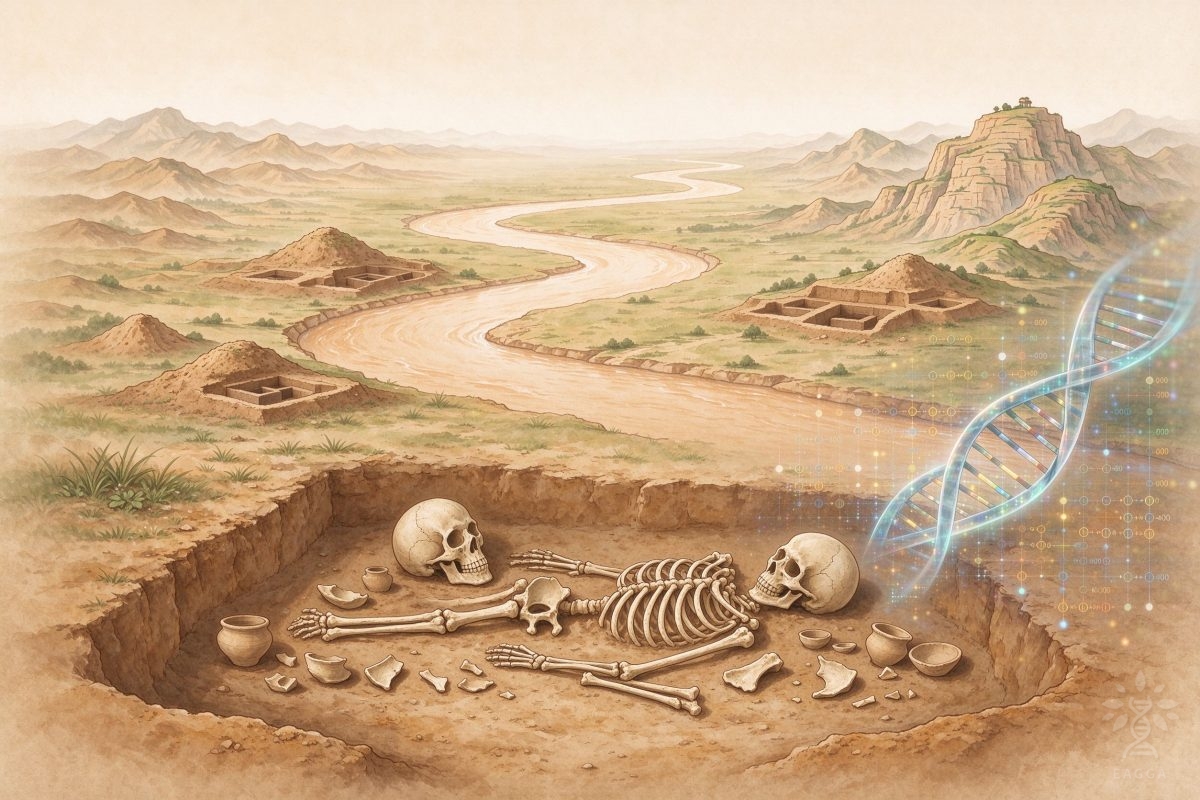
The rise of millet and foxtail millet agriculture transformed prehistoric lifeways across northern China and laid foundations for the development of East Asian civilization. But who were the earliest people to use and cultivate millet? And as early plant use intensified into full farming, was this process driven mainly by local communities, or by the arrival of migrant farming groups? For decades, these questions could not be answered decisively because direct genetic evidence from early millet-related populations was lacking.
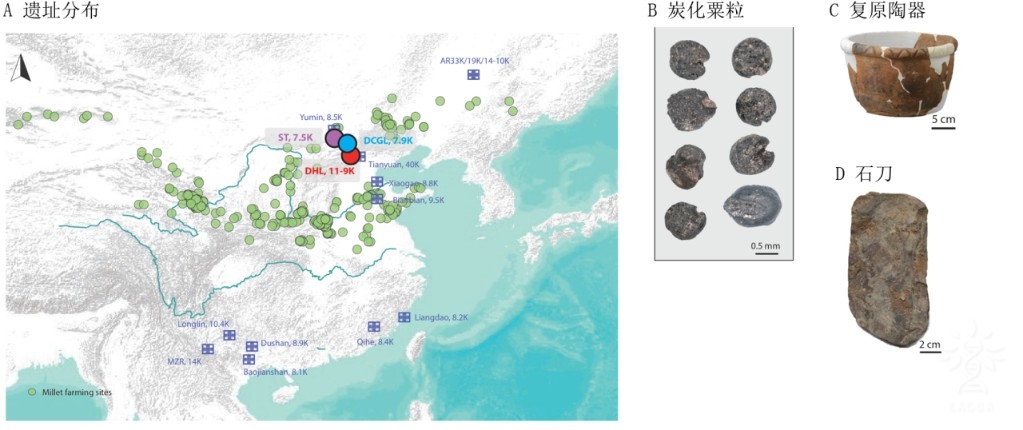
A study published in Science Advances on 16 October 2026 now provides key evidence. Led by Huang Yanyi and Pang Yuhong of Peking University\’s Biomedical Pioneering Innovation Center, together with Zhao Chaohong and Wu Xiaohong of the university\’s School of Archaeology and Museology and collaborating archaeological institutions, the team generated genome-wide data from seven ancient individuals at the Donghulin site in Beijing and the Dengcaogouliang and Sitai sites in Zhangjiakou, Hebei Province, combining ancient genomics with carbon-14 dating and stable isotope analysis. The paper, titled “Early Neolithic genomes suggest a local origin for millet farmers in East Asia,” spans roughly 11,000 to 7,300 years ago.
The three sites form a research sequence stretching more than three millennia. Donghulin, in Beijing\’s Mentougou District, sits at the critical transition from the Paleolithic to the Neolithic; its charred millet grains, pottery and stone tools illuminate the earliest use of millet and the shift toward a settled way of life. The nearby Dengcaogouliang and Sitai sites record a later stage of millet-based agriculture, together allowing researchers to trace the full arc from initial millet use to agricultural intensification.
The team obtained high-quality genomes from three Donghulin individuals dating to about 11,000, 10,700 and 9,200 years ago, plus two individuals each from Dengcaogouliang and Sitai. The Donghulin individuals were genetically close to one another, supporting continuity between the early and late phases of the site, and showed relatively close genetic ties to contemporaneous hunter-gatherers of the Heilongjiang (Amur) River basin — evidence of deep ancestral connections among early Holocene populations of inland northern East Asia.
Comparisons showed that the Dengcaogouliang and Sitai populations were genetically highly similar to Donghulin, all belonging to the same northern inland genetic branch. The Dengcaogouliang people retained ancestry most closely related to Donghulin, with no significant admixture from outside groups — indicating that this local genetic background persisted for more than 3,000 years. In other words, the genetic backbone of the northern interior remained remarkably stable, rather than being successively replaced by incoming populations.
Strikingly, while ancestry remained continuous, diet changed markedly. Carbon and nitrogen stable isotope data from 19 individuals across the three sites and the Yumin site show that the earlier Donghulin people relied mainly on C3 food resources with only small amounts of C4 foods, whereas the later Dengcaogouliang and Sitai populations consumed substantially more C4 resources. Combined with the archaeological record, this reflects the rising dietary importance of millet and other C4 crops. The combination of genetic continuity and dietary shift supports the view that millet farming in the region developed mainly on the basis of local populations — evidence for a local origin of early millet farmers, and a demonstration that agriculture can intensify even against a backdrop of stable ancestry.
Local continuity was accompanied by long-distance contact. Models indicate that the Sitai and Yumin populations derived about 70–80% of their ancestry from the local component represented by Donghulin, with the remaining 20–30% related to ancient populations around Lake Baikal or Mongolia. Donghulin-related ancestry also contributed to the formation of early hunter-gatherer populations around Lake Baikal and in Mongolia, pointing to long-term genetic exchange between northern China and the Baikal–Mongolia region. This ancestral link extends into later Middle Neolithic populations of the West Liao River basin and beyond, offering clues for tracing the formation of later millet-farming groups.
One intriguing detail: the 9,200-year-old Donghulin individual M2 carried a variant of EGLN1 associated with adaptation to low oxygen, suggesting this variant was already present in early Neolithic populations of inland northern East Asia. Its subsequent spread and any selective pressures remain unclear and await future data.
The study, supported by the National Natural Science Foundation of China and other programs, integrates paleogenomics, archaeological remains and dietary evidence to reveal genetic continuity and a local origin for millet-related populations, while also showing how inland northern communities interacted with neighboring groups. As Huang noted, it offers new direct evidence for understanding the relationship between the development of millet farming and population history in East Asia. Whether the earliest millet users were directly continuous with pre-millet hunter-gatherers in the region still requires genomic data from that earlier period to verify.