
The ‘Silk Road’ Written in Paternal DNA: How More Than a Thousand Y Chromosomes Rewrite Northwest China’s Population History—and the Hui
2026年10月16日
Know What Your Grandfather and Grandmother Each Passed to You—Without Testing Them? Inside Ancestry’s New Regions-by-Grandparent Feature
2026年10月16日Three Hundred Pages of an Ancestral Scroll, Now in the Cloud: How One Overseas-Chinese Village Digitized Its Genealogy for Root-Seekers Worldwide
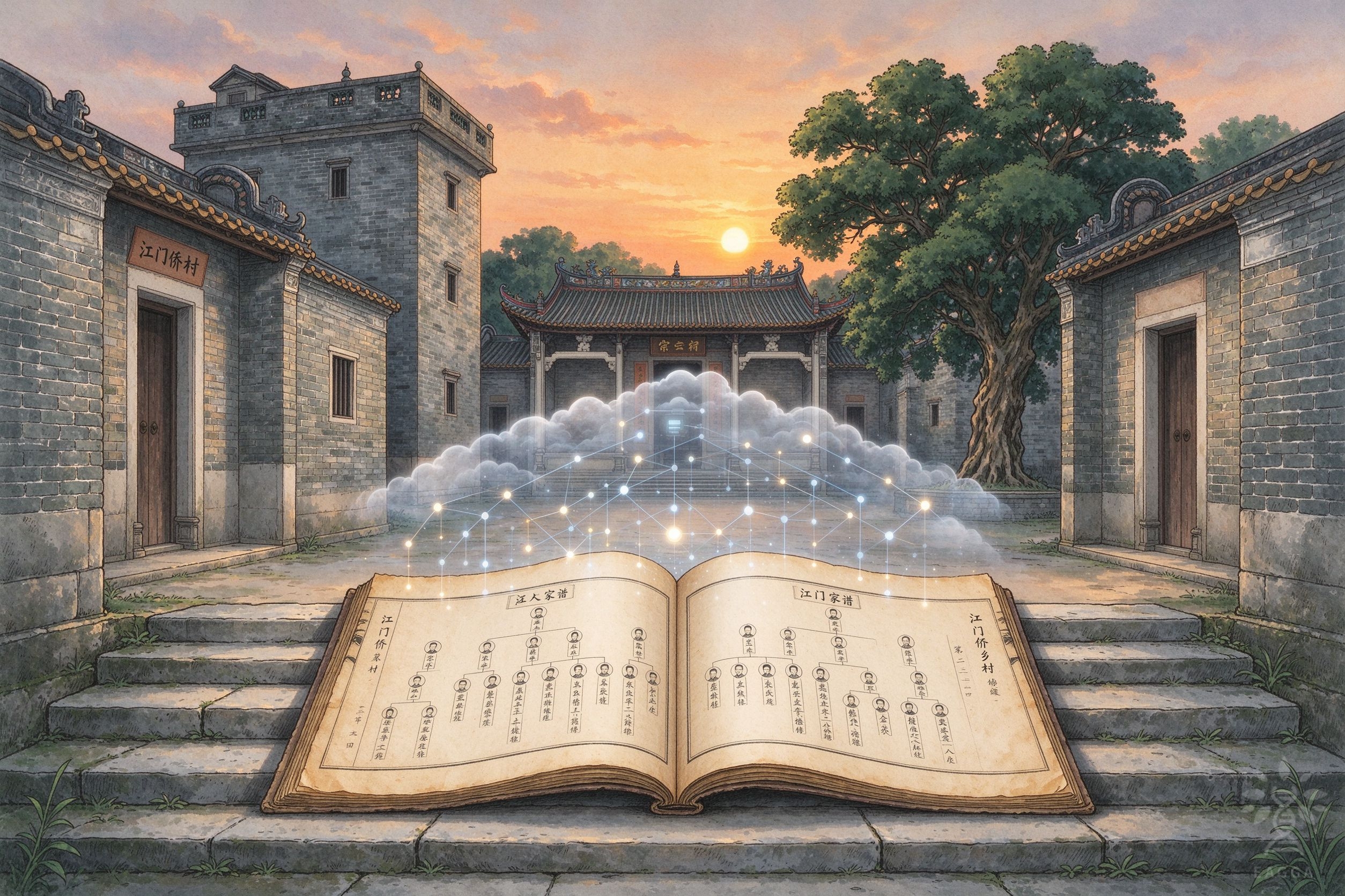
In Laishu village, Gonghe township, Heshan, Jiangmen, the diaolou (watchtower houses) lining the lanes show weathered walls, and the lintels of brick mansions still carry imprints of qiaopi—letters and remittances sent home by overseas Chinese a century ago. Founded in the Northern Song dynasty with a history of more than 950 years, Laishu is a celebrated \’red and beautiful overseas-Chinese village\’ in Guangdong, and the ancestral home countless descendants abroad still dream of. In September 2026, a group of teachers and students from South China University of Technology returned to the village carrying a stack of yellowed Zhong clan genealogies. Their task: to bring a scroll spanning roughly twenty generations and more than three hundred pages to life in the cloud.
A genealogy is the blood-cord code of an overseas-Chinese hometown, and the \’ticket\’ a wandering descendant uses to rejoin his roots. The Zhong clan\’s genealogy at Laishu had been revised and expanded over centuries—voluminous, with dense branch records—yet it long faced the predicament of paper: wear from handling, difficulty of search, and no way for descendants abroad to consult it. The \’Laishu Shock Team\’ from SCUT\’s School of Foreign Studies scanned, collated and transcribed the more than 300 pages one by one, gave each person in the scroll a digital identity, and built an initial Zhong clan genealogy website.
The value became clear immediately: authorized clan members can extend the lineage online, connecting newly born and newly migrated branches to the old scroll; meanwhile descendants overseas—who may have heard of their ancestors only through oral accounts—can log in from anywhere and search their roots remotely, achieving true \’cloud-based root-seeking.\’ One villager remarked that previously he could not answer visitors\’ questions about the stories behind the towers; now not only is the genealogy online, but the village\’s history can be \’understood at a glance.\’
Alongside the digitization ran a wider memory project for the whole village. The team upgraded the Laishu AR guide system—scan a light tag at the village entrance and the phone displays family-instruction animations, live footage of the diaolou\’s bullet scars and clips of oral-history videos. The students interviewed villagers and elders, turning the memories scattered in the minds of the old into a series of \’Laishu Memory\’ oral-history short films. All footage was archived with standardized naming and backed up in the cloud, then handed to the village committee as a public archive and digital asset managed by the villagers themselves.
The details are the most moving part: during the stay, villagers brought out family trees and old photos kept at the bottom of trunks, led the team to ancient wells and ancestral halls, and told stories of ancestors, legends and festival customs. The design team drew two colors—slate gray and rice white—from the local vernacular houses as the basis of a cultural-product line. Their five scented cards, when turned over, spell out the pinyin of Laishu. Cultural genes, carefully packed into objects people can see and carry away.
Laishu\’s story is a microcosm of the current wave of genealogy digitization across China. From Shanxi to Guangdong, from university teams to local archives, paper genealogies are gaining a second life as digital images, structured data and collaborative online platforms. For overseas Chinese, digitization means more than convenient retrieval—it means a tangible sense of belonging: every name on the pedigree chart is a coordinate for going home.
Of course, digitization brings new questions: privacy and authorization boundaries for genealogical data, review mechanisms for extending later generations, and long-term preservation of digital archives. In Laishu\’s practice, the village committee and the university chose the path of \’technology delivered, ownership transferred\’: the data and system source code were handed over completely to the villagers\’ self-governing body. That may be the soundest direction for genealogy digitization—the technology may be brought by outsiders, but the memory always belongs to the clan itself.