

Forensic-Genealogy Milestone: Ireland Approves First-Cousin DNA to Identify Century-Old Degraded Remains
2026年4月27日
[Explainer] The Pacific Was Not a Straight Line: How Palau Genomes Rewrite the “Out of Taiwan” Story
2026年4月29日[Explainer] When 20 STRs Are Not Enough: Why Both Forensics and Ancient DNA Turn to 90,000 SNPs
This explainer is based on the FSI/Tuam case and public literature; it is a secondary overview, not a statement of forensic standards.
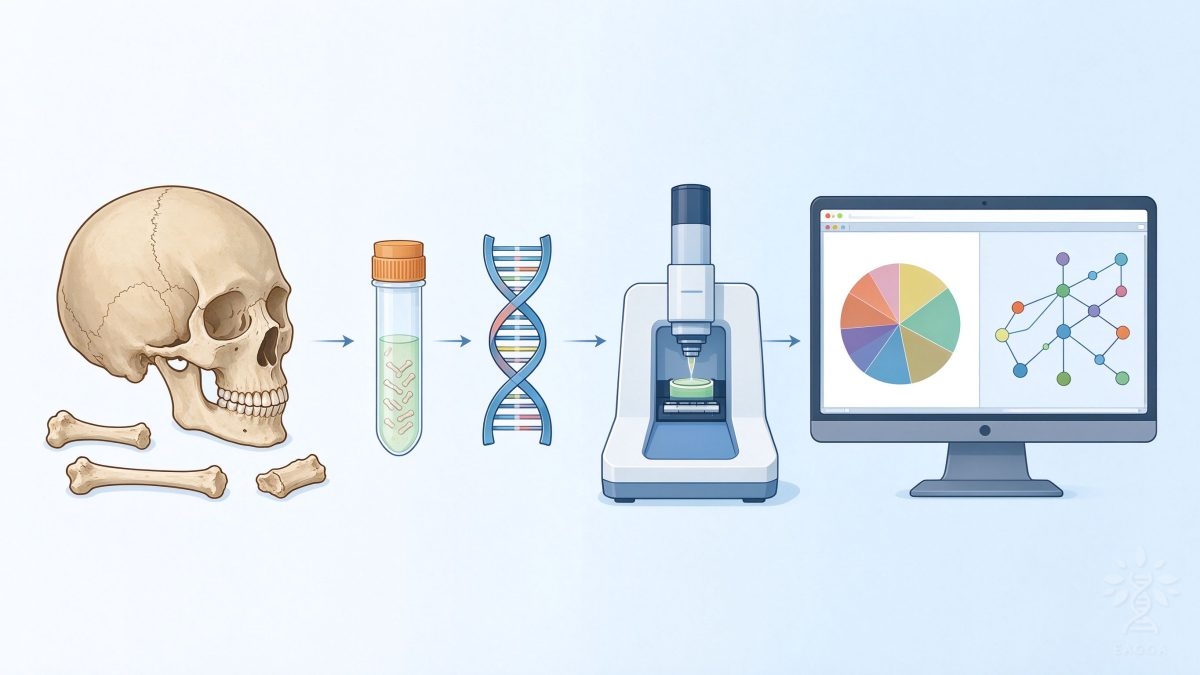
Traditional forensic identification relies on about 15–20 STR (short tandem repeat) loci. That is plenty for first-degree parent–child cases, but it struggles in two situations: century-old bones with severely degraded DNA, and distant relatives such as first cousins, who share on average about 12.5% of their DNA — but in practice anywhere from roughly 4% to 23%. A handful of loci simply cannot deliver a statistically reliable call.
SNPs (single-nucleotide polymorphisms) work differently. Millions of them exist across the genome, each readable from a very short DNA fragment. Typing 25,000–95,000 SNPs in one assay reliably distinguishes third-degree relationships — exactly the technical basis behind Ireland’s extension to cousins in the Tuam project.
Forensics and ancient DNA converge on sampling too: both favor the petrous bone of the inner ear, dense and exceptionally well preserved — a shared “golden sampling site” for both fields. When 20 STRs fall short, 90,000 SNPs and a piece of petrous bone turn out to be the common answer.
Source: public reporting on the FSI/Tuam case (popular-science synthesis). 95,000 SNPs vs 20 STRs, 2026-04-29.

![[Explainer] When 20 STRs Are Not Enough: Why Both Forensics and Ancient DNA Turn to 90,000 SNPs](https://www.eagga.org/wp-content/themes/betheme/images/cookies.png)