
Reconstructing the Human Evolutionary Lineage with Genetic Data
2024年3月26日
Ancient DNA reveals intriguing details about a sixth century Chinese emperor
2024年4月2日Genetic Relationships among 13 Ethnic Groups in China Based on Seven Y-STR Loci
Zhu Yongsheng, Huo Zhenghao, Dang Jie, Chen Yintao, Peng Liang
(Key Laboratory of Reproduction and Genetics of Ningxia; Department of Medical Genetics and Cell Biology, Ningxia Medical University, Yinchuan 750004)
Abstract: Seven Y-STR loci with high genetic polymorphism and stability were selected to analyze the genetic relationships between the Hui population of Ningxia and 17 other Chinese populations. Using multiplex amplification of Y-STRs and ABI automated sequencer typing, combined with gene-scanning and automated allele-calling techniques, the allele frequencies of the DYS19, DYS389 I, DYS389 II, DYS390, DYS391, DYS392 and DYS393 loci were obtained for 150 Hui individuals of Ningxia. Allele frequency data for these seven loci in 17 other Chinese populations were also collected, and genetic distances among them were computed and subjected to cluster analysis. The results show that the Ningxia Hui population first clusters with the Han populations of Beijing, Yunnan, Anhui, Tianjin and Hunan, then with the Fujian Han, and finally with other minority populations, revealing that the Hui and Han populations share great similarity in genetic structure. This provides genetic evidence for the view that a large amount of Han ancestry was incorporated during the origin and development of the Hui people.
Key words: Y-STR; genetic distance; cluster analysis; Hui nationality; Ningxia
Chinese Library Classification: Q987 Document code: A Article No.: 1000-2319(2008)04-0373-06
Short tandem repeats (STRs) are a class of genetic markers widely distributed in the human genome with high polymorphism and genetic stability, occurring on average every 15–20 kb. According to the GenBank database, at least 8,000 STR loci are distributed across the 23 pairs of human chromosomes[1]. Because of their high polymorphism, genetic stability and marked ethnic and regional differences in distribution, STRs have become highly desirable DNA genetic markers in forensic science and human genetics, and are widely applied in population genetics, ethnology, human individual identification, paternity testing and gene mapping[2–3]. Y-STRs show a relatively high degree of variation both among and within populations, and the distribution of alleles and haplotypes differs markedly by region among populations, including those that are distantly related. Studying the polymorphism formed by mutations preserved in the paternal evolutionary history of the human Y chromosome can be used to investigate male migration events during evolution and to reconstruct paternal evolutionary history[4–5]. This study aims to explore the genetic relationships, based on the allele frequencies of the DYS19, DYS389 I, DYS389 II, DYS390, DYS391, DYS392 and DYS393 loci, between the Hui population of Ningxia and 17 Chinese populations, and to provide genetic evidence for the origin, evolution and migration of the Hui people.
\n\n\n\n1 Materials and Methods
\n\n\n\n1.1 Materials
\n\n\n\nVenous blood samples were randomly collected from 150 healthy Hui males of Ningxia, anticoagulated with EDTA and stored at −20 °C. All subjects were unrelated, with both parents Hui, and their families had long resided in Ningxia. Published allele frequency data for these seven Y-STR loci in 17 other populations were collected.
\n\n\n\n1.2 Methods
\n\n\n\nThe genomic DNA of the subjects was amplified with the PowerPlexR○Y fluorescent multiplex amplification kit; electrophoresis and detection were carried out on an ABI377 automated sequencer, the electrophoretic profiles were scanned with Genescan software, and allele typing was performed with Genotyper software.
\n\n\n\n1.3 Statistical analysis
\n\n\n\nNei’s genetic distances among the 18 populations were calculated with PHYLIP 3.65 software, and cluster analysis was performed using SPSS 11.5 statistical software with the between-groups linkage method.
\n\n\n\n2 Results
\n\n\n\n- \n
- Allele frequencies and diversity of the seven Y-STR loci in the Ningxia Hui population \n
Among the 150 unrelated Hui males of Ningxia, six alleles were detected at DYS19 with a diversity of 0.7112; four alleles at DYS389 I with a diversity of 0.6546; seven alleles at DYS389 II with a diversity of 0.7723; five alleles at DYS390 with a diversity of 0.6899; five alleles at DYS391 with a diversity of 0.4446; eight alleles at DYS392 with a diversity of 0.8007; and four alleles at DYS393 with a diversity of 0.6743. The allele frequencies and diversity values of each Y-STR locus are given in Table 1.
\n\n\n\nTable 1 Allele frequencies and diversity of 7 Y-STR loci in the Hui population of Ningxia (n = 150)
\n\n\n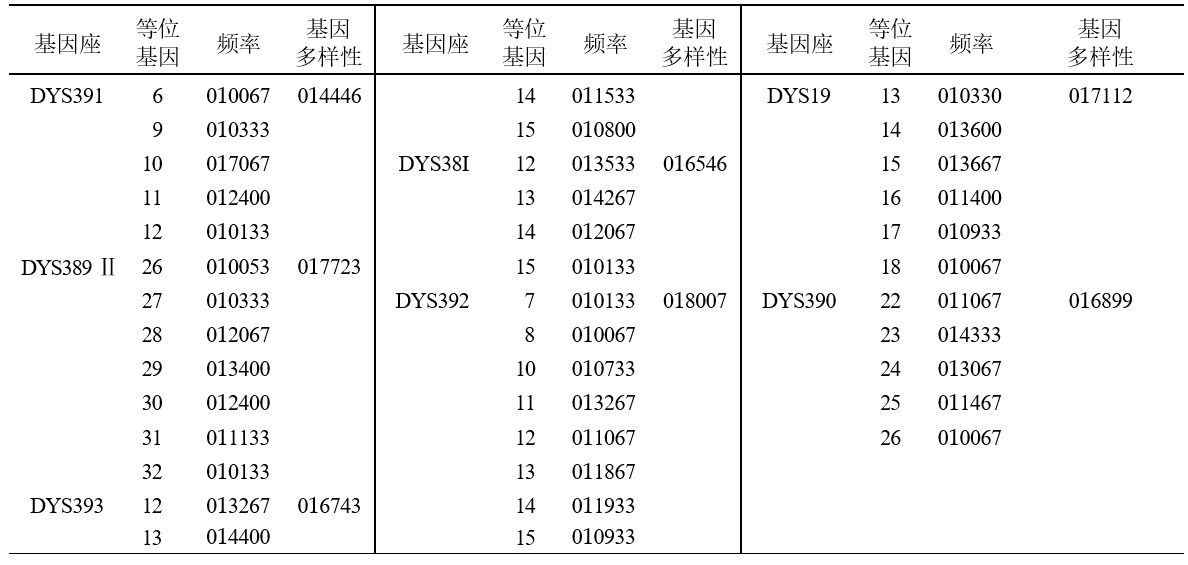
2.1 Genetic distance
\n\n\n\nNei’s genetic distances among the 18 populations, calculated with PHYLIP 3.65 software, are shown in Table 2.
\n\n\n\n2.2 Cluster analysis
\n\n\n\nBased on the data for the seven Y-STR loci, cluster analysis of the Ningxia Hui population and the other 12 minority populations was performed with the between-groups linkage method (squared Euclidean distance) (see Figure 1). The results show that the Han populations of Beijing, Yunnan, Anhui, Tianjin and Hunan first cluster together, then join the Fujian Han, and finally cluster with the other minority populations.
\n\n\n\n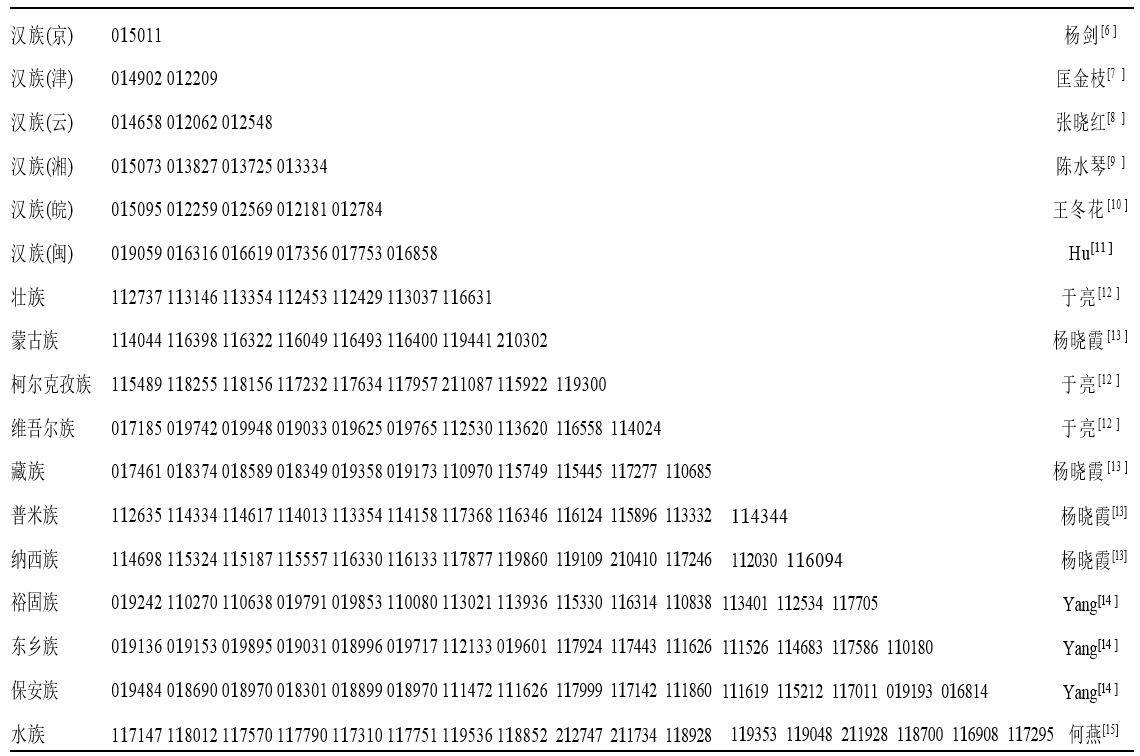
3 Discussion
\n\n\n\nChina is a multi-ethnic country whose principal nationality is the Han, alongside 55 recognized minority nationalities. Owing to differences in region, these peoples differ in language, culture, customs and habits. Exploring the genetic relationships among different ethnic groups, or among different sub-groups of the same ethnic group, provides a theoretical basis for understanding the origins and migrations of the various peoples. During the Tang and Song dynasties, the economy flourished and transport was convenient: overland routes west along the ancient Silk Road reached Central Asia and West Asia, while waterways eastward reached Yangzhou and Hangzhou and from there sailed directly to Arabia. With merchants from many countries gathering in China, the country at that time had no small number of “Hu merchants” and “foreign guests.” In the Yuan dynasty, large numbers of Huihui (Central Asians, Persians and Arabs) migrated to China or came to trade; most did not bring their families and chiefly married Han women to multiply and prosper[16]. The cluster analysis of this study shows that the Ningxia Hui population clusters together with the Hunan, Tianjin, Anhui, Yunnan, Beijing and Fujian Han populations, indicating great similarity in genetic structure between the Ningxia Hui and the Han, and providing genetic evidence for the view that a large amount of Han ancestry was incorporated during the origin and development of the Hui people. This is consistent with the polymorphism analysis of HLA-A, B and DRB1 genes reported by Wu Guoguang and colleagues[17].
\n\n\n\n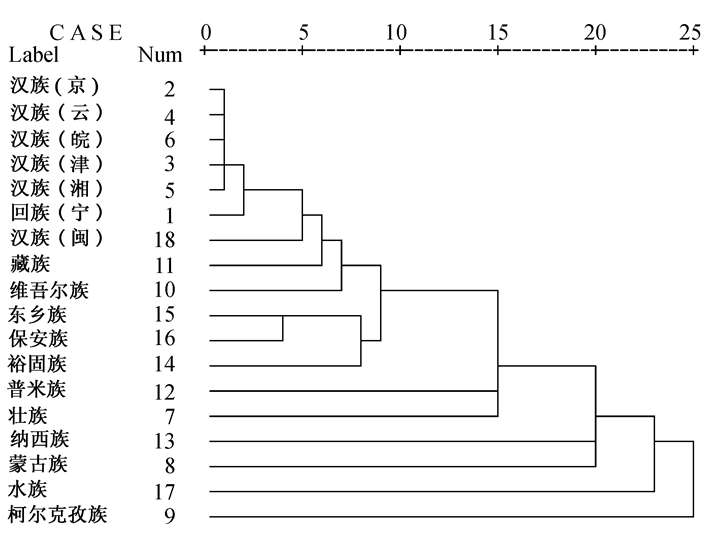
Figure 1 Results of cluster analysis among 13 nationalities (18 populations)
\n\n\n\nIn his study of the origins of the Tibetans, Wen Youfeng[18] found that the frequency of the 9-bp deletion in the mtDNA V region of the Tibetans is close to that of northern-origin nationalities, corroborating the view that the Tibetans belong to the northern ethnic groups of China; cluster analysis of dermatoglyphic parameters in 57 populations including the Tibetans also indicated that the Tibetans are relatively close to the Han. This is consistent with the result of the present cluster analysis, in which the Ningxia Hui are relatively close to the Tibetans.
\n\n\n\nThe Dongxiang, Bonan and Yugur cluster together, then join the other minority populations and the Han. These three nationalities all live in Gansu and show great similarity in ethnic origin, each having gradually formed through long-term integration with the local Hui, Han, Mongol and Tibetan peoples[19]. Both the Dongxiang and the Bonan are Islamic peoples. This indicates that these three nationalities are closely related and that gene exchange has occurred among them.
\n\n\n\nGenetic distance is the ideal way to express genetic differences or genetic evolution between populations[20–22]. The Ningxia Hui population shows the shortest genetic distances to the Yunnan, Tianjin, Beijing, Hunan and Anhui Han populations, at 0.4658, 0.4902, 0.5011, 0.5073 and 0.5095 respectively; its distance to the Uyghur is next, at 0.6550; and its distances to the other ethnic groups are progressively larger. The Hui and the Uyghur share the same religious faith (both are Islamic), and during the development of the Hui people intermarriage occurred with the Han, Uyghur and other peoples, who integrated into Chinese culture, gradually forming one of China’s nationalities. The Uyghur region (Xinjiang) is located in the Western Regions and was a necessary stop on the ancient Silk Road. Studies by Yu Minshu and colleagues[23] on mitochondrial DNA polymorphism in Chinese Han, Uyghur, Kazakh and Hui populations also confirm this point. As uniparentally inherited genetic markers, Y-STRs can effectively capture information on population divergence and migration from the relatively low level of population diversity, making them among the most sensitive genetic markers for tracing the micro-evolutionary processes underlying modern human diversity[17]. The results of the seven highly polymorphic Y-STR loci selected in this study suggest that the ethnic groups that cluster together have had certain kinship ties in history, and that the Ningxia Hui have a closer blood relationship with the Han, providing clues for the origin and migration of the Ningxia Hui.
\n\n\n\nReferences:
\n\n\n\n[1] Benson DA, Boguski MS, Lipman DJ, et al. GenBank[J]. Nucleic Acids Res, 1998; 26(1): 127.
\n\n\n\n[2] Weber JL, May PE. Abundant class of human DNA polymorphisms which can be type using the polymerase chain reaction[J]. Am J Hum Genet, 1989, 44(3): 388-396.
\n\n\n\n[3] Jeffreys AJ, Wilson V, Thein SL. Hypervariable “Minisatellite” region in human DNA[J]. Nature, 1985, 314(6006): 67-73.
[4] Hammer MF. A recent insertion of an Alu element on the Y chromosome is a useful marker for human population studies[J]. Mol Biol Evol, 1994, 11(5): 749-761.
[5] Altheide TK, Hammer MF. Evidence for a possible Asia origin of YAP + Y chromosomes[J]. Am J Hum Genet, 1997, 61(2): 462-466.
[6] Yang Jian, Liu Yacheng, Tang Hui, et al. Genetic polymorphism of Y-chromosomal STRs in the Beijing population[J]. Chinese Journal of Forensic Medicine, 2002, 17(6): 346-347.
[7] Kuang Jinzhi, Zhu Wei, Nie Tonggang, et al. Genetic polymorphism of 12 Y-STR loci in the Tianjin Han population[J]. Forensic Science and Technology, 2005, 1: 19-26.
[8] Zhang Xiaohong, Wu Weiwei, Tang Jianxin, et al. Investigation of genetic polymorphism of 11 Y-STR loci in the Yunnan Han population and its forensic application[J]. Journal of Forensic Medicine, 2006, 22(4): 210-216.
[9] Chen Shuiqin, Chen Hejun, Zeng Xiaoguan, et al. Genetic polymorphism of 11 Y-STR loci in the Hunan Han population[J]. Chinese Journal of Forensic Medicine, 2005, 20(4): 174-176.
[10] Wang Donghua, Chen Ling, Hou Qingtang, et al. Genetic polymorphism of 11 Y-STR loci in the Anhui Han population[J]. Chinese Journal of Forensic Medicine, 2006, 21(5): 302-305.
[11] Hu SP. Genetic polymorphism of 12 Y-chromosomal STR loci in the Minnan Han Chinese in Southeast China[J]. Forensic Sci Int, 2006, 159(1): 77-82.
[12] Yu Liang, Huang Xiaoqin, Shi Li, et al. Study on allele frequencies and haplotypes of 9 Y-STR loci in four minority nationalities of China[J]. Chinese Journal of Medical Genetics, 2005, 22(3): 337-340.
[13] Yang Xiaoxia, Zheng Bingrong, Yang Zhili, et al. Polymorphism analysis of 8 Y-STR loci in 4 minority nationalities of Yunnan[J]. Acta Genetica Sinica, 2003, 30(11): 1065-1070.
[14] Yang YJ, Xie XD, Wang XL, et al. Allele frequency distribution at seven Y-chromosomal STR loci among five ethnic groups from northwest China[J]. J Forensic Sci, 2005, 50(3): 734-736.
[15] He Yan, Shan Keren, Xie Yuan, et al. Polymorphism analysis of 7 Y-chromosomal STR loci in the Shui population of Sandu, Guizhou[J]. Hereditas (Beijing), 2006, 28(12): 1495-1499.
[16] Du Ruofu. Population Genetics of the Chinese People[M]. Beijing: Science Press, 2004, 142-145.
[17] Wu Guoguang, Deng Zhihui, Gao Suqing, et al. Analysis of HLA polymorphism in 6965 Han bone marrow donors[J]. Chinese Journal of Hematology, 2004, 25(8): 473-477.
[18] Wen Youfeng. A Preliminary Study on the Origins of the Tibetan Nationality[D]. China Medical University, 2007, 2-3.
[19] Jin Li, Zhu Jia. Research on Genetic Diversity of the Chinese Nationalities[M]. Shanghai: Shanghai Scientific & Technical Publishers, 2006, 227-228.
[20] Mo Xinquan. A proposal on exploring the origin of the Chinese nation[J]. Science & Technology Review, 1995, 2: 49-56.
[21] Reichenpfader B, Zehner R, Klintschar M. Characterization of a highly variable short tandem repeat polymorphism at the D2S1242 locus[J]. Electrophoresis, 1999, 20(3): 514-517.
[22] Hou YP, Tang JP, Dong JG, et al. Further characterization and population data for the pentanucleotide STR polymorphism D10S2325[J]. Forensic Sci Int, 2001, 123(2-3): 107-110.
[23] Yu Minshu, Qiu Xinfang, Xue Jinglun, et al. Studies on mitochondrial DNA polymorphism in Chinese Han, Uyghur, Kazakh and Hui populations[J]. Acta Genetica Sinica, 1995, 22(1): 1-11.