
Decoding Shimao: How Ancient DNA Unlocks the Story of a Prehistoric Stone City
2025年12月3日
Tracing Austronesian Origins from the Qihedong Skull: A New Maritime Civilization Exhibition
2025年12月9日Did the Hongshan People Actually Move? Northern East Asian Neolithic Exchange in Ancient DNA
Archaeology has a classic problem: when a cultural style—fine jade, distinctive pottery—spreads from one region to another, did the techniques and ideas simply get copied, or did people actually move? The northward and southward reach of Hongshan culture is a case in point.
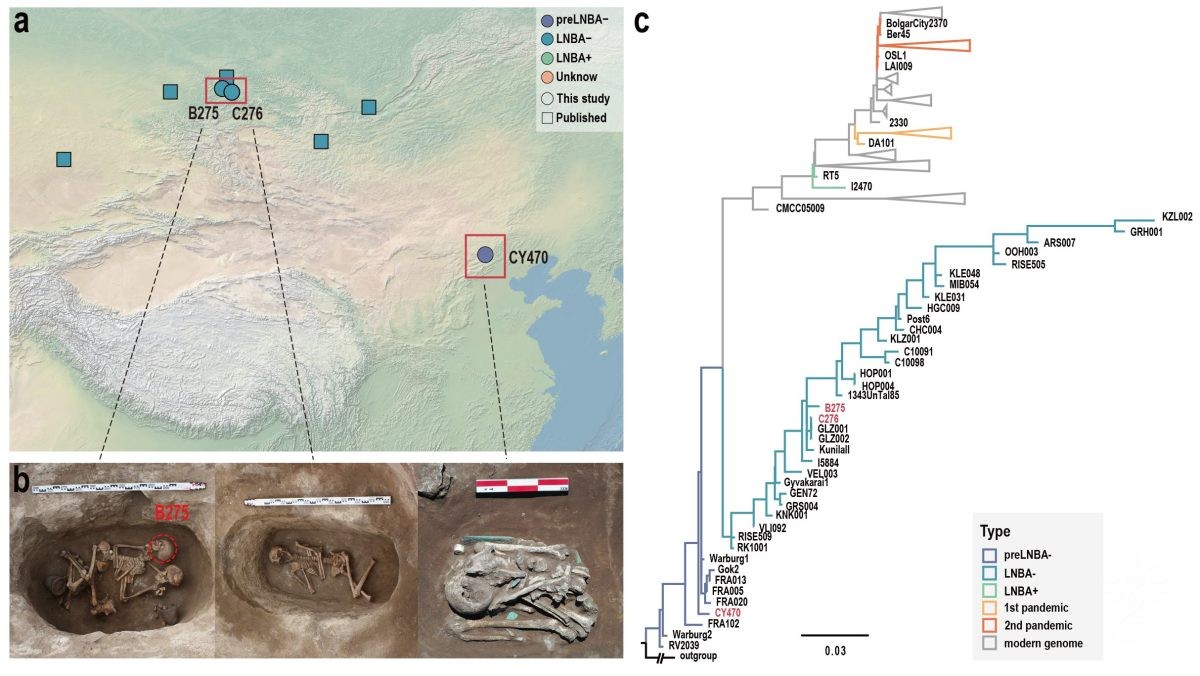
The southeastern edge of the Mongolian Plateau, sitting between the Northeast Asian grasslands and the agricultural zone of northern China, is an ideal place to watch this happen. In work published in The Innovation, Qiaomei Fu’s team and collaborators analyzed 35 ancient human genomes dating to roughly 8,800–5,000 years ago. The results help separate “cultural diffusion” from “human migration.”
First, the early-Holocene locals shared a single ancestral component that endured in the region for a long time, possibly linked to the spread of microlithic technology after the Last Glacial Maximum. The grasslands were already home to a stable population.
Then, around 5,700 years ago, new genes flowed in from the northeastern Mongolian Plateau and from the Hongshan-culture sphere of the Western Liaohe. Cultural styles may have influenced one another earlier, but this genetic turnover shows that, at this stage, Hongshan-related people—carrying genes and perhaps technology—actually moved here.
This is where ancient DNA earns its keep: it can tell a learned culture from a migrated people. Jade can be imitated; genes cannot. The next time two archaeological cultures look similar, we have a sharper question to ask—was it the flow of ideas, or the movement of footsteps?
Source: Liu T et al., Qiaomei Fu team (popular-science rewrite). The Innovation, 2025-11-20.