

Two mysterious ancestors revealed in modern human DNA: Science technique pinpoints a “ghost ancestor” and a “super-archaic ancestor”
2026年7月30日
149 ancient genomes reveal how wheat agriculture reached Gansu as technology transfer, not mass migration
2026年9月3日First prehistoric East-Asian plague genome reveals rapid trans-Eurasian spread ~5,300 years ago
Plague (Yersinia pestis) has caused three devastating pandemics in recorded human history, yet its prehistoric origins and dispersal routes have remained largely mysterious. On 24 July 2026, Nature Communications published a landmark study led by Jilin University and the Academy of Military Medical Sciences, reporting the first prehistoric plague genome from East Asia and pushing the timeline of the rapid trans-Eurasian expansion of plague back to roughly 5,300 years ago. The work fills a long-standing gap in prehistoric plague archaeogenomics and offers crucial evidence for how the pathogen left its homeland.
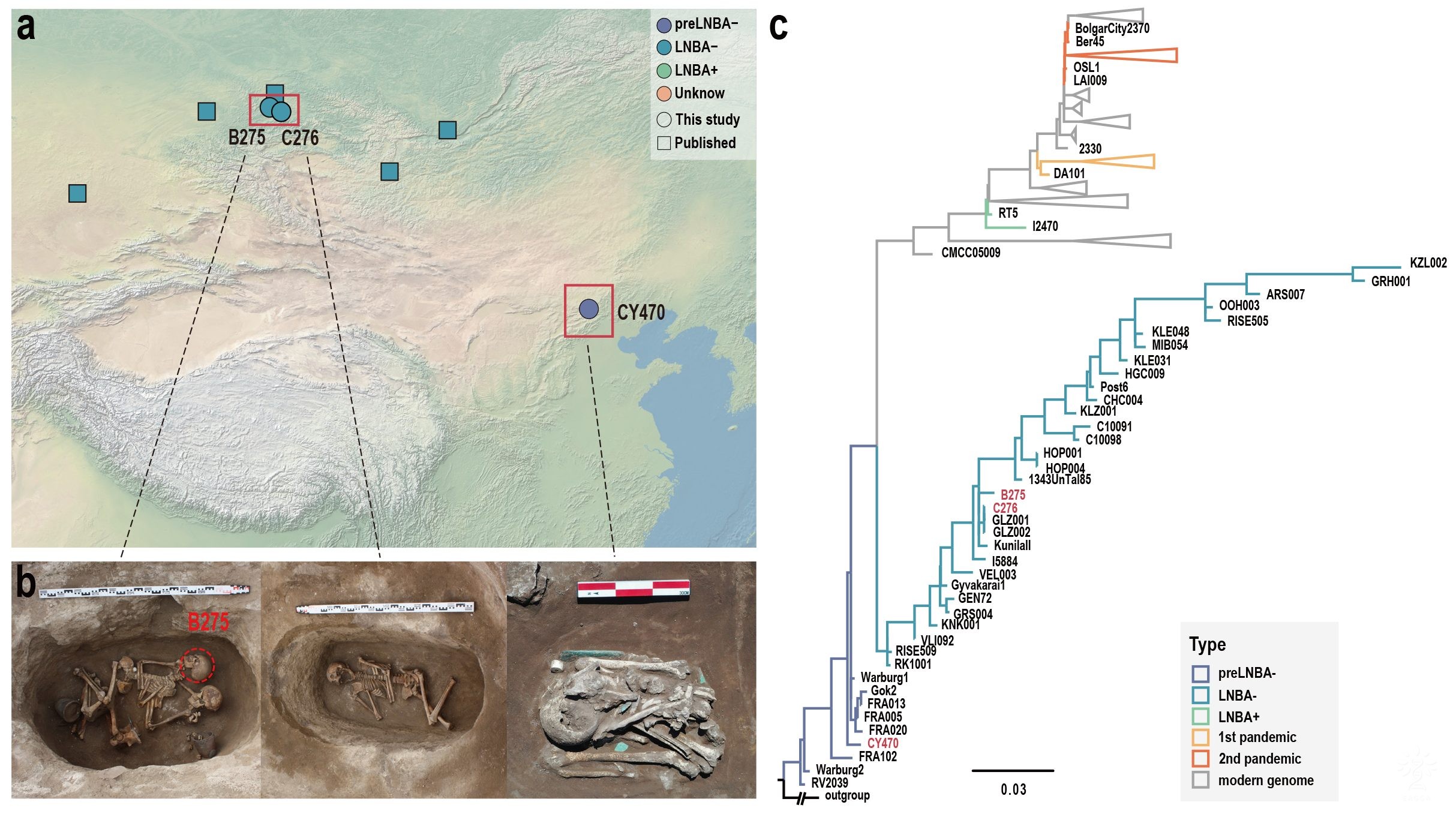
East Asia’s first prehistoric plague genome
The team systematically screened about 1,400 ancient human remains from the eastern part of Eurasia, spanning nearly 8,000 years, and recovered three prehistoric plague genomes: one from northern China — the first of its kind from East Asia — and two new genomes from Siberia. Combined with 136 published modern and ancient plague genomes, they built one of the highest-resolution evolutionary frameworks for Y. pestis to date, providing a continent-wide basis for tracing how plague spread and evolved.
One node, three continental lineages, more than 7,500 km apart
The phylogenetic analysis revealed the study’s most striking finding: plague lineages from Scandinavia, Central Europe and northern China all diverged from the same ancestral node around 5,300 years ago. In other words, these lineages — separated by more than 7,500 kilometres — split within a remarkably short window of time.
Even more tellingly, strain CY470 from the Zhengjiagou site in northern China differs from the most recent common ancestor of that node by only five single-nucleotide polymorphisms (SNPs). Such a tiny genetic distance suggests the Zhengjiagou strain is a near-direct descendant of that ancestral node — one of the most direct pieces of evidence yet that prehistoric East Asian and European plague lineages share a common origin.
Speed estimate: at least ~33 km per year
The researchers further estimated the rate at which plague spread across prehistoric Eurasia: the median lower bound of long-distance transmission is roughly 32.9 km per year (95% CI: 13.81–109.40 km/yr). This pace far exceeds what natural rodent dispersal could achieve, making natural movement among wild rodent populations an unlikely explanation.
Instead, the authors propose that the expansion around 5,300 years ago was propelled by human long-distance activity — the rise of prehistoric trade networks, the adoption of wheeled transport, and large-scale migration. The pathogen may have been carried along human routes, relay-style, through infected individuals, flea-carrying host animals, or contaminated goods and materials. The finding lends archaeogenomic support to the view that human mobility was the core driver of long-distance pathogen dispersal in prehistory.
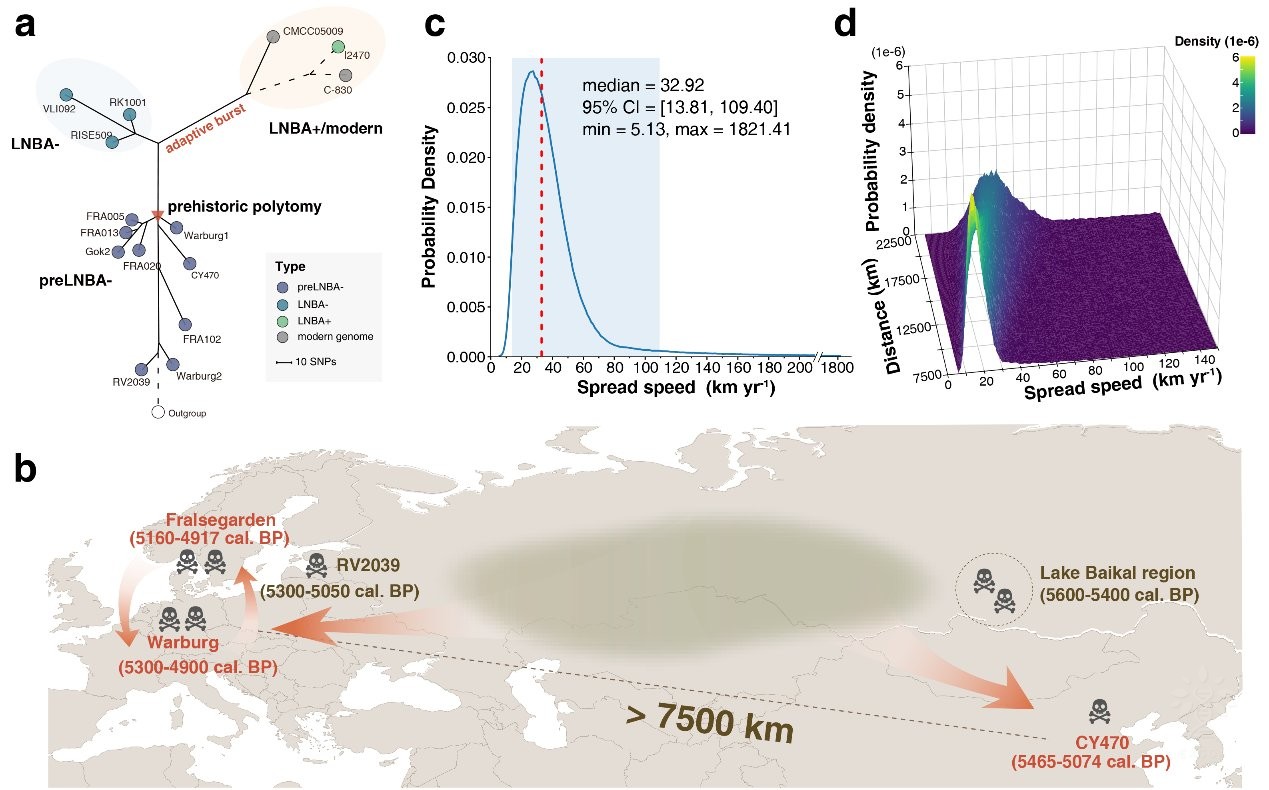
Genomic ‘reshaping’: from sylvatic plague to flea-adapted plague
Beyond dispersal routes, the study also traced key genomic changes in Y. pestis. In the early evolutionary stages of the LNBA+ (Late Neolithic–Bronze Age) lineages, the analysis found a cluster of events involving acquisition of the ymt gene, together with inactivation and loss of a series of genes. The ymt gene is thought to be closely linked to the pathogen’s ability to colonise the flea gut and transmit through fleas.
These changes indicate that the formation of later flea-adapted plague lineages was not a single event but a multi-stage genomic ‘reshaping’ built on earlier lineages. The combined effects of gene gain, inactivation and loss shaped the transition of Y. pestis from a ‘sylvatic’ form transmitted directly among rodents to an efficient flea-borne ‘pandemic’ form.
Why this study matters
Over the past decade, prehistoric plague archaeogenomics has focused almost exclusively on Europe and Siberia, leaving East Asia a blank spot on the map. This study is significant for three reasons. First, it brings East Asia into the global framework of prehistoric plague research, showing that plague was already widespread across Eurasia — including northern China — around 5,300 years ago. Second, using the Zhengjiagou strain as an anchor, it links East Asian and European prehistoric plague lineages to the same evolutionary node. Third, it provides pathogen-level, independent evidence for long-distance interactions among prehistoric populations — archaeological debates about ‘wheels and trade’ on the Bronze Age Eurasian steppe now find a molecular response.
More broadly, the study reminds us that the dispersal history of pathogens is, in essence, a history of human activity. Understanding how plague hitched a ride with prehistoric humans as they moved out of the steppe not only helps reconstruct the original picture of disease evolution, but also carries implications for assessing the transmission risk of zoonotic diseases across today’s global transport networks.
Reference and source
Original paper: A prehistoric East-Asian Yersinia pestis genome and a ~5.3 ka trans-Eurasian expansion of plague. Nature Communications, 2026. https://www.nature.com/articles/s41467-026-75911-y
Related report: Jilin University News Centre, ‘East Asia’s first prehistoric plague genome reveals rapid trans-Eurasian spread around 5,300 years ago’.