
First prehistoric East-Asian plague genome reveals rapid trans-Eurasian spread ~5,300 years ago
2026年7月31日
Popular Science: High-Coverage Genomes of an 8,300-Year-Old Jomon Woman and a 2,300-Year-Old Yayoi Man Reshape East Asian Ancestry
2026年8月16日Jomon Genomes Reveal Cold Adaptation in Ice Age Hunter-Gatherers of Eastern Eurasia
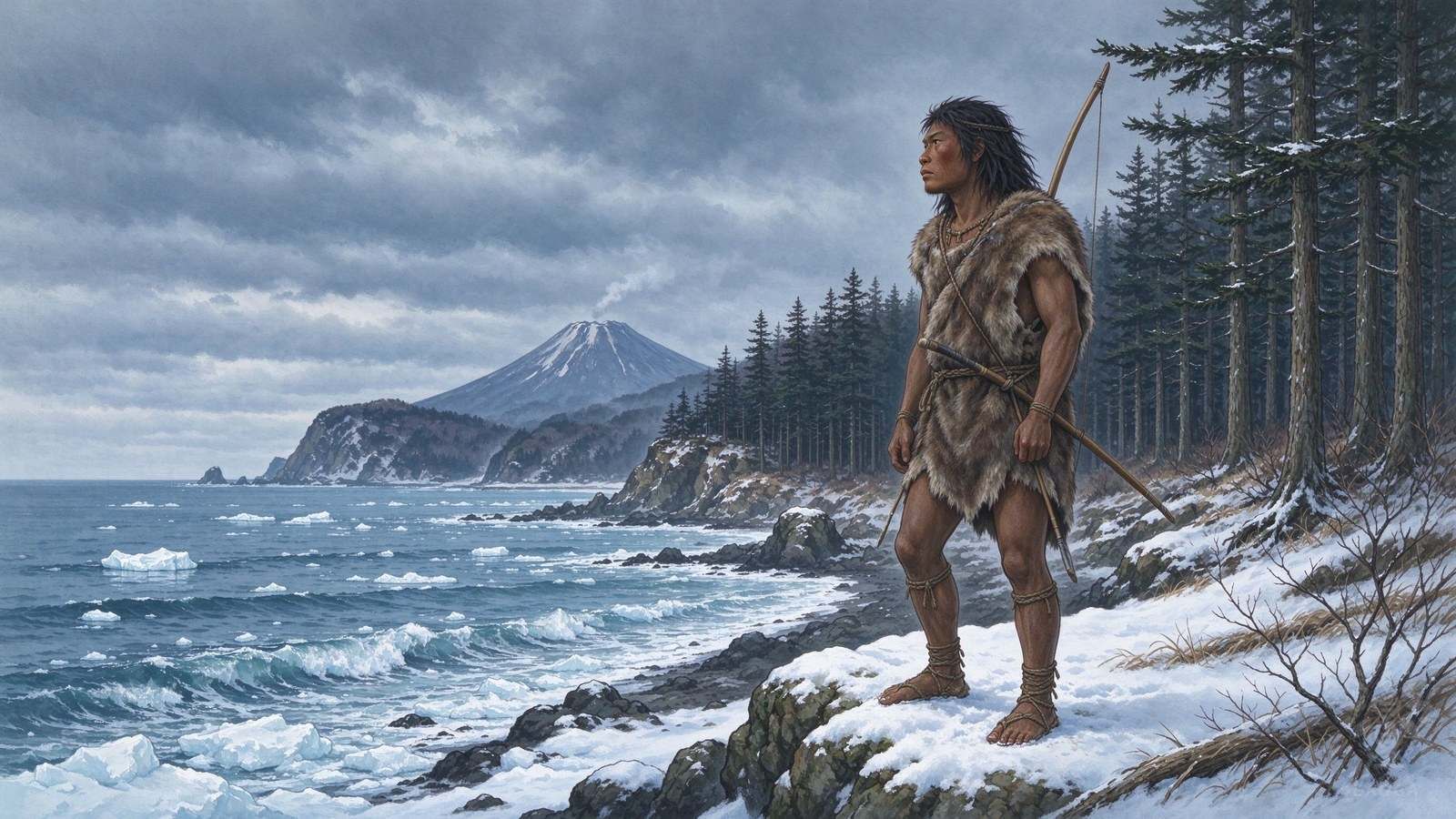
As modern humans expanded northward across Eurasia some 50,000 years ago, the extreme cold of the Last Glacial Maximum (LGM, roughly 26,000–19,000 years ago) was a formidable threshold. How did humans keep warm without shivering? Part of the answer may lie in the genomes of the Jomon hunter-gatherers of the Japanese archipelago.
On 12 August 2026, Science Advances published a study by Hiroki Oota’s team at the University of Tokyo: integrating 42 Jomon hunter-gatherer genomes — 25 newly sequenced and 17 from published data, including three high-coverage (~30×) individuals — the researchers uncovered signatures of cold adaptation in this ancient East Eurasian lineage, providing one of the first paleogenomic frameworks for studying ancient adaptations in Upper Paleolithic East Eurasians.
The Jomon: an isolated genetic archive of the Paleolithic
The Jomon were hunter-gatherers who inhabited the Japanese archipelago from roughly 16,000 to 3,000 years ago. The study shows that their ancestral lineage split from continental East Eurasian populations around 27,000–19,000 years ago, during the later phase of the LGM, and was subsequently preserved in the isolation of the archipelago. Rising sea levels at the end of the LGM submerged the land bridges connecting the archipelago to the continent (Paleo-Honshu and the Paleo-Sakhalin-Hokkaido-Kurile Peninsula), setting this population on an independent evolutionary trajectory — making its genomes a precious archive for studying Ice Age East Eurasians.
42 genomes: hunting for selection signals in degraded ancient DNA
Ancient genomes are typically heavily degraded and incomplete. The team sequenced 25 Jomon individuals (about 7,400–4,300 years old) and combined them with 17 previously published genomes. To fill in missing genetic information, they used a large reference panel of 9,290 present-day Japanese genomes (National Center Biobank Network), enabling genome-wide scans for natural selection at the population level. Using the rXP-nSL statistic together with GWAS data from present-day Japanese, they searched for signatures of positive selection in the Jomon.
Finding 1: genes for cold adaptation during the LGM
The Jomon carried multiple gene variants associated with cold environments. Most striking were variants related to nonshivering thermogenesis — a mechanism occurring mainly in brown adipose tissue that maintains body temperature without shivering. One variant previously linked experimentally to heat production in brown fat had an allele frequency of about 73% in the Jomon, compared with only 17% in present-day East Asians.
The researchers also detected positive selection in gene regions associated with body mass and blood lipid metabolism, including FTO and APOA5. These adaptations would have helped the body both store energy and make it more readily available to brown fat for heat generation — making it easier to maintain body temperature in freezing conditions. Notably, the population frequency of the APOA5-related variant rose sharply during a period corresponding to the LGM, suggesting this cold adaptation was not a chance remnant of later times but was strengthened under glacial conditions in the Jomon’s Paleolithic ancestors.
Finding 2: convergent evolution with Greenlandic Inuit
Intriguingly, the Jomon were not the only population to evolve along these lines. When the researchers examined a genomic region associated with fatty acid processing, they found the Jomon were significantly more similar to Greenlandic Inuit than to present-day East Asian populations — a textbook case of convergent evolution, in which distantly related groups independently develop similar adaptations in response to similar environmental pressures. The archaeological record supports this interpretation: early Jomon pottery preserves evidence that aquatic resources were an important part of the diet, and both the genomes and the archaeology point to metabolic adaptations to a high-fat, high-protein diet in a cold environment, much like the Inuit.
Finding 3: reframing the “Upper Paleolithic ancestors” of East Asians
The study also clarified a long-standing debate on the peopling of East Asia. Phylogenetic analyses show that the Jomon descend from an isolated Upper Paleolithic East Eurasian lineage, with detectable gene flow from northern UP Siberians into the Jomon — reconciling long-running disagreements between bioanthropology and archaeology. Notably, no Jomon-specific Denisovan ancestry was found, suggesting that Denisovan introgression occurred before the Jomon ancestors diverged from mainland populations at the LGM — a new time coordinate for the Denisovan genetic legacy in East Asian populations.
From the Ice Age to modern health
These findings extend far beyond evolutionary history. Modern Japanese individuals with higher proportions of Jomon ancestry tend to have higher body mass index (BMI) — an association identified in a 2024 analysis of more than 170,000 people in Japan. The authors connect this with the “thrifty gene” hypothesis: mechanisms that helped ancestors store and expend energy in a cold, unpredictable world may, in warm and abundant environments, become risk factors for conditions such as obesity.
“Our findings illuminate how ancient populations adapted to extreme environments, and how these adaptations may continue to shape present-day variation in health-related traits, highlighting the broader relevance of paleogenomics to human biology and public health,” the researchers wrote.
Paper: Yusuke Watanabe et al., “Jomon genomics reveal cold adaptation in Upper Paleolithic hunter-gatherers of eastern Eurasia”, Science Advances 12, eaea7469 (2026), published online 12 August 2026.