Ministry of Education Key Laboratory of Contemporary Anthropology, Fudan University, Shanghai 200433
\n\n\n\n
\n
Abstract: Human origins and evolution are among the most intensely studied questions in science, and genetic research in recent years has become the most solid evidence for understanding human evolutionary history. Because the genomes of chimpanzees and other great apes differ from those of modern humans by only a small amount, the families Pongidae and Hominidae have been merged, and chimpanzees belong, in fact, to the human lineage (Hominina). The human lineage originated roughly 7 million years ago, and within it the genus Homo arose from Australopithecus more than 2 million years ago—this is what we ordinarily mean by “human.” The early members of our genus evolved forms such as H. gautengensis, H. habilis, H. rudolfensis and H. ergaster, while the later members split into two major branches, H. erectus and H. sapiens. Genome comparisons among the modern humans, Neanderthals and Denisovans within Homo sapiens show that they diverged between 800,000 and 600,000 years ago, so H. sapiens can be divided into the southern (H. s. australis), northern (H. s. septentrionalis) and eastern (H. s. orientalis) subspecies. All modern humans belong to the southern subspecies, which underwent a physical transformation about 200,000 years ago, left Africa around 70,000 years ago, and spread across the globe to form the eight races recognized today. The evolutionary diversification of Y-chromosome lineages occurred in parallel with the formation of the races, so the two correspond well with each other. A correct understanding of human history and racial differences—and a rejection of racism, which asserts the superiority of some races over others—helps promote harmony in human society and also advances the development of medicine and other sciences. Keywords: human origins, genome, lineage analysis, Y-chromosome haplogroup, human race
\n\n\n\n
Recent genetic findings based on genomics have overturned traditional paleontology and biological classification, and have even shaken the classical staged model of human evolution. Drawing on the latest genetic research, this article reconstructs the course of human evolution step by step, from the apes to modern races.
\n\n\n\n
The Lineage of the Apes
\n\n\n\n
For a long time, humans believed their species was so exceptional that it should stand apart from the animal kingdom as an entirely new group. With the establishment of systematic and evolutionary biology, however, biologists came to recognize that humans still belong to the order Primates and are closely related to the other apes. Among primates, tailless species are called apes. Two major groups of apes survive today: lesser apes and great apes. The lesser apes are the various gibbons, usually placed in their own family without controversy. The great apes, by tradition, were divided into the families Pongidae (orangutans, gorillas and chimpanzees) and Hominidae (only humans). But many evolutionists suspected that separating Hominidae from Pongidae was simply an act of human self-regard. In recent years, increasingly complete primate genomics has deepened our understanding of ape phylogeny and confirmed that humans are not a special case.
\n\n\n\n
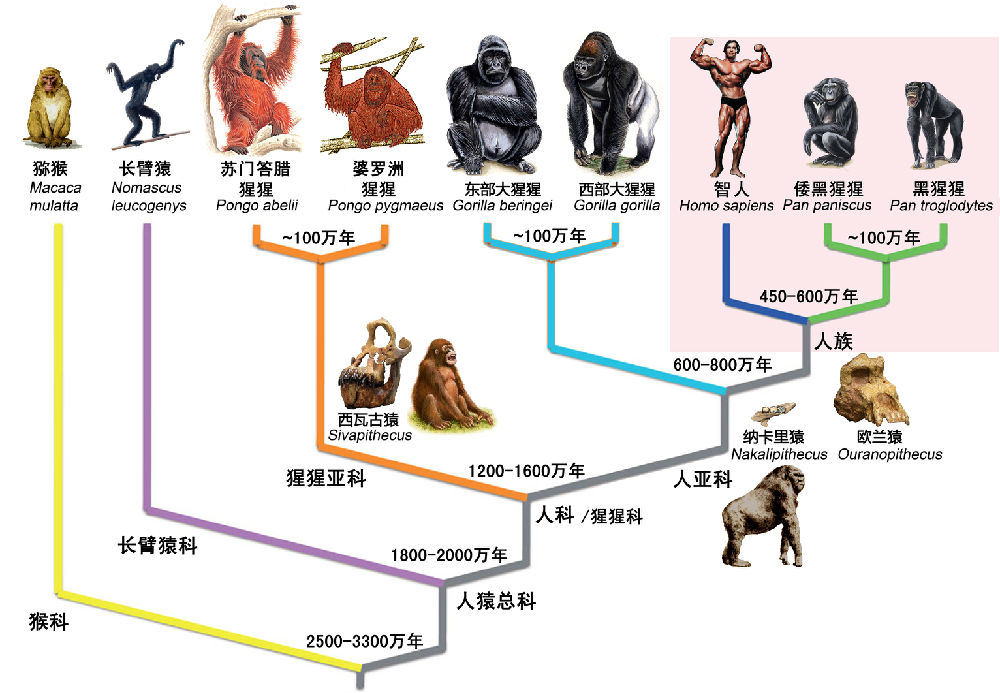
Because the morphological characters of the hominid lineage are ambiguous, traditional classification based on form carries an inherent weakness: similar forms can arise along different evolutionary routes. Genomic differences, by contrast, are explicit and quantifiable, making them a far better material for evolutionary study. The degree of genomic difference between two species is proportional to the length of their shared divergence history; calibrated against the geological timescale, genomic difference can therefore be converted into divergence time. Generally speaking, in the animal kingdom, species that evolved within roughly the last 10 million years can be assigned to a single family. Humans and chimpanzees differ genomically by less than 2% and diverged less than 6 million years ago, so they clearly cannot belong to two separate families. The families were accordingly merged, and the family name now universally adopted internationally is Hominidae, subdivided into the subfamilies Ponginae (orangutans) and Homininae (gorillas, chimpanzees and modern humans)[1]. Because the orangutan lineage diverged from the others well beyond 10 million years ago, it might arguably be placed in a family of its own.
\n\n\n\n\n\n\n\n
Genetic phylogeny of the great apes: the bonobo and the chimpanzee, together with modern humans, belong to the hominin lineage.
\n\n\n\n
Within Homininae, the tribes Gorillini and Hominini are distinguished. Many species that are called “human” are in fact included in the hominin lineage. According to current paleontological discoveries, the earliest hominin species is Sahelanthropus, found in central Africa and dated to about 7 million years ago—already earlier than the human–chimpanzee divergence. The chimpanzee therefore naturally falls within the hominin lineage, and morphologically it is already more evolved than Sahelanthropus, with a larger brain. Since even Sahelanthropus is called a “human,” the chimpanzee, too, should arguably be renamed—at the very least it deserves to be called a “black ape” rather than a “chimpanzee.” In fact, the ancient Chinese term 猩猩 (xingxing) referred only to the orangutan, hence the color name “orangutan red.”
\n\n\n\n
The Lineage of the Hominins
\n\n\n\n
The second hominin species is Orrorin, discovered in Kenya in 2000 and dated to about 6 million years ago. Orrorin‘s morphology is very close to the chimpanzee, yet its femur is even closer to humans (genus Homo) than is that of Australopithecus, which appeared 3 million years later. It is possible that Australopithecus was not our direct ancestor and that humans may have evolved directly from Orrorin. Because fossils older than about 50,000 years can almost never yield analyzable DNA, however, genetics has only limited power in studying hominin evolution; and because Orrorin fossils are extremely scarce, no definite conclusion can be drawn from them.
\n\n\n\n
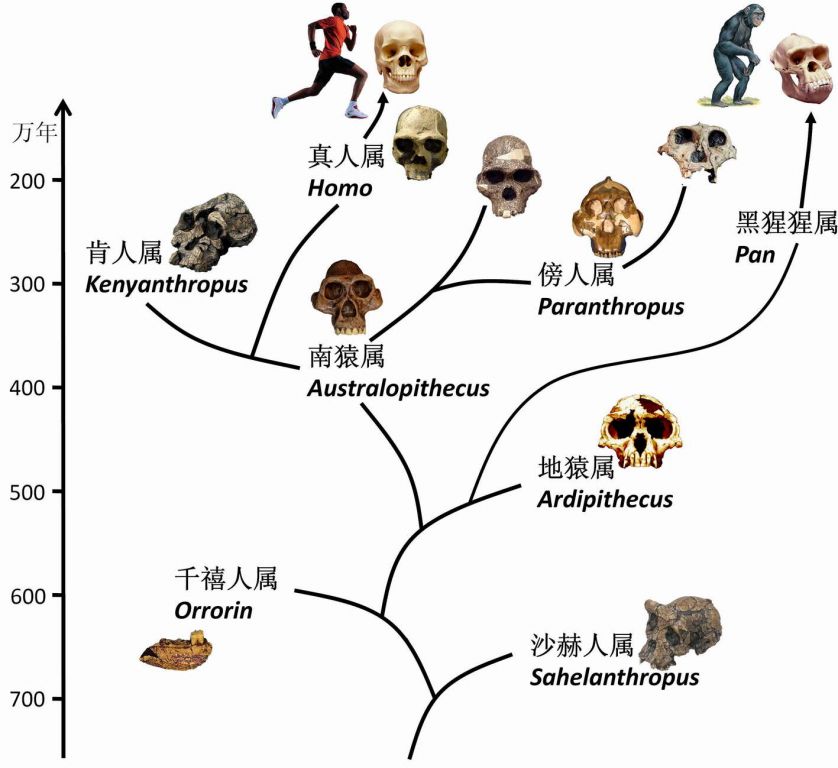
Ardipithecus was discovered in Ethiopia and dates to about 5 million years ago. Its morphology is closer to the chimpanzee, and it is quite possibly an ancestor of the chimpanzee; but its teeth resemble those of Australopithecus, so it remains difficult to determine whether it belongs to the chimpanzee or the human branch. Around 4 million years ago, Australopithecus appeared and became a flourishing group among the hominins; successive discoveries include A. anamensis, A. afarensis, A. bahrelghazali, A. africanus, A. garhi and A. sediba, spanning roughly 2 million years. Whether the Kenyan Kenyanthropus platyops deserves its own genus is still debated. From Australopithecus evolved two groups with opposite evolutionary strategies: Paranthropus and Homo. Paranthropus was very robust, with a prominent sagittal crest on the crown—that is, well-developed head muscles—and posterior molars twice the size of ours, yet a small braincase. With its powerful chewing apparatus, Paranthropus was a “brawny but brainy-simple” type, almost like a beast of prey; recent research, however, suggests it was mainly herbivorous. Homo, by contrast, steadily increased in brain size while its limbs and teeth became more gracile. In the end, the better-developed brain allowed Homo to prevail in evolution and to survive to the present day.
\n\n\n\n
Most interestingly, two to three million years ago, Africa was home simultaneously to several close relatives of humans—Australopithecus, Paranthropus, and Homo habilis and H. rudolfensis of the genus Homo—so humanity was once not alone[2].
\n\n\n\n\n\n\n\n
A phylogenetic tree of the hominin genera: more than 3 million years ago, the genus Homo split from Australopithecus and ultimately prevailed.
\n\n\n\n
The Lineage of the Genus Homo
\n\n\n\n
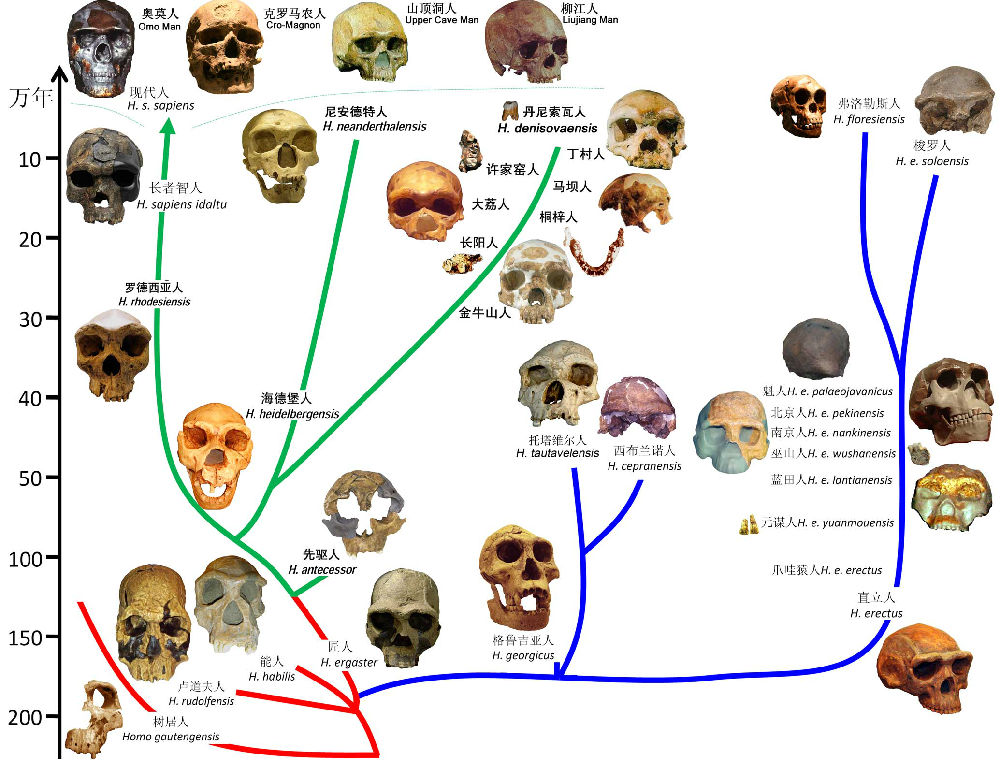
What we traditionally call “human” is, in fact, the narrow sense of the term—that is, the various species of the biological genus Homo. The genus originated roughly 2 million years ago. The earliest Homo fossils found so far are H. habilis from East Africa, about 2.3 million years old, and this species may have survived until about 1.4 million years ago. In 2010, however, H. gautengensis was discovered in Gauteng, South Africa; morphologically more primitive than H. habilis, it may be an even earlier human species. The currently known H. gautengensis fossils date to roughly 1.9 to 0.6 million years ago, and earlier fossils may yet be found. H. rudolfensis, discovered in Kenya and dated to about 1.9 million years ago, is probably a branch of H. habilis.
\n\n\n\n
Besides these three early species, another human species—H. ergaster—evolved in eastern and southern Africa between 1.8 and 1.3 million years ago. Judging by brain size and other traits, H. ergaster may have possessed higher intelligence than H. habilis and produced more advanced tools. After diverging from H. habilis, H. ergaster became the most likely direct ancestor of modern humans. Because early Homo fossils are too old for DNA analysis, and because not all four species left descendants available for genetic study, molecular genetics cannot help resolve the phylogeny of the early members of Homo. It is quite possible that H. gautengensis and H. habilis diverged 2 million years ago, and that H. rudolfensis and H. ergaster split from H. habilis about 1.9 million years ago.
\n\n\n\n
Later humans were traditionally divided into three categories—ape-men (H. erectus), archaic humans (early H. sapiens) and new humans (late H. sapiens)—once regarded as three successive stages of human development. That staged model has long since been abandoned in the light of paleoanthropological and genetic findings. First, fossil discoveries show that H. erectus left Africa and spread from West Asia to East Asia as early as 1.8 million years ago. Second, molecular genetic analyses of modern human populations on every continent—whether whole-genome, mitochondrial DNA or Y-chromosome lineage analyses—have consistently shown that all modern humans re-originated in Africa within the last 200,000 years. Modern humans therefore cannot be descendants of Asian H. erectus; H. erectus and H. sapiens are two different branches, not two stages[3].
\n\n\n\n
The erectus branch that evolved from H. ergaster may also have produced several closely related lineages, including the Tautavel Man of France, the Ceprano Man of Italy and the Georgian H. erectus georgicus. The Georgian hominin, 1.8 million years old, is the earliest human fossil found outside Africa. These forms are often regarded as subspecies of H. erectus. The type specimen of H. erectus is Java Man of Indonesia; 500,000 years ago, humans across East and Southeast Asia belonged to various erectus subspecies, the most famous being Peking Man, Lantian Man and Yuanmou Man. (The Yuanmou Man fossil, however, consists of only two teeth.) Although H. erectus was widely distributed in East and Southeast Asia, its populations were probably very small, many of its sites were occupied for only short periods, and these populations died out one after another; the Solo Man of Java survived until about 140,000 years ago. The most peculiar of the erectus group is H. floresiensis, found on Flores Island in eastern Indonesia. Living from 94,000 to 13,000 years ago, this species was extremely small—less than 110 cm tall—the smallest humans ever discovered, an adaptation probably produced by tens of thousands of years on a small island with scarce resources. Because of its distinctive morphology, H. floresiensis is generally considered an independent species distinct from H. erectus[4].
\n\n\n\n\n\n\n\n
Phylogenetic structure within the genus Homo: H. sapiens and H. erectus are the two major late branches.
\n\n\n\n
The Three Subspecies of Homo sapiens
\n\n\n\n
The phylogeny of Homo sapiens has recently advanced dramatically. Obtaining whole-genome data for the Neanderthals[5] and the Denisovans[6] may be the most significant achievement of human evolutionary research in the past decade. The Neanderthals of western Eurasia survived until about 30,000 years ago, and the Denisovans of eastern Eurasia until about 40,000 years ago. Comparing the whole genomes of Neanderthals, Denisovans and modern humans reveals their evolutionary relationships with complete clarity: the Neanderthal–Denisovan split dates to roughly 600,000 years ago, while each diverged from modern humans about 800,000 years ago. These three types should therefore represent the three major branches of H. sapiens. All modern humans left Africa within the last 200,000 years, and their direct ancestor was probably the early African sapiens form—H. sapiens rhodesiensis (Kabwe). Neanderthals ranged widely across Europe and West Asia, even into Central Asia. The Denisovans, although discovered in the Altai Mountains, may represent the early sapiens of all East and Southeast Asia. The terms “early sapiens” and “late sapiens” are therefore imprecise; better names would be the southern, northern and eastern subspecies of Homo sapiens.
\n\n\n\n
Maternal-line mitochondrial phylogeny, however, yields a slightly different topology among the three: modern humans and Neanderthals separated more than 400,000 years ago, and both separated from Denisovans about 1 million years ago[7]. The difference between the purely maternal structure and the whole-genome structure may hint at a complex story of ancient migration—absorbing women from other populations may have been comparatively easy. The timing of the sapiens divergence is broadly consistent with the divergence dates of the two species within each of the genera Pongo, Gorilla and Pan, possibly because of dramatic global climate change at that time.
\n\n\n\n
The origin of Homo sapiens is estimated at about 1.2 million years ago. The earliest European human discovered so far—H. antecessor at Atapuerca, Spain—dates to that period and already possesses many sapiens features. But H. antecessor appeared in Spain only briefly, probably becoming extinct soon after; it was a side branch of human evolution that left no descendants. The earliest species unambiguously belonging to Homo sapiens is H. heidelbergensis, found mainly in Europe and living roughly 600,000 to 400,000 years ago. The brain size of H. heidelbergensis was roughly equivalent to ours, perhaps because of their large bodies: European heidelbergensis averaged 180 cm tall. Some scholars consider contemporary Africans to belong to the same species, including the “giant” found in South Africa—the tallest of all human species, at 213 cm. H. heidelbergensis may have had language and may already have buried its dead; it likely represents the stage just after the three sapiens branches diverged, before morphological differences had yet formed.
\n\n\n\n
Whether genetic exchange occurred among the three sapiens branches—that is, whether Neanderthals or Denisovans contributed genetic material to living modern humans—is the most fascinating question in human evolutionary research. Before the Neanderthal and Denisovan genomes were available, speculation was all that was possible. Now, by comparing the three genomes, we can answer with considerable precision. Before 2010, purely paternal Y-chromosome and purely maternal mitochondrial DNA analyses found no Neanderthal or Denisovan component in modern humans. But recent whole-genome analyses have reached a somewhat different conclusion. Among Africans, still no Neanderthal or Denisovan ancestry is found; but in all modern human populations outside Africa, 1–4% Neanderthal genomic ancestry is present. This gene flow occurred around 70,000 years ago, just as modern humans were leaving Africa, and never happened again—even though modern humans and Neanderthals coexisted in Europe for tens of thousands of years. Populations that formed around the world after the exodus therefore all preserve the same proportion of Neanderthal DNA.
\n\n\n\n
Although the Denisovans were discovered in North Asia, no Denisovan ancestry is found in modern Asian mainland populations. Instead, about 6% Denisovan ancestry is found among the indigenous populations of New Guinea in Oceania[8]. It is quite possible that the ancestors of New Guineans encountered Denisovan groups while migrating through mainland Southeast Asia and exchanged genes. We can therefore be sure that Denisovans were geographically widespread—at least from North Asia to Southeast Asia—and numerous enough to pass substantial genetic material into modern New Guineans. The period of the Denisovans broadly overlaps the period of the “early sapiens of East Asia,” and it can be inferred that the “early sapiens of East Asia” and the “Denisovans” were one and the same species.
\n\n\n\n
Why East Asian modern humans show no gene flow from Denisovans is a fact not easy to explain. Researchers once expected early East Asian modern humans to carry more Neanderthal or Denisovan ancestry. But the genome of the Tianyuan Man from the Zhoukoudian area of Beijing, published in 2013 and dating to more than 40,000 years ago, is almost indistinguishable from that of modern Chinese people, with no extra “early sapiens” ancestry[9]. It appears that gene flow among the three sapiens branches may have occurred, but only to a very limited extent.
\n\n\n\n
The Eight Branches of Modern Humans
\n\n\n\n
The southern sapiens of Africa began to show pronounced morphological change at least 160,000 years ago: in Ethiopia, H. sapiens idaltu evolved, with a form intermediate between Rhodesian Man and modern humans. But Omo remains, almost 200,000 years old, have also been found in Ethiopia, indicating that the idaltu form may have arisen even earlier, and that some groups simply never evolved into the modern human morphology. Modern humans therefore originated at least 200,000 years ago. Not all of these earliest groups, however, survived to pass their entire gene pools down to the present. Depending on the mode of inheritance of different genomic segments, the modern human lineage can be traced back to different dates: the purely maternal mitochondrial lineage goes back to about 200,000 years ago, while the purely paternal Y-chromosome lineage goes back only 142,000 years. This suggests that women have enjoyed a fairer chance of reproduction and have been more readily accepted by other groups; between 200,000 and 142,000 years ago, many women left direct descendants to this day, whereas only one paternal line in that interval left a direct descendant.
\n\n\n\n
Because males dominate group identity, paternal genetic types (Y-chromosome lineages) easily become reduced in number. The genetic material that differs most among groups is therefore the Y-chromosome lineage, also called the Y-chromosome haplogroup. The world’s Y-chromosome haplogroups form a reliable phylogeny. The formation of the major Y haplogroups requires long periods of isolated evolution, and this is the same mechanism by which modern human races formed in isolation. In the early development of modern humans, Y haplogroups and races should therefore have corresponded well; over the past few millennia, large-scale population admixture has somewhat disrupted this correspondence.
\n\n\n\n
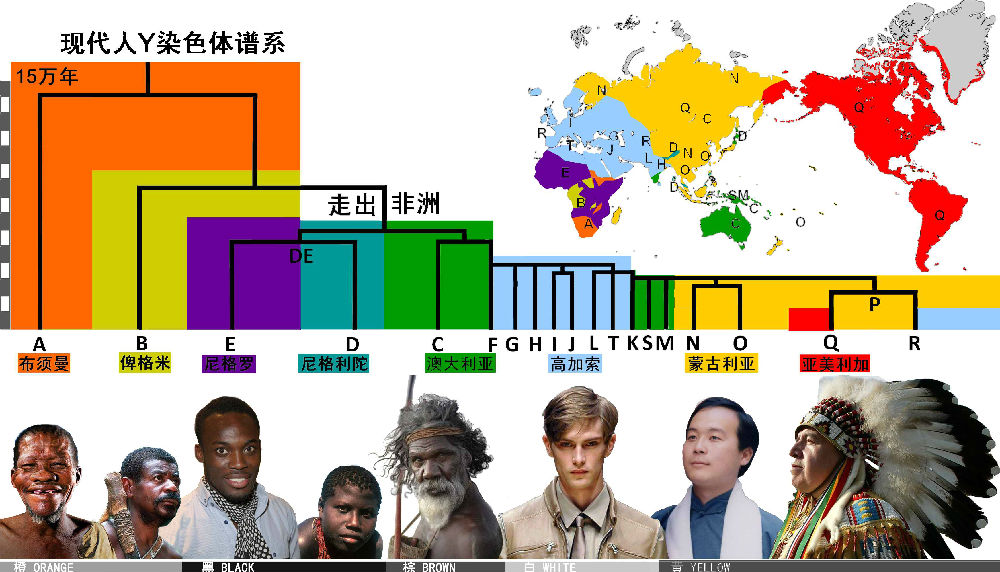
The root lineage of the Y chromosome is haplogroup A, found only in Africa; next is haplogroup B, also in Africa. From the Y-chromosome evidence, modern humans must therefore have originated in Africa. The lineages after C (C–T) diverged from B about 70,000 years ago, so modern humans cannot have left Africa earlier than 70,000 years ago. The sub-lineages within each of the five haplogroups A, B, C, D and E began to diverge about 60,000 years ago—precisely the period when the earliest races of modern humans were forming. More than 70,000 years ago, a great catastrophe struck the earth: the super-eruption of Mount Toba on Sumatra, known as the Toba catastrophe. The earth then entered an ice age; many animal populations perished, and human groups perished in large numbers as well. The few small groups that survived, isolated across central to northeastern Africa, formed several races. Subsequently, as sea levels fell during the ice age, many new land connections appeared between continents, human groups began migrating across continents, and the races evolved further.
\n\n\n\n\n\n\n\n
The divergence of the world’s Y-chromosome lineages was synchronized with the formation of the eight modern human races.
\n\n\n\n
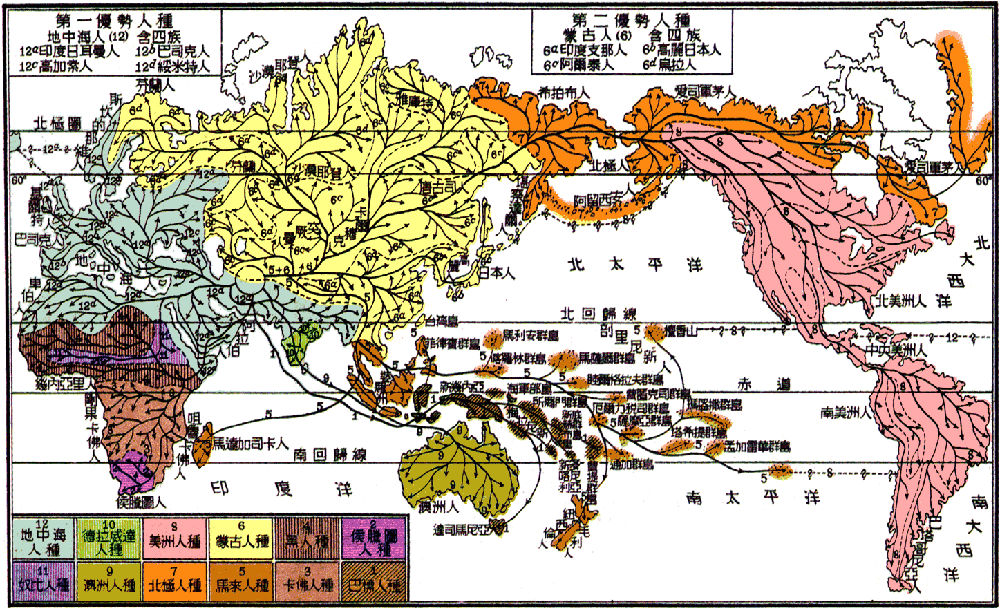
In 1863, the German biologist Ernst Haeckel drew a chart of human racial origins in which the world’s humans were divided into twelve races. Now that we have surveyed global populations comprehensively, we find that Haeckel missed two small-statured races—the Pygmies of Africa and the Negritos of Asia. Genetic analysis of the various races also shows that some of Haeckel’s races are actually mixed groups of others: for example, the Nubian and Kaffir races are different admixtures of the Negro and Hottentot races, the Dravidian race is a mixture of the Mediterranean and Australian races, and the Malay race is a mixture of the Mongolian and Negrito races. Meanwhile, the differences between the American and Arctic races, and between the Australian and Papuan races, are in fact not large.
\n\n\n\n\n\n\n\n
Ernst Haeckel’s chart of human racial origins in Natürliche Schöpfungsgeschichte (The Natural History of Creation), translated by Ma Junwu, Commercial Press, 1936.
\n\n\n\n
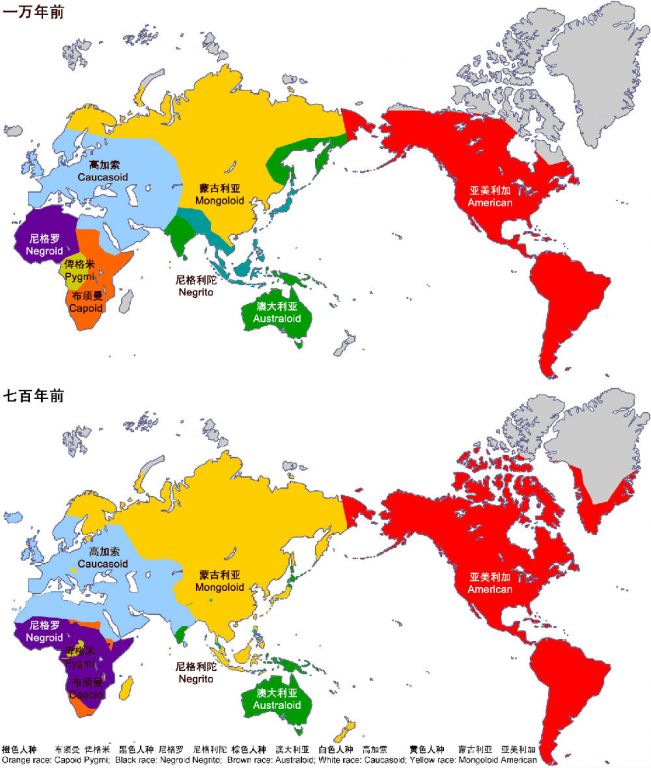
Human populations worldwide display five skin colors: orange, black, brown, white and yellow. According to whole-genome analysis[10], the world’s populations can be divided into eight races: Bushman, Pygmy, Negro, Negrito, Australian, Caucasian, Mongoloid and Amerindian. On the basis of physical characteristics, modern humans worldwide can also be divided into these eight races. In recent years, driven by the political imperative of anti-racism, some Western geneticists have proposed the particular view that the concept of race has no genetic basis, citing the existence of transitional types between races without absolute boundaries, and the fact that most gene alleles have some frequency distribution in every race. In reality, the error of racism lies in the claim that races are ranked as superior or inferior, which has led to repeated genocidal tragedies in human history. To oppose racism is to oppose racial discrimination and the notion that races are innately superior or inferior—not to deny the objective differences between races in appearance and genetic history. To say that black and white people are biologically identical is plainly contrary to fact. The transitional types between races invoked by some Western geneticists are in fact the product of population admixture over the past few millennia. On the Caribbean islands, for example, transitional types between Amerindians and blacks clearly formed by admixture, not as a gradation from Africans. Nor do allele types need to differ absolutely between races: after all, even the genomes of modern humans and chimpanzees differ by less than 2%. For the races, then, only a few genes with race-specific distributions are sufficient to support the biological reality of race.
\n\n\n\n\n\n\n\n
Schematic historical-geographic distribution of the eight modern human races. Grey areas are uninhabited.
\n\n\n\n
Parallel Evolution of Y-Chromosome Lineages and Human Races
\n\n\n\n
The genetic material that corresponds best to the modern human races is the Y-chromosome phylogeny. According to Y-chromosome lineage analysis, the oldest type is haplogroup A, concentrated in southern and northeastern Africa, with sporadic occurrences in central Africa. The related races are the Bushmen of southern Africa (formerly called the Capoid or Hottentot race) and, to some extent, the Nilo-Saharan peoples of northeastern Africa (the Nubian race). Some sub-lineages of haplogroup A occur only in certain Ethiopian groups. Recent research indicates that haplogroup A can be traced to a region just northeast of central Africa, and that the A lineages of the southern African Bushmen also came from the north. The Khoisan languages of the Bushmen are the most distinctive of the world’s languages, famous for their complex click consonants. The skin color of the Bushman race, including the Nilo-Saharan peoples, is orange-red rather than the common dark black of Africans. Both archaeology and genetics show that black Africans expanded from western Africa into eastern and southern Africa only within the last millennium; before that, the inhabitants of most of Africa were the orange-skinned race. In the contact between the black and orange races, Y-chromosome haplogroup A also flowed into the blacks of central and southern Africa.
\n\n\n\n
The next-oldest Y-chromosome lineage is haplogroup B, which corresponds roughly to the Pygmies of the tropical rainforests of central Africa and the Congo. The Y chromosomes of the Hadza of Tanzania are also mostly haplogroup B, and their stature is similarly short. The Pygmy race is highly adapted to life in the rainforest—some villages are built entirely in the forest canopy. Their skin is also orange-tinted rather than the black of western Negroes, so they too count as an orange-skinned race. The short Pygmies and the tall Negroes also differ markedly in hair and facial hair: adult Pygmy men have thick beards, while Negro men’s beards are generally sparse.
\n\n\n\n
Both orange-skinned races diverged from the other populations more than 70,000 years ago. All other branches are the descendants of groups that left Africa within the last 70,000 years. Among them, haplogroups D and E were the earliest black lineages: they probably separated around the Red Sea gateway between Ethiopia and Yemen 60,000–70,000 years ago. The carriers of haplogroup E returned to Africa and spread westward, becoming the tall Negroes of western Africa; the carriers of haplogroup D migrated eastward and onward, becoming the small-statured Negritos of Southeast Asia. That the two black races live so far apart is an astonishing pattern, and they also stand at opposite extremes in height. Negroes are very tall—adult men of some western African groups often exceed 180 cm—while Negrito adults generally do not exceed 150 cm and are often even shorter. Negritos survive today only in the Andaman Islands south of Myanmar, the border highlands of Thailand and Malaysia, and the northern and central highlands of the Philippines. Their corresponding Y-chromosome haplogroup D, however, is widely distributed across the Tibetan Plateau, the Japanese archipelago and mainland Southeast Asia, suggesting that these regions were the historical range of the Negritos before their physical characteristics changed under the influence of yellow- or brown-skinned populations. Interestingly, the Negritos of the Philippines show no haplogroup D Y chromosomes; instead they carry haplogroups C and K from the brown-skinned peoples of New Guinea, probably a result of later brown-race expansion. The earliest inhabitants of the Japanese archipelago, the Jomon people, carried haplogroup D and stood below 150 cm, so they should belong to the Negrito race—yet their facial features are those of the typical brown-skinned Australians. At the ends of migration routes, the complexity of exchange among races far exceeds our imagination.
\n\n\n\n
After crossing the Red Sea, the carriers of Y-chromosome haplogroups C and F continued northward: F reached Mesopotamia, while C reached the Indus Valley. In these two regions the two populations evolved into different races. The C population formed the brown race, also called the Australian race, spreading to East Asia, Southeast Asia, Australia, New Guinea and Melanesia 50,000–60,000 years ago. The F population, by contrast, is the ancestor of both the white and yellow races.
\n\n\n\n
About 30,000–40,000 years ago, the F super-lineage began to expand from Mesopotamia and the southern shore of the Caspian Sea, producing fourteen sub-lineages from G to T. G, H, I, J, L and T became the Caucasian race in western Eurasia. The Caucasian race is often called “white,” though its skin is not necessarily very pale. About 20,000 years ago, the O and N populations arrived in East Asia to form the Mongoloid race, replacing the brown race as the main population of East Asia. Around 13,000 years ago, the N population expanded from East Asia into North Asia and Northern Europe. Also around 20,000 years ago, the Q and R populations arrived in Central Asia; they did not form a distinct race there, but mostly merged into neighboring races. Most Q carriers migrated eastward and joined the Mongoloids; some continued eastward and crossed the Bering Strait about 15,000 years ago to enter the Americas, forming the Amerindian race. R is the major lineage of Central Asia but also migrated westward in large numbers to join the Caucasoids, becoming a mainstream lineage of southern European populations.
\n\n\n\n
As Y-chromosome lineage research deepens, the dating of the divergence of each Y lineage becomes increasingly precise, and the history of human population evolution will become ever clearer. An objective and accurate understanding of human evolutionary history—of the similarities and differences among races, ethnic groups and populations in every respect—helps us better appreciate the harmony that should exist among human groups and between humans and nature, and better protect the physical health of populations and the health of society.
\n\n\n\n
References
\n\n\n\n
1. Locke D P, Hillier L W, Warren W C, et al. (2011) Comparative and demographic analysis of orang-utan genomes. Nature, 469 (7331): 529-533.
\n\n\n\n
2. Tattersall I. (2000) Once we were not alone. Scientific American, 282 (1): 56-62.
\n\n\n\n
3. Stringer C. (2012) Evolution: What makes a modern human. Nature, 485 (7396): 33–35.
\n\n\n\n
4. Brown P, Sutikna T, Morwood M J, et al. (2004) A new small-bodied hominin from the Late Pleistocene of Flores, Indonesia. Nature, 431 (7012): 1055-1061.
\n\n\n\n
5. Green R E, Krause J, Briggs A W, et al. (2010) A Draft Sequence of the Neandertal Genome. Science, 328 (5979): 710–722.
\n\n\n\n
6. Reich D, Green R E, Kircher M, et al. (2010) Genetic history of an archaic hominin group from Denisova Cave in Siberia. Nature, 468 (7327): 1053–1060.
\n\n\n\n
7. Krause J, Fu Qiaomei, Good J M, et al. (2010) The complete mitochondrial DNA genome of an unknown hominin from southern Siberia. Nature, 464 (7290): 894-897.
\n\n\n\n
8. Reich D, Patterson N, Kircher M, et al. (2011) Denisova Admixture and the First Modern Human Dispersals into Southeast Asia and Oceania. Am J Hum Genet, 89 (4): 516–528.
\n\n\n\n
9. Fu Qiaomei, Meyer M, Gao Xing, et al. (2013) DNA analysis of an early modern human from Tianyuan Cave, China. PNAS, doi: 10.1073/pnas.1221359110.
\n\n\n\n
10. The HUGO Pan-Asian SNP Consortium. (2009) Mapping Human Genetic Diversity in Asia. Science, 326: 1541-1545.