

Popular Science: High-Coverage Genomes of an 8,300-Year-Old Jomon Woman and a 2,300-Year-Old Yayoi Man Reshape East Asian Ancestry
2026年8月16日
149 ancient genomes reveal how wheat agriculture reached Gansu as technology transfer, not mass migration
2026年9月3日Industry News: Ancient DNA and Isotopes Reveal a “Third Pathway” of Millet Farming in Northern China
In August 2026, a research team led by Zhang Fan at the Center for Archaeological Science, Sichuan University, published a study online in Current Biology (Cell Press; released online on 14 July 2026). Combining ancient genomes and stable isotopes from human remains at the Xinglong site in Kangbao, Hebei, the team proposed a “third pathway” of agricultural origins, providing key evidence from East Asia for global theories of how farming began.
An East Asian case beyond the two classic models
For decades, two classic models have dominated the international debate on agricultural origins and spread: the European model, in which farming spread with large-scale population replacement; and the Southwest Asian model, characterized by intense internal differentiation and spatial reorganization among local foragers. As one of the centers where millet farming originated, northern China has long lacked direct bioarchaeological evidence linking population dynamics to subsistence transitions, leaving East Asia on the sidelines of global comparisons.
Xinglong: a local gene pool continuous for 1,500 years
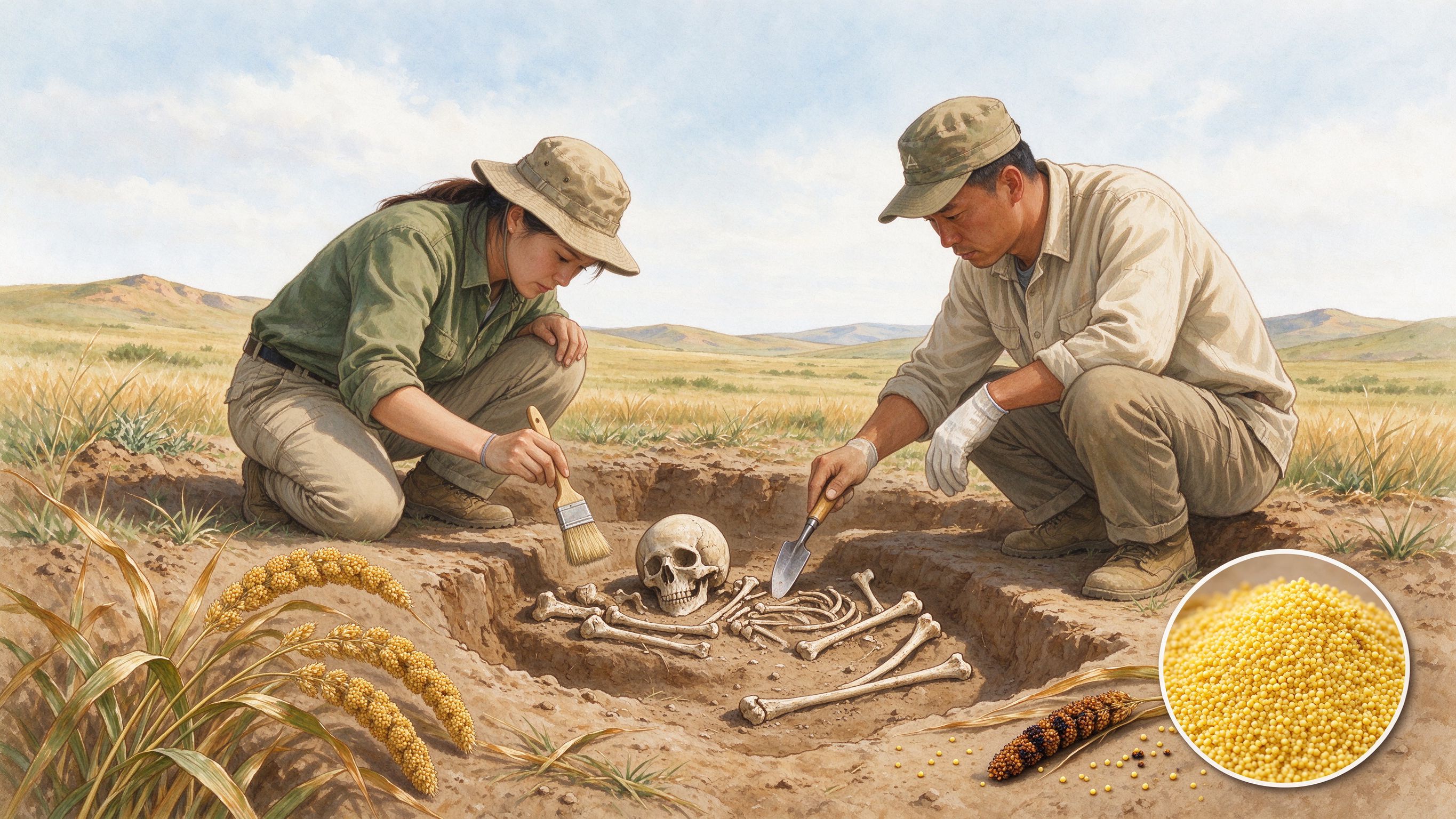
The team focused on the Xinglong site in Kangbao, Hebei, on the southeastern edge of the Mongolian Plateau. High-throughput ancient genomes and carbon/nitrogen stable isotope analyses were obtained from 11 human remains dating to roughly 9,000-5,500 years ago. Individuals across ~1,500 years were highly homogeneous genetically, representing a local ancestral gene pool continuously sustained through the early Holocene, with no sign of large-scale replacement by outsiders.
Isotopic dietary reconstruction revealed a striking subsistence shift: around 9,000 years ago, staple foods came mainly from C3 wild plants; by ~7,500 years ago, consumption had clearly turned to C4 crops such as foxtail millet and broomcorn millet – fully consistent with directly dated millet remains (~7,500 BP) at the site. Together, the two lines of evidence show that early millet farming in northern China arose as an economic transition achieved within a continuous local population, not through the arrival of outsiders.
The “third pathway”: population continuity plus local subsistence transition
The core of this pathway is the parallel operation of “population continuity” and “local subsistence transition.” At Xinglong, the intensification of settlement and millet farming proceeded largely in step, with a smooth transition under genetic and cultural continuity – no population replacement, no drastic restructuring of society. The study provides the first direct ancient-DNA evidence that agricultural transitions need not entail large-scale population replacement or social upheaval, revising a long-held hypothesis.
Family structure, demography, and regional interaction
Kinship analysis shows that individuals buried in the same pit or same house floor at Xinglong were generally closely related, with recognizable nuclear family units such as mother-child and parent-son pairs – indicating that kinship-based family structure was already a foundation of social organization. Runs of homozygosity and effective population size estimates indicate no recent inbreeding and, notably, no immediate population boom in the ~1,500 years after farming appeared, suggesting that food production, sedentism, and population growth were not simply synchronized.
At the regional level, Xinglong people were genetically distinct from contemporaneous Yangshao-Longshan populations of the middle Yellow River, Dawenkou populations of the lower Yellow River, and Hongshan populations of the West Liaohe region – showing that farming in northern China did not spread from a single center but arose independently among local foragers in several ecological zones. As millet farming developed, these formerly separate regional populations engaged in long-term, sustained, and peaceful gene flow; Xinglong-related ancestry gradually appeared in Yangshao and Hongshan populations. This pattern of interaction without replacement or conflict offers new genetic insight into the formation of the “pluralistic unity” (duoyuan yiti) of Chinese civilization.
(Compiled from the release of the Center for Archaeological Science, Sichuan University, and the Current Biology publication.)