
Chinese scientists reveal for the first time the survival landscape of Denisovans in South China: major discovery at Yunnan Bianfu Cave published in Nature
2026年9月10日
Ancient genomes reveal that the Bronze Age main population of the Eastern Tianshan combined East Asian and North Asian ancestry
2026年9月26日Members Column: Yunnan-Guizhou Paleogenomics Reveals 12,000 Years of Population History in Southwestern East Asia
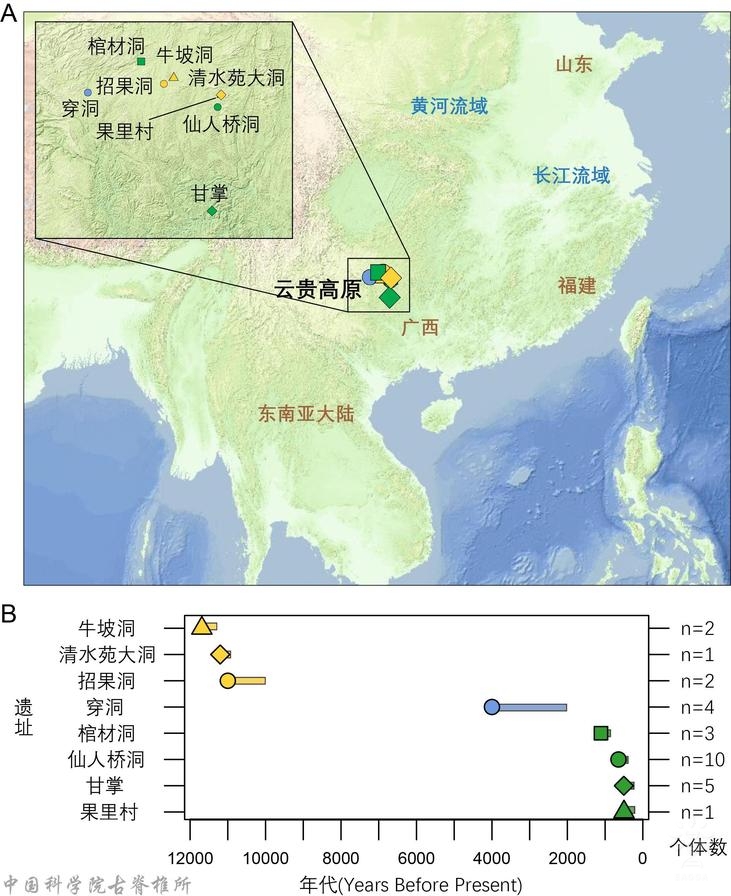
A major study recently published in the National Science Review fills a key gap in ancient genome research in southwestern East Asia. A team led by Fu Qiaomei of the Institute of Vertebrate Paleontology and Paleoanthropology (IVPP), Chinese Academy of Sciences, together with the Guizhou Provincial Institute of Cultural Relics and Archaeology, the Institute of Archaeology of the Chinese Academy of Social Sciences, the Guizhou Museum, and Sichuan University, systematically analyzed 50 human remains from eight sites in Guizhou – including Zhaoguo Cave, Niupo Cave, Qingshuiyuan Great Cave, Chuandong Cave, Guancai Cave, and Xianrenqiao Cave – spanning roughly 12,000 to 300 years ago, recovering 36 high-quality nuclear genomes.
Paleolithic: when a basal East Asian ancestry met a northern component
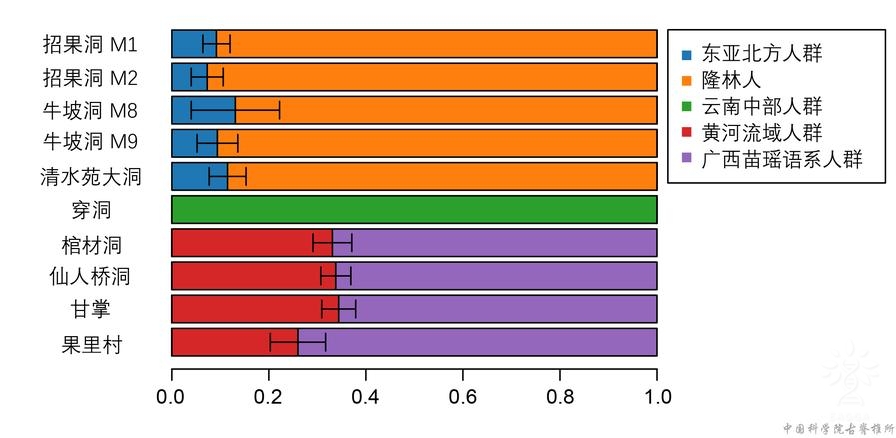
The study adds five genomes older than 10,000 years from Guizhou, doubling the number of ancient genomes from this period in southern East Asia. Paleolithic Guizhou individuals carried a basal East Asian ancestry represented by the Xingyi individual of Yunnan – a deeply diverged lineage closely related to the ~40,000-year-old Tianyuan individual and the ~8,000-year-old Hòabìnhian individuals. Unlike neighboring Yunnan, Guizhou populations also carried a substantial northern East Asian genetic component. This shows that genetic components associated with northern populations had already reached Guizhou by ~12,000 years ago – meaning north-south interaction in East Asia began earlier and was more complex than previously assumed.
Consistent with this, Guizhou sites of this period show burials becoming common, bone tools deposited as grave goods, and increasingly standardized stone artifacts – archaeological signatures of frequent cultural exchange. The genetic evidence also speaks to a long-debated question about the origin of “small flake” lithic technology: people carrying northern components did indeed reach or dwell in Guizhou during the late Paleolithic.
Eve of the Bronze Age: a profound population replacement
Analysis of individuals from Chuandong Cave dated to roughly 4,000-2,000 years ago gives a clear answer: by the Bronze Age, the basal East Asian ancestry carried by Paleolithic Guizhou populations is no longer detectable – the local Paleolithic population had been replaced. The dominant ancestry of Bronze Age Chuandong individuals closely matches late Neolithic populations of central Yunnan, which carry Austroasiatic-related ancestry. This reveals a major historical process: before about 4,000 years ago, populations ancestral to Austroasiatic speakers expanded eastward from central Yunnan into Guizhou, largely replacing the older local populations that had persisted since the Paleolithic – a subsistence-technological transition accompanied by deep demographic change.
Historical period: language families and genetic interaction
Genomes from Guizhou cave-burial populations dating to ~1,100-300 years ago show that historical Hmong-Mien (Miao-Yao) populations of Guizhou are genetically highly similar to contemporary Hmong-Mien populations of Guangxi, while differing markedly from Tai-Kadai (Zhuang-Dong) populations. Despite frequent exchange between Guizhou and Guangxi, this interaction did not erase genetic differences between language families – linguistic and cultural affiliation profoundly shaped regional population dynamics. Guizhou populations also show dual influence from Yellow River Neolithic populations and older local Guangxi ancestry.
Implications for East Asian genetic genealogy
This study systematically fills a geographic and chronological gap in southwestern East Asian paleogenomics: it pushes the onset of north-south genetic exchange in East Asia well before the spread of farming; it provides solid evidence for a major population replacement on the eve of the Bronze Age; and it shows that language affiliation is a key factor shaping regional genetic structure. For research on East Asian genetic genealogy, the Yunnan-Guizhou Plateau is the crucial hub for understanding the origins, migrations, and admixture of southwestern populations within the “pluralistic and integrated” pattern of Chinese civilization – and each step of this work adds a key piece to that picture.
(Compiled from the official release of the Institute of Vertebrate Paleontology and Paleoanthropology, CAS, for academic and popular-science purposes.)