Chinese scientists retrieve lineage-specific genetic information from 400,000-year-old Homo erectus for the first time
2026年5月14日
Unraveling the Piast Dynasty: How Polish Scientists Rebuilt the Genetic Family Tree of a Millennium-Old Royal House
2026年5月26日AI “Instant Matching” Becomes a New Key to Root-Seeking: Reconnecting Bloodlines in the Digital Age
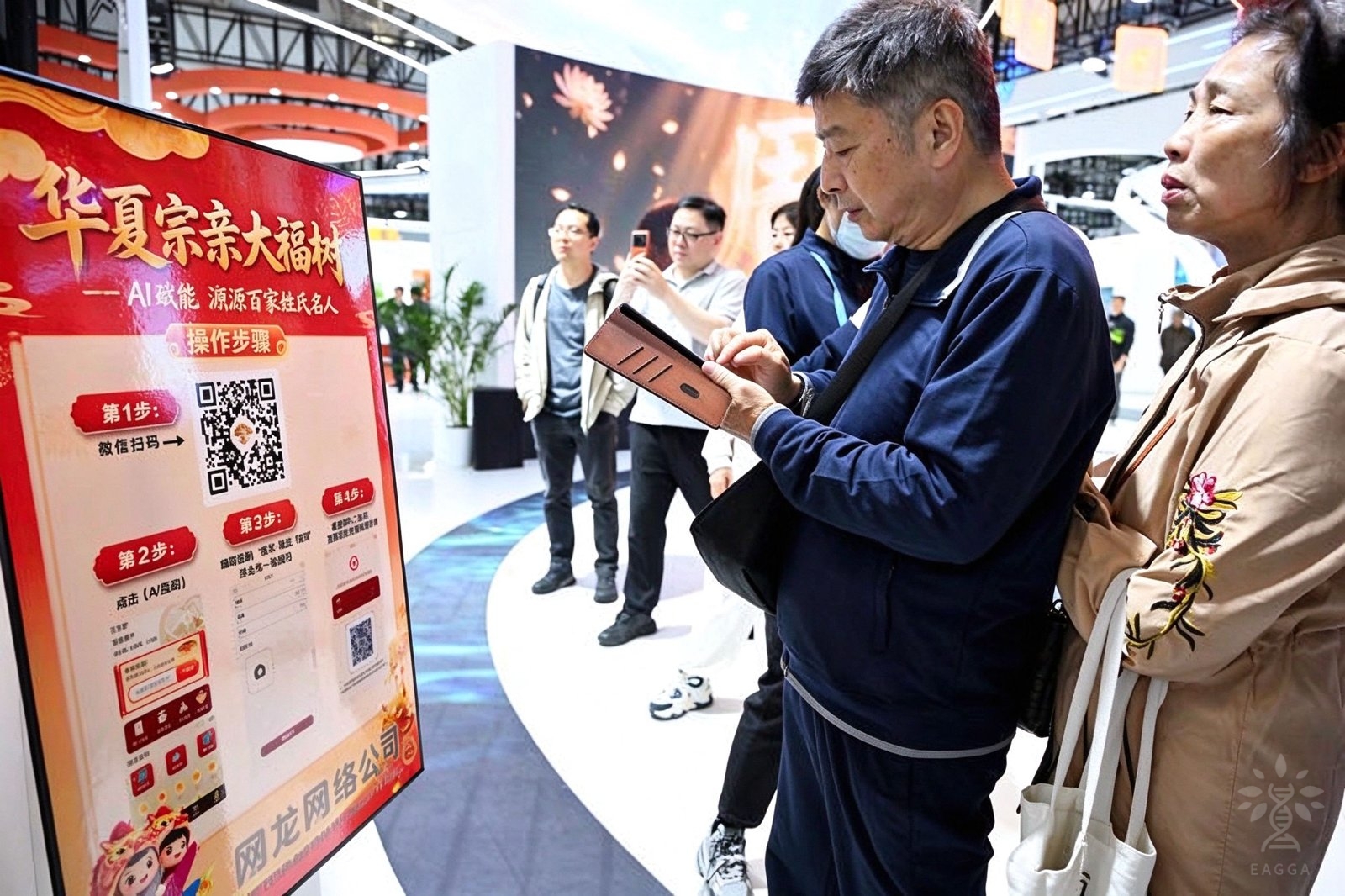
At the hands-on experience zone of the 9th Digital China Summit, open from 28 April to 4 May, a striking installation drew crowds of visitors: a “Great Family Tree of China” generated by artificial intelligence. Type in a surname, and a lush three-dimensional tree of the clan appears on screen; visitors can even take a “cloud photo” alongside a famous ancestor bearing the same surname. Created by Fujian’s NetDragon Websoft, the application is a vivid microcosm of how AI is powering a new wave of root-seeking among overseas Chinese and compatriots in Hong Kong, Macao and Taiwan.
In the past, tracing one’s ancestral home relied on genealogies, oral traditions and vague memories — a search that felt like looking for a needle in a haystack. Expats trying to confirm their ancestral village had little more than fragmentary place names passed down by elders, faint inscriptions on tombstones, and hours of fieldwork and luck. Today, AI’s “instant matching” is changing the game: the combination of ancient-script restoration, image recognition, surname-origin databases and intelligent humanities platforms compresses what once took weeks of painstaking research into seconds.
The experience of Malaysian-Chinese Li Chengming is a telling example. In Nan’an, Fujian, he could barely make out the words “Quannan” and “which du (administrative district)” on his great-grandfather’s tombstone. Using a domestic AI assistant to restore and decipher the weathered script, he first identified the key place name “Liudu”, then cross-checked it against a tool comparing historical and modern Nan’an place names, confirming that “Ershiliudu Yuanwei” is today’s Yuanmei Village in Luncang Town. “Without AI, we might still be searching,” he said.
Philippine-Chinese Huang Qingquan demonstrated another dimension of AI image recognition. Using AI-powered photo recognition and retrieval, he located his ancestral home — Daitou Village in Jiaomei Town, Zhangzhou — from the inscription “Fujian Longxi Shiwai Daitou” on his ancestors’ tombstone. When worn epitaphs meet machine-learning-driven character comparison, information buried by time can begin to “speak” again.
Behind the “Great Family Tree” lies a vast database built from surname histories, genealogical documents and historical-geographical data. A NetDragon representative said the application not only uses gamified, visual interaction to draw young people into clan culture, but also speaks directly to the deep emotional attachment overseas Chinese and compatriots in Hong Kong, Macao and Taiwan feel toward their “roots, origins, ancestors and lineage”. Through playful interaction, family memory and historical knowledge pass across generations.
Platform development is accelerating too. In 2025, Fujian’s first large-model-based humanities platform, “Qiaomai Zhilian”, went live in Xiamen; its intelligent root-seeking system instantly integrates scattered genealogies, local chronicles and overseas-Chinese archives, compressing weeks of manual verification into moments. In the overseas-Chinese hometown of Quanzhou, the “Comprehensive Service Platform for Root-Seeking of Overseas Chinese from Southeast Asia” has digitized more than 10,000 volumes of genealogies, providing a solid data foundation for cross-sea searches.
The momentum is also visible across the Taiwan Strait. On social media, many young people from Taiwan post family photographs and, with AI algorithms and information screening, quickly locate their ancestral homes on the mainland — some successfully reconnecting with relatives lost touch with for decades. A faded photograph and a fragmentary memory, aided by intelligent algorithms, re-link the bloodline across the Strait.
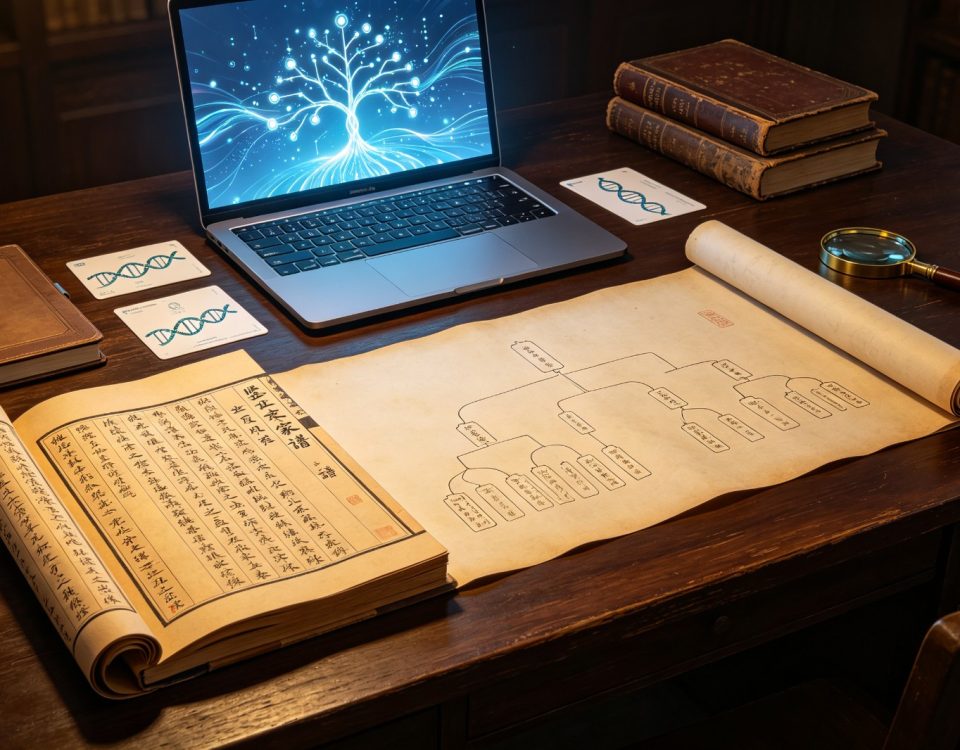
Su Meixiang, secretary-general of the Cross-Strait Integration and Development Research Center at the Fujian Academy of Social Sciences, said the journey of root-seeking is shifting from “mountains and rivers” to “clear skies”: family bonds that span generations and seas have found a new home and resonance in the digital age. For genealogy researchers, AI does more than speed up searches — it is giving birth to entirely new forms of digital family trees. When traditional documents meet intelligent technology, the ancient medium of the family register is being reborn.