
Fudan team reveals 6,000 years of population history in the middle Yellow River: Yangshao ancestry endures for 6,200 years
2026年6月26日
First prehistoric East-Asian plague genome reveals rapid trans-Eurasian spread ~5,300 years ago
2026年7月31日Two mysterious ancestors revealed in modern human DNA: Science technique pinpoints a “ghost ancestor” and a “super-archaic ancestor”
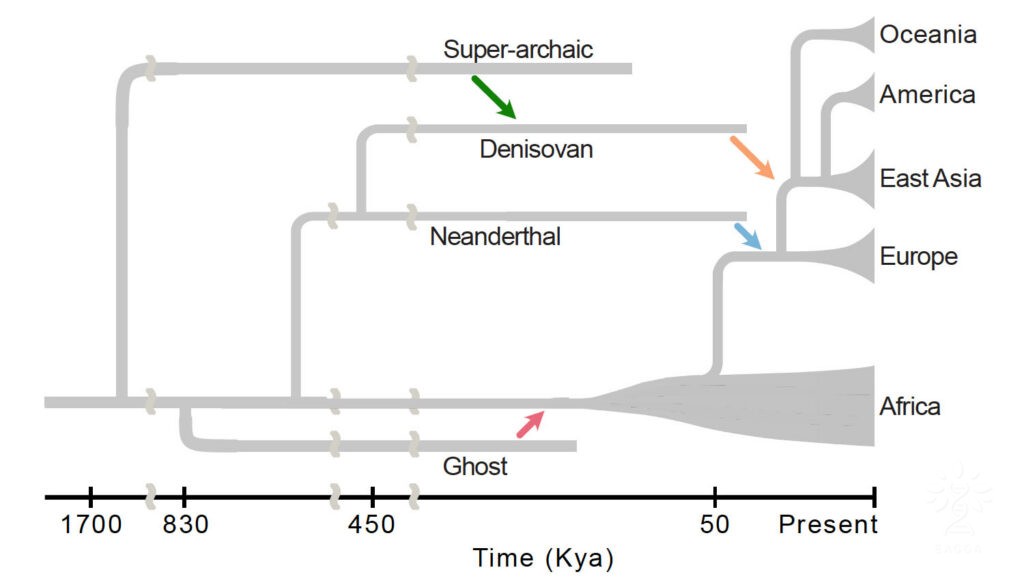
On 30 July 2026, researchers at the University of California, Berkeley, published a study in the journal Science announcing that they had located, in the modern human genome, DNA regions inherited from two unknown ancient ancestors: a “ghost ancestor” that diverged about 800,000 years ago, and a “super-archaic ancestor” from a lineage about 1.8 million years old. Using a genealogy-reconstruction technique developed by the team, the study mapped for the first time the distribution of these hidden ancestors across the human genome and established a timeline for the gene flow.
The finding reveals that human evolution was not a simply branching tree, but more like a complex web woven from repeated migrations and admixture.
No ancient DNA required: recombination graphs as a record
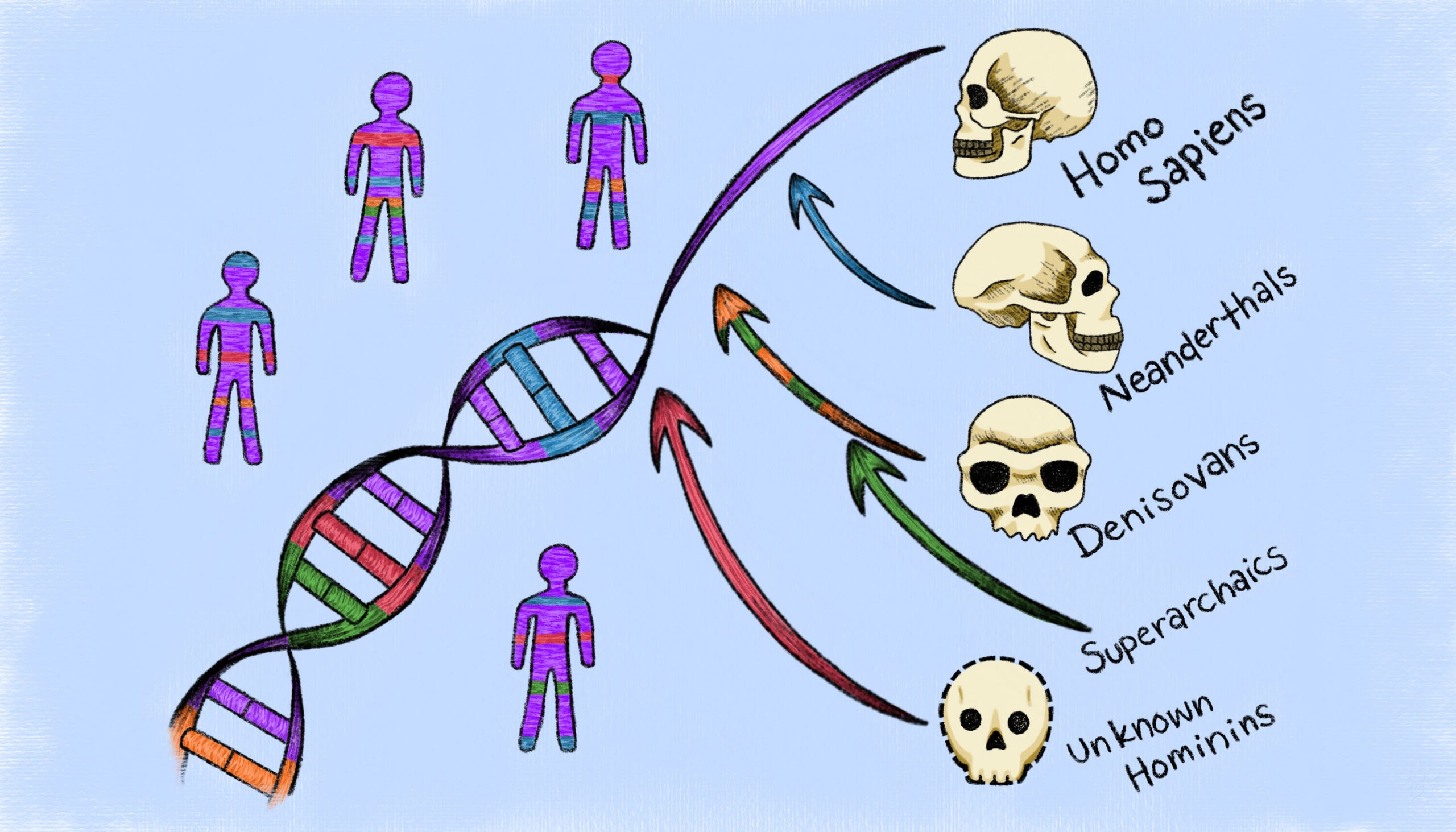
Scientists previously confirmed that after Homo sapiens left Africa some 50,000 years ago, they interbred with two much older hominin groups, the Neanderthals and the Denisovans, whose DNA still persists in modern humans. But the genome also contains traces of even earlier admixture, from extinct hominins that left no sequenceable genetic material, making their contributions difficult to identify.
Priya Moorjani, an associate professor of molecular and cell biology at UC Berkeley, and her team developed a technique called TRACE (TRacking Archaic Contributions via ARG Estimation). It uses whole-genome data from modern individuals around the world to reconstruct genealogical relationships across the genome — an ancestral recombination graph (ARG) — depicting how DNA segments have been passed down through shared ancestry over time. As Moorjani explains, genealogies preserve a record of our evolutionary past: even in the absence of ancient DNA, genetic contributions from extinct populations can be uncovered.
As a validation, TRACE correctly identified regions matching the sequenced Neanderthal genome — Neanderthal DNA makes up about 1% of the modern human genome — and accurately pinpointed known regions of Denisovan introgression in Asian and Oceanian populations. But the truly novel discoveries lay in the ancient segments matching neither Neanderthals nor Denisovans.
Two hidden ancestors, two ancient stories
These DNA segments came from two distinct hominin lineages, with different introgression times.
The first is what the researchers call the “ghost ancestor.” This lineage diverged from the modern human lineage around 800,000 years ago — roughly the time Neanderthals and Denisovans split — and later interbred with modern humans in Africa before 50,000 years ago, prior to the most recent major migration of Homo sapiens out of Africa. Earlier studies had suggested ghost ancestry might exist but could not determine whether it was confined to Africans or when the admixture occurred. The new study mapped genomic locations from this lineage for the first time, showing that ghost ancestry is present in all modern humans, not only Africans — each modern individual carries about 0.5% to 1% of their genome from this lineage, comparable in scale to the Neanderthal contribution.
The second, the “super-archaic ancestor,” is even more striking. This is a hominin lineage that diverged 1.8 million years ago. It did not interbreed directly with modern humans; instead, it first admixed with Denisovans in Eurasia, and Denisovans later passed a small portion of this super-archaic DNA into modern humans through interbreeding with Homo sapiens. Remarkably, the researchers recovered this lineage by analysing only genomes from Oceanian populations — Pacific islanders who carry up to 4% Denisovan DNA — while Denisovans themselves harbour roughly 3% to 5% super-archaic ancestry.
An interwoven evolutionary history
These findings highlight that, over the past million years, early modern humans not only lived alongside numerous hominin groups in Africa and Eurasia, but were genetically close enough to interbreed with many of them. Moorjani notes: “With ancient DNA from Neanderthals and Denisovans and with these new genealogical methods, we are learning that mixture among human populations has been very pervasive across time. We often think of human evolution as a branching tree, but new genomic data and analytical methods reveal a much more interconnected history.”
Notably, many of the archaic segments are enriched in genomic regions related to immune and metabolic functions. The researchers say this is unsurprising: adapting to new pathogens and food sources has been among the strongest selective pressures in human evolution. Admixture supplied natural selection with additional “raw material,” allowing beneficial variants to persist and spread across generations. A precedent already exists: the EPAS1 gene, which helps high-altitude adaptation in Tibetan populations, has been shown to derive from Denisovans.
Who exactly these two mysterious ancestors were remains unresolved. The inferred divergence times overlap with the existence of Middle Pleistocene Homo groups in Africa 800,000 years ago and Homo erectus in Eurasia 1.8 million years ago. As global genomic databases grow more diverse and more Denisovan genomes are published, their identities may gradually come to light.
The co-first authors are UC Berkeley graduate student Yulin Zhang and Johns Hopkins University postdoctoral researcher Arjun Biddanda; the corresponding author is Priya Moorjani. Original paper: Science (DOI: 10.1126/science.aef8874). This article is compiled from public information from Science and Technology Daily, the Chinese Academy of Sciences, and UC Berkeley News.