
The Naotegai Site in Inner Mongolia: A New Super-Large Hongshan Settlement Discovery
2026年5月29日
Two mysterious ancestors revealed in modern human DNA: Science technique pinpoints a “ghost ancestor” and a “super-archaic ancestor”
2026年7月30日Fudan team reveals 6,000 years of population history in the middle Yellow River: Yangshao ancestry endures for 6,200 years
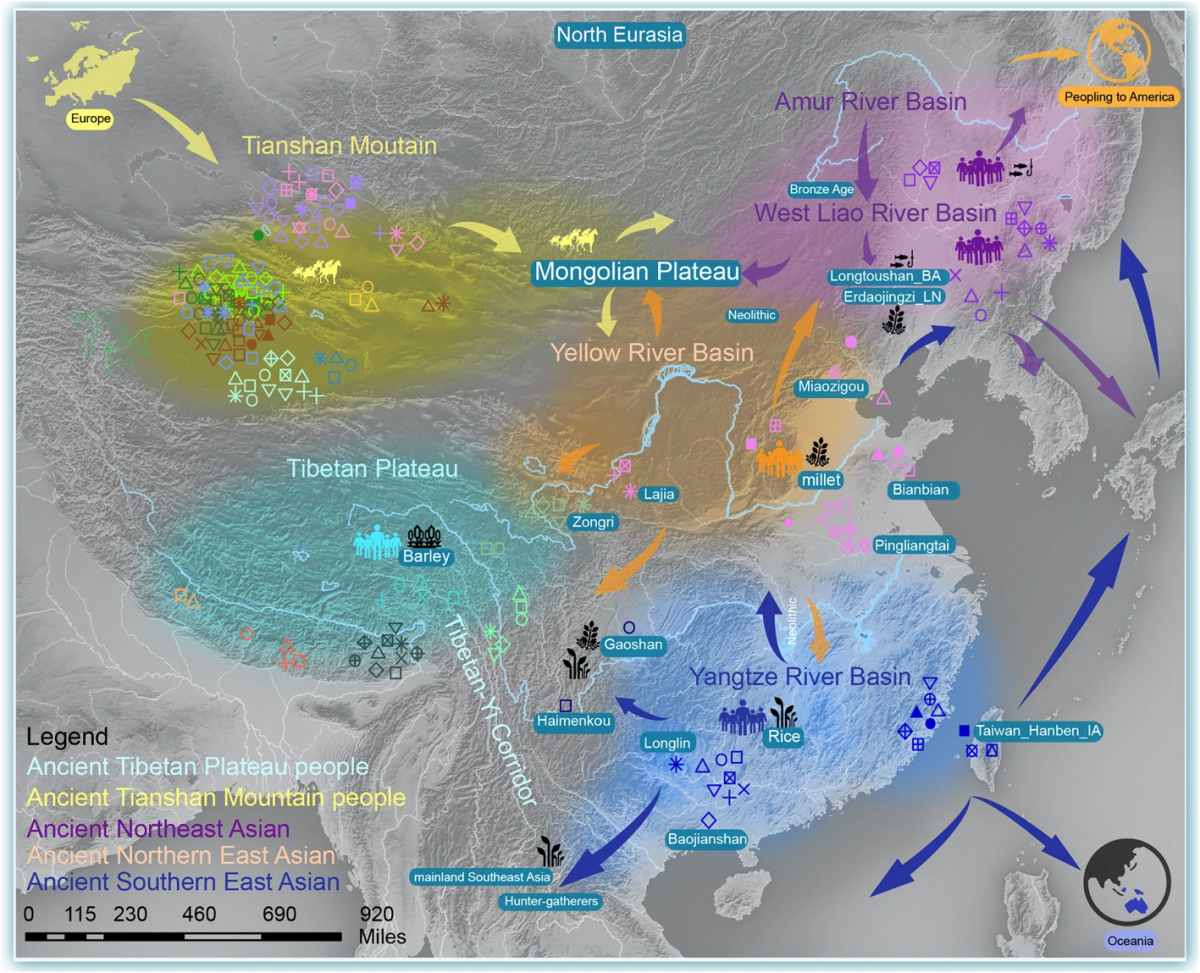
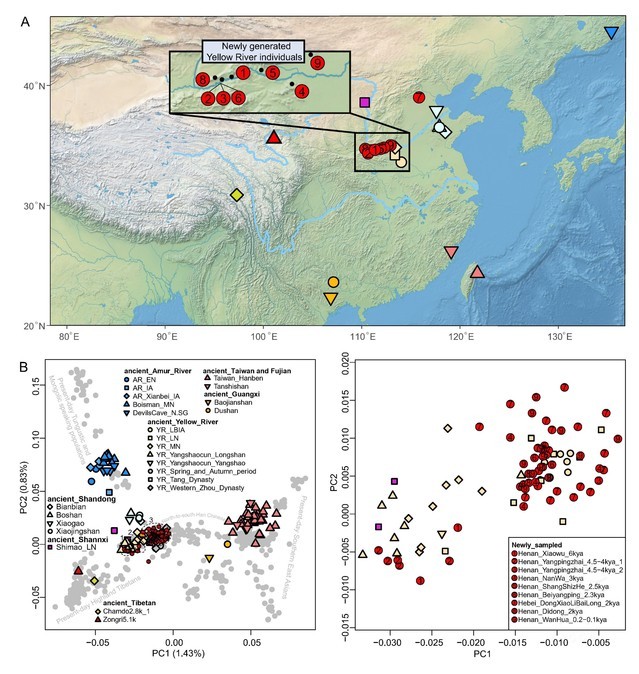
On 26 June 2026, researchers from Fudan University, the Henan Provincial Institute of Cultural Heritage and Archaeology, Zhengzhou University, Xiamen University, and the Institute of Forensic Science (Ministry of Public Security) published a study online in the National Science Review titled “A 6,000-year genomic transect in the middle Yellow River.” By sequencing and deeply analysing 112 ancient genomes from eight sites in the middle Yellow River region (Henan and Hebei provinces), the team reconstructed a 6,000-year population history of the region.
The Yangshao culture originated in the Yellow River basin and is one of the earliest, most important, and most intensively studied Neolithic cultures in China, with its core area in western Henan, southern Shanxi, and eastern Shaanxi. Ancient DNA research has offered new perspectives on the demographic history of Yangshao-related populations, yet genomic data from the Yangshao period in western Henan had remained extremely scarce—only two genomes, from the middle and early Yangshao phases, had previously been reported, leaving the population structure of the Yangshao core area unresolved.
Genetic continuity: six millennia traced to Yangshao ancestors
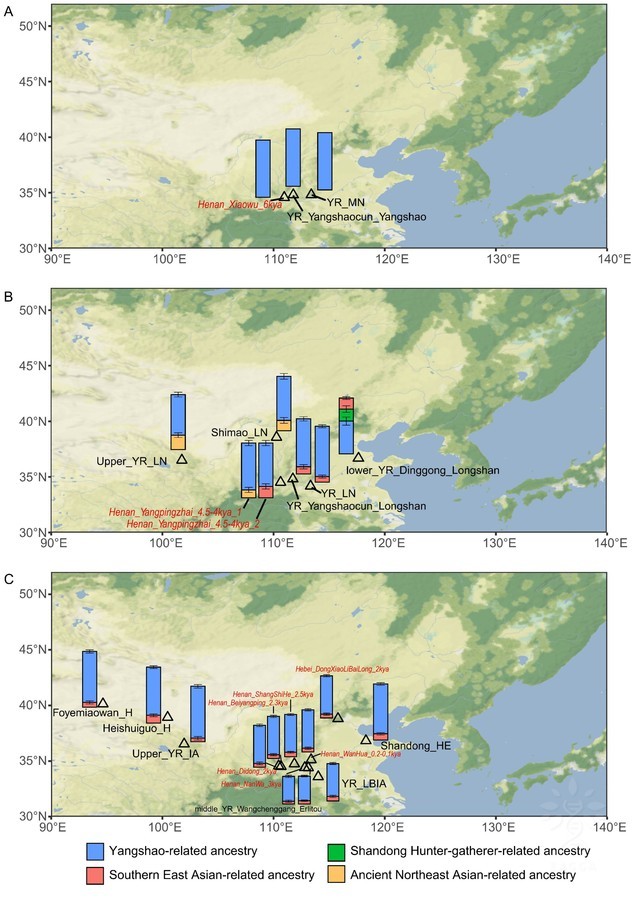
The team successfully extracted and sequenced 112 high-quality ancient genomes from eight sites, including Didong, Xiaowu, Yangpingzhai, Nanwa, and Beiyangping, spanning from the early Yangshao culture around 6,200 years ago to the Ming-Qing period about 100 years ago. The Xiaowu site in Lingbao, western Henan, yielded one of the oldest Yangshao-related genomes in the middle Yellow River region. Non-significant f4-statistics and pairwise qpWave results supported a single-source model—the 6,000-year-old western Henan Xiaowu population alone—to account for the genetic composition of late Yangshao populations in the middle Yellow River, demonstrating genetic continuity at the heart of Yangshao territory. One notable exception: the 6,000-year-old Xiaowu population showed greater genetic similarity to some ancient Tibetan groups than other Neolithic populations of the middle Yellow River, hinting at an additional genetic link between early Yangshao and some ancient Tibetan populations.
Two major shifts in genetic structure
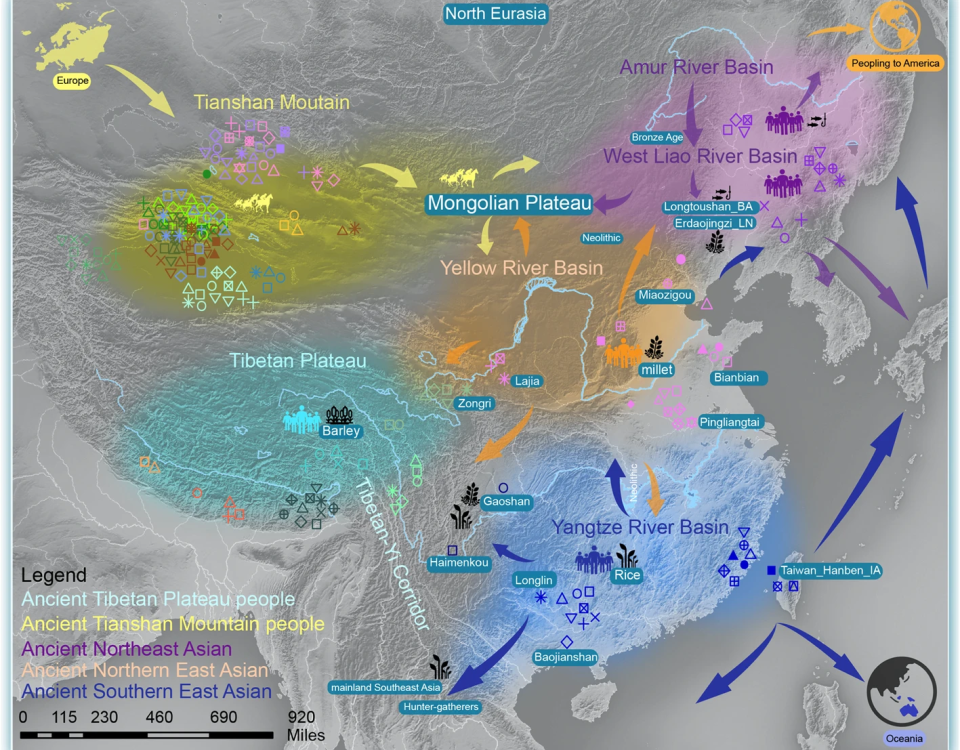
The study revealed two major shifts. First, around 4,500 years ago during the Longshan period, western Henan underwent genetic changes associated with cultural transformation, likely linked to the expansion of populations from the Jin-Shaan region (exemplified by the Taosi, Shimao, and Lushanmao cultures): the newly sequenced 4,000-year-old Yangpingzhai individuals displayed ancestry features similar to the Shimao people, while no Shimao-related ancestry was found in western Henan Yangshao populations, indicating close population ties between western Henan and the Jin-Shaan region during the Longshan period. One genetic outlier at Yangpingzhai carried predominant ancestry characteristic of late Neolithic populations of central Henan around 4,000 years ago, further reflecting individual or small-scale population movement between central and western Henan at that time. Second, over the following two millennia, the expansion of central Henan populations drove genetic homogenisation across the entire Yellow River basin.
The dynastic era: remarkable genetic stability
During the more than three thousand years of dynastic rule (from the Shang dynasty to the Ming-Qing period), the Central Plains exhibited remarkable genetic stability. Analyses showed that populations from the Shang, Zhou, and subsequent dynasties down to the Ming-Qing period were all unmixed descendants of local Longshan/Erlitou populations. Although historical records document frequent incursions of nomadic peoples such as the Rong, Di, Xianbei, and Xiongnu, the genetic data revealed no significant admixture from steppe nomads in the main Central Plains population—the arrival of foreign peoples was more a matter of political and cultural exchange; even where intermarriage occurred, these newcomers were quickly absorbed into the large local population. Regional differentiation between western and central Henan had disappeared by the Zhou dynasty at the latest, and differentiation across the upper, middle, and lower Yellow River had vanished by the Han dynasty at the latest, ultimately forming a highly genetically homogeneous gene pool across the Yellow River basin.
Scientific significance
The study fills a critical gap in genomic data from the Yangshao core area, confirms the mode of Yangshao population dispersal, and provides key genetic evidence for understanding the pluralistic-integrated structure of Chinese civilisation and the rise of the Central Plains as its core. The study also used two case studies to examine the social structure of ancient populations, offering new perspectives on Iron Age social organisation in northern China.
Corresponding authors include Prof. Chuan-Chao Wang, Prof. Xingtao Wei, Prof. Caixia Li, and Prof. Yawen Zhou. Original paper: National Science Review (DOI: 10.1093/nsr/nwad395). This article is compiled from public information from the Ministry of Education Key Laboratory of Contemporary Anthropology, Fudan University, and the Henan Provincial Administration of Cultural Heritage.